The high-contrast pattern of giant pandas helps them blend in with their natural environment.
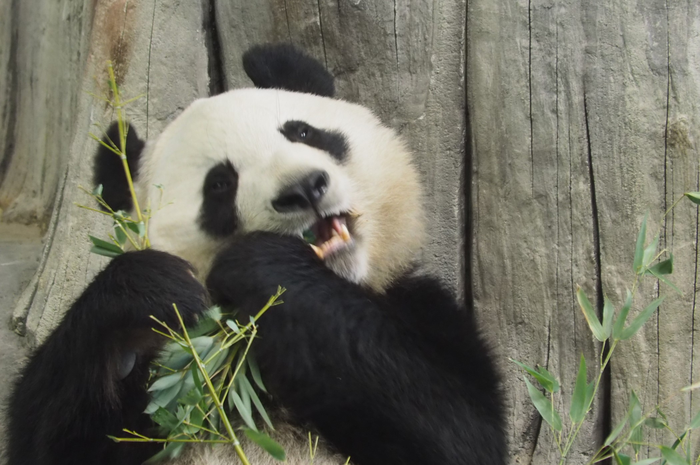
Credit: Anssi Nokelainen
The high-contrast pattern of giant pandas helps them blend in with their natural environment.
Researchers at the University of Bristol, Chinese Academy of Sciences and the University of Jyväskylä have used state-of-the art image analysis techniques to demonstrate, counterintuitively, that the unique colourings work to disguise the giant panda. The results have been published today in Scientific Reports.
While most mammals are drab browns and greys, there are a small number of well-known and intriguing exceptions such as zebras, skunks, and orcas. Perhaps the most famous of all however is the giant panda.
The international team analysed rare photographs of the giant pandas, taken in their natural environment. They discovered that their black pelage patches blend in with dark shades and tree trunks, whereas their white patches match foliage and snow when present. Also, infrequent pale brown pelage tones match ground colour, providing an intermediate colour which bridges the gap between the very dark and very light visual elements in the natural habitat. The results are consistent whether viewed by human, felid or canine vision models; the last two represent panda predators.
Next, the researchers examined a second form of camouflage – disruptive colouration – in which highly visible boundaries on the surface of an animal break up its outline – in the panda’s case the borders between the large black and white patches of fur. They found that giant pandas show this form of defensive coloration especially at longer viewing distances.
Finally, the researchers utilised a novel colour map technique to compare a similarity-to-background metric across a variety of species, as well as the giant panda. This comparative analysis confirmed that the background resemblance of the giant panda fell solidly within other species that are traditionally considered as well camouflaged.
Prof Tim Caro of Bristol’s School of Biological Sciences explained: “I knew we were on to something when our Chinese colleagues sent us photographs from the wild and I couldn’t see the giant panda in the picture. If I couldn’t see it with my good primate eyes, that meant that would-be carnivorous predators with their poorer eyesight might not be able to see it either. It was simply a matter of demonstrating this objectively.”
Dr Ossi Nokelainen, the lead author, added: “The rare photographic evidence allowed us to examine the giant panda appearance in its natural environment for the first time. With help of the state-of-the-art image analysis, we were able to treat these images as if the pandas would have been seen by their predator surrogates using applied vision modelling techniques and also to explore their disruptive coloration. Comparative results totally bust the myth of giant pandas being overtly conspicuous in their natural habitat.”
Prof Nick Scott-Samuel of Bristol’s School of Psychological Science said: “It seems that giant pandas appear conspicuous to us because of short viewing distances and odd backgrounds: when we see them, either in photographs or at the zoo, it is almost always from close up, and often against a backdrop that doesn’t reflect their natural habitat. From a more realistic predator’s perspective, the giant panda is actually rather well camouflaged.”
Paper:
‘The giant panda is cryptic’ in Scientific Reports by Ossi Nokelainen, Nicholas E. Scott-Samuel, Yonggang Nie, Fuwen Wei and Tim Caro
Journal
Scientific Reports
Method of Research
Imaging analysis
Subject of Research
Animals
Article Title
The giant panda is cryptic
Article Publication Date
28-Oct-2021