The rapid scientific advancements that followed the mapping of the human genome have revealed just how staggeringly complex the world of genetics is. We now know that proteins are not just the products of genes, but that they also interact with genes, influencing and regulating the rhythm of their expression. A typical example of this are transcription factors, which begin the transcription of genes from DNA into mRNA – the first step to making a protein.
Credit: Denis Duboule (EPFL/UniGe)
The rapid scientific advancements that followed the mapping of the human genome have revealed just how staggeringly complex the world of genetics is. We now know that proteins are not just the products of genes, but that they also interact with genes, influencing and regulating the rhythm of their expression. A typical example of this are transcription factors, which begin the transcription of genes from DNA into mRNA – the first step to making a protein.
But how do genes “know” when to turn on, what to make, and when to stop? How do they work as part of intricate molecular machinery without being confused with other nearby genes? These are the questions that drive a new study from Professor Denis Duboule, who runs research groups at EPFL and the University of Geneva. Their work is now published in Genes & Development.
Rita Amandio, Leo Beccari and their colleagues from this laboratory were interested in a particular zinc finger protein known as CTCF, which is peculiar because it’s really a multifunctional protein; depending on the cell’s needs, it can either turn on gene transcription, or repress it.
On the genome, there are specific sites where CTCF can bind, which play important roles in the packaging of DNA in the cell’s nucleus as chromatin. But what was of interest to the researchers was that CTCF and its binding sites can also block the communication between short DNA sequences known as gene promoters and gene enhancers. Enhancers are where activator proteins bind to increase the likelihood that a gene will be transcribed; promoters are where transcription factors bind to kickstart the process.
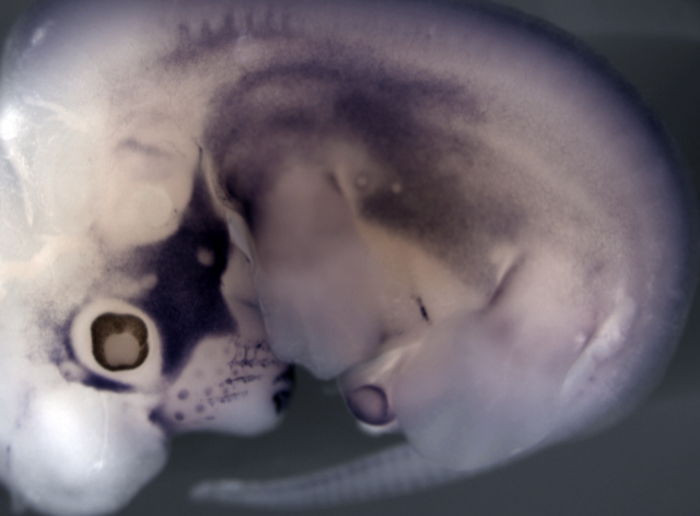
The researchers used a strategy based on CRISPR/Cas9 technology to disrupt five contiguous locations where CTCFs bind the genome, to control the activation of a family of genes known as the HoxD cluster. These genes encode proteins that are important in organizing the structures during the development in the mammalian embryo. The transcription factors are also highly conserved, which means that they don’t differ significantly across vertebrate species.
The study showed that CTCF-binding sites within Hox clusters are necessary for enhancers to be able to select the right sub-groups of target genes, especially if those enhancers are remote and not in the nearby vicinity as their target genes.
But given the dual function of CTCF, not all its binding sites act to promote gene activation and some have an inhibitory effect on gene transcription, the study found. The two roles seem to depend on the type of tissue where the genes operate, meaning that some CTCF binding sites can display opposite activities in different tissues.
The study revealed that although CTCF sites within the Hox cluster act in multiple roles, they all together contribute to the creation of what is known as a “TAD border” (TAD stands for “topologically associated domain). This is a defined region on the genome within which genes can interact with each other, helping to organize the tremendous complexity of the “genetic dance”.
“The variety of tasks uncovered for these CTCF sites may explain their amazing evolutionary conservation amongst the Hox clusters of all vertebrates,” the authors conclude.
Reference
Ana Rita Amândio, Leonardo Beccari, Lucille Lopez-Delisle, Bénédicte Mascrez, Jozsef Zakany, Sandra Gitto, Denis Duboule. Sequential in-cis mutagenesis in vivo reveals various functions for CTCF sites at the mouse HoxD cluster. Genes and Development 27 October 2021.
Journal
Genes & Development
Article Title
Sequential in-cis mutagenesis in vivo reveals various functions for CTCF sites at the mouse HoxD cluster.
Article Publication Date
27-Oct-2021