MADISON, WI, Oct. 25, 2021 — Households manage their yards in diverse ways and new research has found that their landscaping and management decisions have the potential to increase wild bird habitat and influence bird biodiversity in their yard and also at the neighborhood and city scale.
Credit: Photo by David Mizejewski, National Wildlife Federation.
MADISON, WI, Oct. 25, 2021 — Households manage their yards in diverse ways and new research has found that their landscaping and management decisions have the potential to increase wild bird habitat and influence bird biodiversity in their yard and also at the neighborhood and city scale.
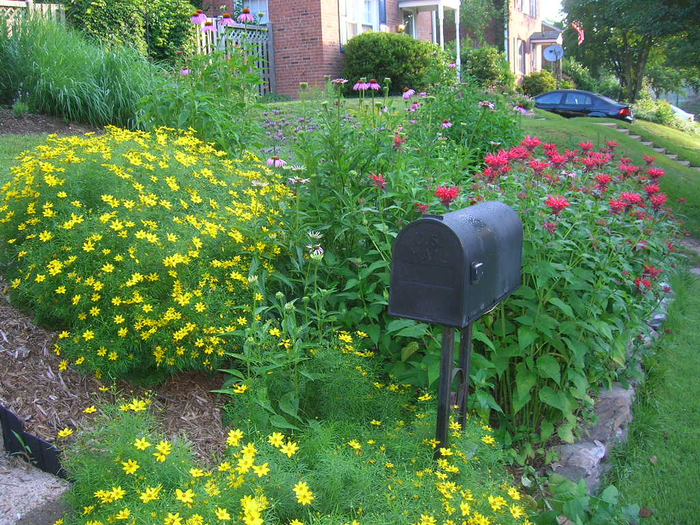
Across the United States, bird populations are declining due to decreases in availability of habitat. Recently, a team of scientists explored the value of the biggest chunk of green space found in cities – residential yards –as wildlife habitat. A new study, “Residential yard management and landscape cover affect urban bird community diversity across the continental USA,” was published this month in the journal Ecological Applications. The research was co-led by USDA Forest Service Research Ecologist Susannah Lerman and Post-Doctoral Researcher Desirée L. Narango from City University of New York and University of Massachusetts. Together with partners they conducted bird diversity observations in four residential yard types and in natural parks in six cities with distinctly different climate conditions: Baltimore, MD; Boston, MA; Los Angeles, CA; Miami, FL; Minneapolis-St. Paul, MN; and Phoenix, AZ. The researchers found similar patterns in all six cities; although urban parks support more species of conservation concern (an official designation of species whose long-term persistence is in question) compared with yards, yards certified as wildlife habitat through the National Wildlife Federation’s certification program support a wider variety of bird species compared with more traditional yard landscaping (e.g., lawn-dominated yards.) This suggests that landscape management for wildlife can contribute to region-wide bird diversity. The study also considered public interest levels based on Google searches and bird sightings and found that yards supported more popular species compared with parks.
“This study shows that when people landscape with wildlife in mind, householders can contribute to conservation right in their own back yards,” said Lerman, who is with the Forest Service’s Northern Research Station. “And our yards often support some of our most beloved backyard birds.”
“Scientists are finding that we can’t study cities in isolation. It will improve bird conservation efforts if we can understand which management practices are effective across regions and nationally, and which are effective at a more local level, “ said Narango.
In addition to Lerman and Narango, co-authors include Meghan L. Avolio, Johns Hopkins University; Anika R. Bratt, Duke University and Davidson College; Jesse M. Engebretson, University of Minnesota; Peter M. Groffman, City University of New York and Cary Institute; Sharon J. Hall, Arizona State University; James B. Heffernan, Duke University; Sarah E. Hobbie, University of Minnesota; Kelli L. Larson, Arizona State University; Dexter H. Locke, USDA Forest Service; Christopher Neill, Woodwell Climate Research Center; Kristen C. Nelson, University of Minnesota; Josep Padullés Cubino, University of Minnesota and Masaryk University; and Tara L. E. Trammell, University of Delaware.
###
USDA is an equal opportunity provider, employer and lender.
Journal
Ecological Applications
DOI
10.1002/eap.2455
Subject of Research
Animals
Article Title
Residential yard management and landscape cover affect urban bird community diversity across the continental USA