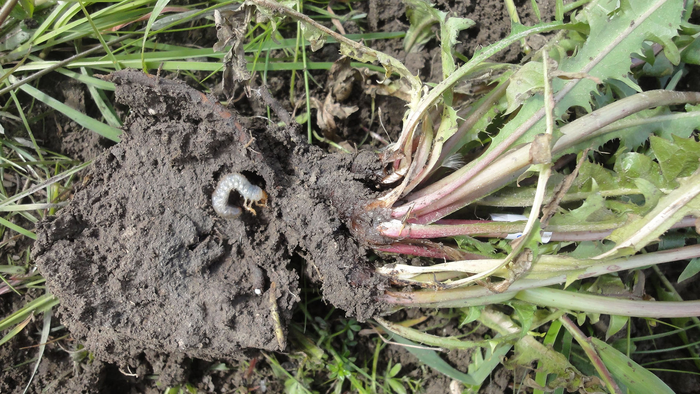
Plants are not entirely at the mercy of their herbivore enemies. Often, chemical defences ensure that the plants are inedible, or even toxic, and as a result insects and other hungry animals steer clear of them. A new study has shown, for the first time, that the degradation of plants’ defence substances by insects’ digestive enzymes can influence the insects’ preference for certain food plants. Researchers at the University of Münster, the University of Bern (Switzerland) and the Max Planck Institute for Chemical Ecology in Jena investigated this phenomenon in the larvae of cockchafers (Melolontha melolontha) and the plant they feed on, dandelion (Taraxacum officinale).
Credit: Meret Huber
Plants are not entirely at the mercy of their herbivore enemies. Often, chemical defences ensure that the plants are inedible, or even toxic, and as a result insects and other hungry animals steer clear of them. A new study has shown, for the first time, that the degradation of plants’ defence substances by insects’ digestive enzymes can influence the insects’ preference for certain food plants. Researchers at the University of Münster, the University of Bern (Switzerland) and the Max Planck Institute for Chemical Ecology in Jena investigated this phenomenon in the larvae of cockchafers (Melolontha melolontha) and the plant they feed on, dandelion (Taraxacum officinale).
In tackling the enemies that feed on it, the plant organism often uses a chemical trick: it binds a sugar component to the antigen and thus deactivates it. As a result, the substance is prevented from damaging the plant itself. Only when someone nibbles at the plant is the sugar component removed. The result is that the compound becomes toxic or deters the attacker. “Strangely enough, during digestion some insects themselves remove the sugar component in the plant defence compound,” says biologist Dr. Meret Huber from Münster University. “It is not yet known precisely,” she adds, “what consequences this has for the insects, and especially for their behaviour.”
One example of a defence compound containing sugar is a substance called taraxinic acid β-D-glucopyranosyl ester (TA-G), which dandelions accumulate in their roots in particularly high concentrations. TA-G is an important defence compound in dandelions, deterring the larva of the cockchafer from eating.
The team led by Dr. Meret Huber and Prof. Matthais Erb (University of Bern) demonstrated that the pH conditions in the cockchafer’s gut inhibit the activity of dandelion enzymes which would otherwise remove the sugar from TA-G. Instead, the cockchafer larva removes the sugar itself, with the aid of an enzyme from the gut that belongs to the class of so-called beta-glucosidases (sugar-splitting enzymes).
By using biotechnological methods to simultaneously manipulate the production of TA-G and the presence of the insect enzyme, the researchers showed that the insect glucosidase promotes the growth of the larva on dandelion plants containing TA-G. At the same time, however, the separation of the sugar from TA-G also leads to dandelion plants containing TA-G being shunned. “This means that, for the first time, we were able to demonstrate that the metabolization of plants’ defence substances by the digestive enzymes of insects changes the choice of food plant,” says Meret Huber. “This finding is important, because the choice of host plant plays a key role in the distribution of herbivore insects and, as a result, has a strong influence on the damage caused.”
Why the separation of sugar increases growth in the cockchafer larva – while simultaneously deterring the larva – is one of the as yet unanswered questions. Possibly this shunning behaviour on the part of the larva helps in finding the side roots of the plant – which have a lower TA-G concentration but a higher nutritional content than the main roots.
For the purpose of their studies the researchers used different methods of chemical analysis and biotechnology. They also carried out so-called bio-essays to study the effects of TA-G on the choice of food plant by the larvae. The results are intended to help in improving our understanding of the interactions between plants and their consumers. Future studies in various systems might make it possible to develop medicines or pesticides which are activated only in the presence of certain conditions specific to species or environments.
Journal
eLife
DOI
10.7554/eLife.68642
Method of Research
Experimental study
Subject of Research
Not applicable
Article Title
A beta-glucosidase of an insect herbivore determines both toxicity and deterrence of a dandelion defense metabolite
Article Publication Date
11-Oct-2021
COI Statement
The authors declare that no competing interests exist.