Psoriasis is a chronic inflammatory autoimmune disease that manifests as red, scaly skin patches. There is no causal treatment for the disease, but the symptoms can be significantly alleviated with modern therapies. Complex changes in the networks of immune cells and the messengers they use to communicate with each other are responsible for the development of the skin disease. Clinical trials revealed that newly developed drugs blocking only the messenger interleukin-23 are more effective than previous treatments targeting both interleukin-23 and interleukin-12 in psoriasis patients. The responsible mechanism has so far remained unknown. Now, researchers at the University of Zurich (UZH) have uncovered the underlying molecular mechanisms.
Credit: University of Zurich
Psoriasis is a chronic inflammatory autoimmune disease that manifests as red, scaly skin patches. There is no causal treatment for the disease, but the symptoms can be significantly alleviated with modern therapies. Complex changes in the networks of immune cells and the messengers they use to communicate with each other are responsible for the development of the skin disease. Clinical trials revealed that newly developed drugs blocking only the messenger interleukin-23 are more effective than previous treatments targeting both interleukin-23 and interleukin-12 in psoriasis patients. The responsible mechanism has so far remained unknown. Now, researchers at the University of Zurich (UZH) have uncovered the underlying molecular mechanisms.
Role of interleukin-12 in psoriasis decoded
The research teams of immunology professor Burkhard Becher and group leader Sarah Mundt from the Institute of Experimental Immunology at UZH have systematically investigated the function of interleukin-12 in psoriasis. They show that the messenger does not contribute to the disease – on the contrary, it protects against it. “These results surprised us, because so far drugs for the treatment of psoriasis also aim at blocking interleukin-12,” says Becher.
Interleukin-12 maintains normal function of skin cells
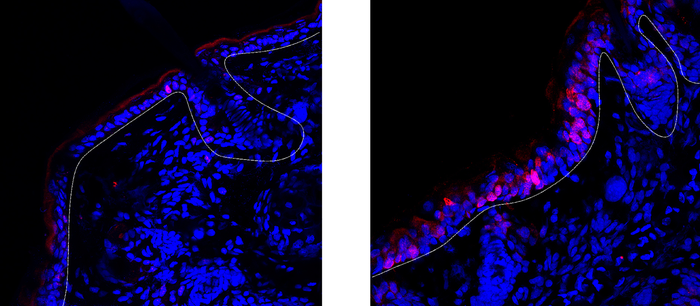
Detailed studies in mice and with human tissue now show that various cell types in the skin are also equipped with receptors for interleukin-12. Not only the T cells of the immune system, but also keratinocytes, horn-forming skin cells that build up the epidermis, can thus recognize the messenger. In fact, the recognition of interleukin-12 by these skin cells was responsible for the protective effect of the messenger, as the researchers found out. “Interleukin-12 is essential for the normal, physiological function of keratinocytes. For example, it prevents the increased cell division observed in psoriasis,” explains Mundt.
Improving psoriasis treatment
“Our findings indicate that blocking interleukin-12 is not advisable, and such drugs should therefore no longer be used to treat psoriasis patients,” says Pascale Zwicky, PhD student and first author of the study. Accordingly, psoriasis drugs should only block the messenger substance interleukin-23, but no longer interleukin-23 and -12 together.
The UZH researchers’ findings could be important for the treatment of other diseases. “The combined blocking of interleukin-23 and -12 is also used in the treatment of chronic inflammatory bowel diseases and psoriatic arthritis,” says Burkhard Becher. “In these diseases, the role of interleukin-12 has not yet been sufficiently studied. But here, too, a protective role of the messenger substance is possible.”
###
Journal
Science Immunology
DOI
10.1126/sciimmunol.abg9012
Method of Research
Experimental study
Subject of Research
Human tissue samples
Article Title
IL-12 regulates type 3 immunity through interfollicular keratinocytes in psoriasiform inflammation
Article Publication Date
22-Oct-2021