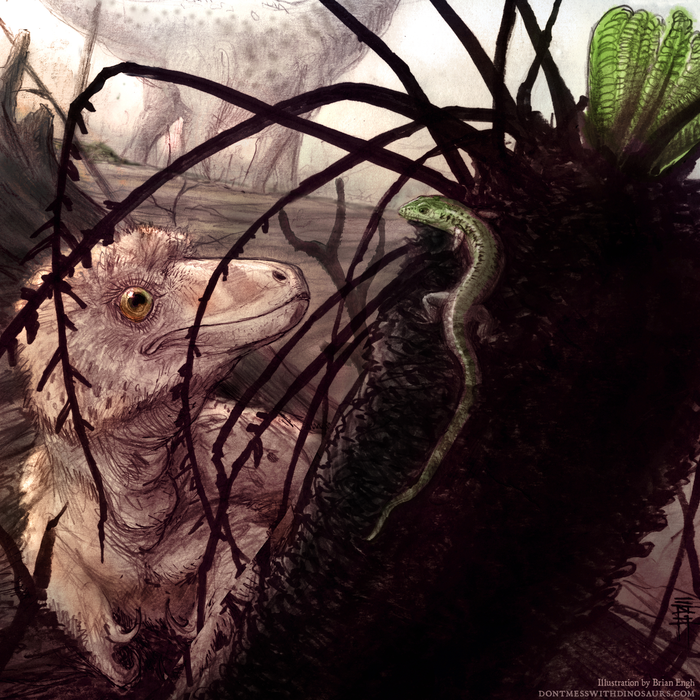
Two new species dating back to the Early Cretaceous Period were recently discovered in Sevier County in southwest Arkansas. One is a small skink researchers named Sciroseps pawhuskai and the other is a new fish named Anomoeodus caddoi.
Credit: Paleoart by Brian Engh
Two new species dating back to the Early Cretaceous Period were recently discovered in Sevier County in southwest Arkansas. One is a small skink researchers named Sciroseps pawhuskai and the other is a new fish named Anomoeodus caddoi.
The discoveries serve both to underscore the variety of fossils found at this site, including dinosaurs, mammals, fish, amphibians and reptiles, and to reinforce the overall lack of variety of fossils found throughout North America during the Early Cretaceous, roughly 110 million years ago.
The discoveries were highlighted in a recent paper published in PeerJ, titled “A new vertebrate fauna from the Lower Cretaceous Holly Creek Formation of the Trinity Group, southwest Arkansas, USA.” Celina Suarez, associate professor of geosciences at the U of A, served as primary author on the article, which pulls together decades of research in the area, known as the Holly Creek Formation.
While Arkansas is not traditionally considered a fertile source of Early Cretaceous fossils, this location has been unusually rich in them — including dinosaur tracks. Since the 1970s, thousands of sauropod and theropod tracks have been discovered in the area.
More recent work reveals that this ancient coastal plain of Arkansas was inhabited by a wide variety of freshwater and land animals, including long-necked dinosaurs, large carnivores, raptor-like carnivores and armored dinosaurs. But the site also provides a wide assortment of fossilized bones and teeth of much smaller creatures, such as sharks, fish, frogs, lizards, turtles and crocodilians, providing a clearer picture of the overall ecosystem at that time.
While the study enriches our knowledge of ancient fauna in Arkansas, it also serves to confirm that North America did not have as wide a variety of species in the Early Cretaceous as it did in the Late Cretaceous (roughly 70 million years ago). By and large, the majority of fauna found in the Holly Creek Formation are similar to fauna found throughout North America at the same time.
What caused increased diversity of life between the Early and Late Cretaceous Periods? The papers suggest that plate tectonics, which created mountains in the west, and climate changes, which drove rising sea levels, led to increased geographic isolation among similar species, spurring evolutionary changes in separated populations.
“When habitats are fragmented it can cause evolutionary changes,” Suarez explained. “One way this and other discoveries from the Cretaceous of North America can help us understand the modern world is how climate change can affect evolution of animals, be it extinction or the origination of new species. Given that the Cretaceous was a period of rapidly warming and cooling worlds, understanding these time periods is important for understanding how future warming worlds will react to climate change.”
Suarez also noted that she and her colleagues from other universities have been working to describe and catalogue many discoveries from southwest Arkansas since she arrived at the U of A in 2012. This paper is the first time so many specimens have been reported from a single site.
Suarez’s co-authors included Joseph Frederickson, Richard L. Cifelli, Jeffrey G. Pittman, Randall L. Nydam, ReBecca K. Hunt-Foster and Kirsty Morgan.
Journal
PeerJ
DOI
https://doi.org/10.7717/peerj.12242
Subject of Research
Not applicable
Article Title
A new vertebrate fauna from the Lower Cretaceous Holly Creek Formation of the Trinity Group, southwest Arkansas, USA
Article Publication Date
21-Oct-2021