Around the world, every second, someone gets a retinal OCT scan, typically as a routine portion of an eye exam. The high-resolution images obtained by OCT allow ophthalmologists to diagnose and monitor treatment for many retinal diseases.
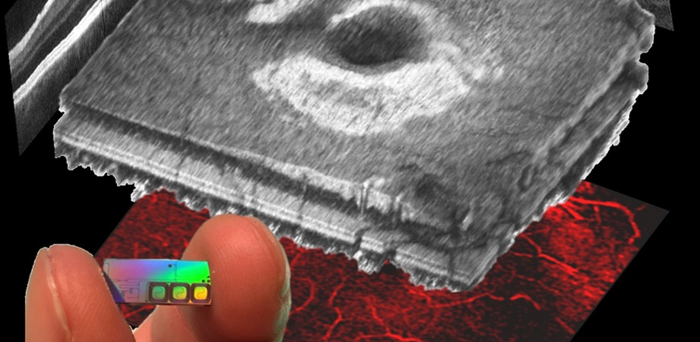
Credit: Image courtesy of OCTChip.
Around the world, every second, someone gets a retinal OCT scan, typically as a routine portion of an eye exam. The high-resolution images obtained by OCT allow ophthalmologists to diagnose and monitor treatment for many retinal diseases.
Optical coherence tomography is somewhat like ultrasound—but instead of sound, OCT uses light reflection to noninvasively obtain cross-sectional images of tissue structure. Originally developed in 1991 by James Fujimoto’s group at MIT, as well as pioneering work from Adolf Fercher’s group in Vienna, OCT has been the fastest adopted imaging technology in the history of ophthalmology. Yet the original motivation for OCT extended well beyond ophthalmology: the idea was to enable optical biopsy of organs that are not easily accessible, such as the heart, intestines, or the brain, to allow rapid diagnostic feedback with consequent reduction in healthcare costs.
According to a recent perspective published in the Journal of Biomedical Optics (JBO), OCT has significant growth potential and already enables enhanced medical diagnosis across a wide range of medical applications, from cardiology to dermatology. Multimodal and miniaturized OCT are among the most exciting prospects.
Multimodal OCT
Multimodal OCT incorporates complementary optical imaging methods, which compensates for the deficits of OCT, especially penetration depth and limited contrast, and extends its usefulness. For example, endoscopic OCT enables probes to access internal organs.
According to Wolfgang Drexler, professor and head of the Medical University of Vienna’s Center for Medical Physics and Biomedical Engineering, OCT in endoscopy functions as a kind of global positioning system: “Multimodal imaging applications combining techniques complementary to OCT will more and more be transferred from significantly improved microscopy setups—acting as fast quasi-histological optical biopsies next to the operating room—to the miniaturized endoscopic level with OCT acting like a GPS by prescreening the tissue at a wider field of view with microscopic resolution.”
Other exciting extensions of OCT include dynamic contrast OCT, which can enable optical biopsy by revealing subcellular metabolic contrast in freshly excised tissues. OCT angiography, which provides structural and functional information about blood and lymph flow, holds particular promise for noninvasive diagnosis of neurogenerative diseases like Alzheimer’s and Parkinson’s, by using the eye as a window to the brain.
Miniaturized, portable OCT
If you recall your last OCT retinal scan, you may recall the machine takes up a sizeable chunk of office space. According to Drexler, most commercial OCT devices currently have a footprint of a square meter and cost up to $180,000 USD. Given that footprint, “miniaturized OCT” must refer to reductions in both size and cost. Thanks to efforts by industry and academic labs worldwide, increasingly compact, mobile, and cost-effective OCT systems with good imaging performance have begun to emerge. Newly emerging OCT-on-a-chip, home-OCT, and self-OCT systems based on micro-optic assemblies or photonic integrated circuits will reportedly revolutionize new applications and availability in the near future.
According to Drexler, “The technology of miniaturized OCT is still young and foreshadows an exciting future of more widespread, mainstream, automated, intelligent, and smart point-of-care devices for early detection of pathological changes.”
These potentially future-disruptive innovations hinge especially on reducing size and cost without compromising OCT’s imaging resolution and speed.
Global OCT market
Widespread adoption of OCT outside of ophthalmology has been somewhat slow to take off because OCT has vied with less expensive, older, and more widely recognized imaging modalities. According to Drexler and his co-authors, take-off is imminent—as cost-effective OCT is enabled by technological advancements like photonic integration and the availability of cheaper swept-source laser technology.
Drexler notes that recent market reports indicate a global OCT market of about 1.5 billion USD in 2023. In particular, compound annual growth rates are predicted for handheld and integrated OCT systems.
So, prospects are bright for OCT at its 30th anniversary, with engineering challenges that will reward the new generation of biomedical engineers.
Read the open access review by Rainer Leitgeb et al., “Enhanced medical diagnosis for dOCTors: a perspective of optical coherence tomography,” J. Biomed. Opt. 26(10), 100601 (2021) doi 10.1117/1.JBO.26.10.100601.
Journal
Journal of Biomedical Optics
DOI
10.1117/1.JBO.26.10.100601
Method of Research
Systematic review
Subject of Research
Not applicable
Article Title
Enhanced medical diagnosis for dOCTors: a perspective of optical coherence tomography
Article Publication Date
20-Oct-2021