Most animals sync their body clocks to the daily rhythm of the sun, but what happens during the polar winter when the sun never rises above the horizon? According to a study by Jonathan Cohen at the University of Delaware and colleagues, publishing October 19th in the open-access journal PLOS Biology, arctic krill can detect tiny changes in light intensity during polar winter days, allowing them to maintain their daily biological rhythms. Northerly range expansions in response to climate change may force other marine species to evolve similar adaptations to thrive in this extreme environment.
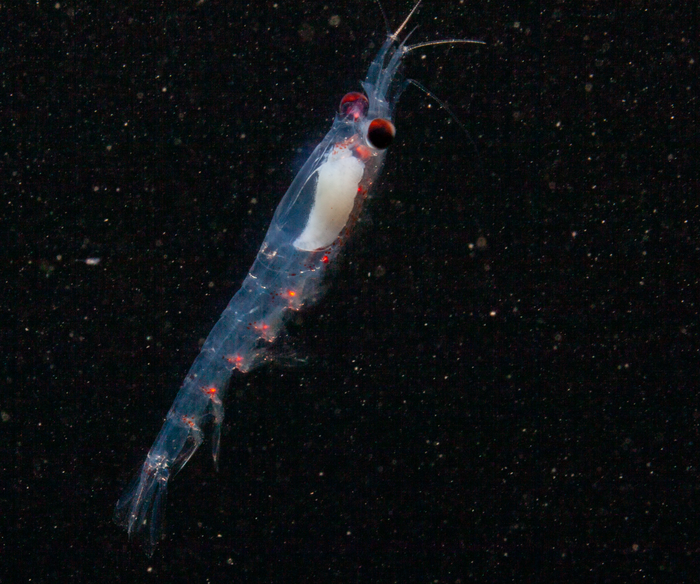
Credit: Geir Johnsen, CC-BY 4.0 (https://creativecommons.org/licenses/by/4.0/)
Most animals sync their body clocks to the daily rhythm of the sun, but what happens during the polar winter when the sun never rises above the horizon? According to a study by Jonathan Cohen at the University of Delaware and colleagues, publishing October 19th in the open-access journal PLOS Biology, arctic krill can detect tiny changes in light intensity during polar winter days, allowing them to maintain their daily biological rhythms. Northerly range expansions in response to climate change may force other marine species to evolve similar adaptations to thrive in this extreme environment.
The researchers measured midday light intensity during winter months in the Svalbard archipelago in the Arctic Ocean, from a land-based light observatory and a marine research vessel, and used underwater acoustic recordings to monitor the daily migrations of Arctic krill (Thysanoessa inermis). Krill are a type of small shrimp-like crustacean that form an important part of the diet of many large marine animals such as whales.
Light availability was just 2-fold higher at midday than at midnight in the middle of the arctic winter, compared to a 7-fold difference during spring and autumn. Nevertheless, the krill exhibited a strong circadian rhythm, migrating to the surface to feed during the polar night and retreating to the depths to avoid predators during the midday twilight.
To investigate the mechanisms underpinning these nightly migrations, the researchers used a technique called extracellular electroretinogram recording (ERG) to measure the visual sensitivity of krill in the laboratory. They found that krill were more sensitive to light at night than during the daytime, indicating that they are able to synchronize their circadian rhythms with small variations in external light cues.
Increases in visual sensitivity at night allow krill to acclimatize to tiny variations in light intensity and maintain their daily rhythms of behavior throughout the polar winter. Such adaptations may also be essential in regulating monthly and annual cycles of behavior and physiology, the authors say.
Cohen adds, “We found that the light environment during the high Arctic Polar Night has a complex timing of ‘light’ and ‘dark’ due to light coming from the sun below the horizon, the moon, and the aurora borealis. While this light is dim and unlike the typical photoperiod at lower latitudes, we show that it is sufficient to set a biological clock in krill, showing this animal has one of the more sensitive biological rhythms studied to date.”
#####
In your coverage, please use these URLs to provide access to the freely available article in PLOS Biology: http://journals.plos.org/plosbiology/article?id=10.1371/journal.pbio.3001413
Citation: Cohen JH, Last KS, Charpentier CL, Cottier F, Daase M, Hobbs L, et al. (2021) Photophysiological cycles in Arctic krill are entrained by weak midday twilight during the Polar Night. PLoS Biol 19(10): e3001413. https://doi.org/10.1371/journal.pbio.3001413
Author Countries: United States of America, United Kingdom, Norway
Funding: Support for this work came from the Norwegian Research Council (NFR) projects ArcticABC and DeepImpact (NFR grants 244319 and 300333, JB) and the Centre for Autonomous Marine Operations and Systems (NTNU AMOS, NFR 223254, GJ). Additional support came from the CHASE project, part of the Changing Arctic Ocean programme, jointly funded by the UKRI Natural Environment Research Council (NERC, project number: NE/R012733/1, KSL) and the German Federal Ministry of Education and Research (BMBF, project number: 03F0803A, KSL). The funders had no role in study design, data collection and analysis, decision to publish, or preparation of the manuscript.
Journal
PLoS Biology
DOI
10.1371/journal.pbio.3001413
Method of Research
Observational study
Subject of Research
Animals
COI Statement
Competing interests: The authors have declared that no competing interests exist.