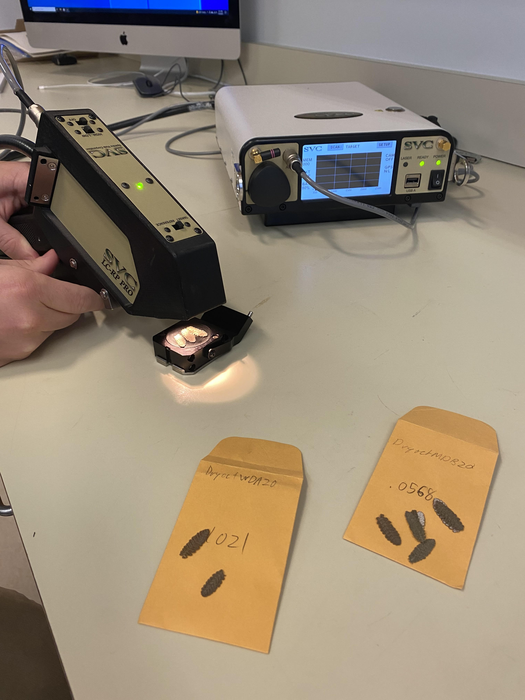
In Star Trek, characters carry a little handheld device called a tricorder that they can point at objects to analyze and identify them. When the show’s writers cooked up the idea in the 1960s, it was purely science fiction, but a new paper in New Phytologist takes the idea a step closer to reality. The researchers used a handheld device that looks a little like a ray gun to record how plant leaves on different Alaskan mountains reflect light. And, it turns out, different populations of plants of the same species– for instance, plants living on neighboring mountaintops– reflect light differently, in ways that echo their genetic variation from each other.
Credit: Courtesy of Lance Stasinski
In Star Trek, characters carry a little handheld device called a tricorder that they can point at objects to analyze and identify them. When the show’s writers cooked up the idea in the 1960s, it was purely science fiction, but a new paper in New Phytologist takes the idea a step closer to reality. The researchers used a handheld device that looks a little like a ray gun to record how plant leaves on different Alaskan mountains reflect light. And, it turns out, different populations of plants of the same species– for instance, plants living on neighboring mountaintops– reflect light differently, in ways that echo their genetic variation from each other.
“While trained biologists can usually walk into the field and identify species with their eyes, it takes expensive genetic analyses to reveal the populations– groups of individuals of the same species within a gene pool– that are so important for conservation and evolutionary research,” . says Dawson White, a postdoctoral researcher at Chicago’s Field Museum and the study’s co-lead author. “In this new study, we’ve shown that you can use light instead of DNA to define plant populations, at a similar level of detail. This new method is a lot faster and cheaper than genetic testing, which could dramatically increase our efficiency at mapping and monitoring biodiversity.”
“DNA is like an instruction manual on how to build an organism, and it turns out that this manual contains instructions for building and combining the smallest individual parts that make up that organism,” says Lance Stasinski, a graduate student researcher at the University of Maine and the paper’s other co-lead author. “We are able to use light that is reflected from these parts to determine which instruction manual was used to build the organism– even when the instruction manuals vary by only a handful of words.”
All living things contain DNA, and the more similar two organisms’ DNA is, the more closely related to each other they are. That’s true both between and within species– your DNA is more similar to a chimpanzee’s than to a dog’s, because we’re more closely related to chimps, and your DNA is closer to your cousin’s than to a random stranger on the other side of the world. The same is true for plants: even within a single species, there are variations in DNA from one population to another.
Genetic research has shown that sometimes these variations appear at a very fine scale– for instance, plants from one species on one mountaintop can form groups that have slightly different DNA than the plants on a mountaintop just a few miles away. When populations split like this, that means that they’re not sharing pollen or seeds with each other and are genetically isolated.
Scientists study these differences in DNA to tell one plant population from another, but it’s an arduous task– they have to collect the plant samples, store them, get permits to move them to the lab, then go through the many steps to actually sequence the plant’s genetic code and compare them. It’s a process that takes weeks or even months. In this new study, however, the researchers have found another method to determine how closely related two plant populations are to each other, one that could eventually be done almost instantaneously out in the field. This is where the ray guns come in.
Spectroradiometers are instruments that measure how much light reflects off a surface and what wavelengths that light contains. The instrument itself fits in a backpack, and there’s a handheld probe attached to a fiber optic cable that looks like a little ray gun. Agricultural scientists use these instruments to analyze the light bouncing back off of leaves to detect disease. But this new study revealed that the light bouncing off of leaves varies from one population of plants to the next.
“Leaves have evolved to interact with light, and these machines are recording differences in the light after photons have entered the leaves and been absorbed or bounced around based on different chemistry and structure,” explains White. “This instrument reads the visible and infrared light that bounces back off of the leaf, and that information can give you a tremendous amount of information about the chemistry and structure of the leaf.”
White and his colleagues from the Schoodic Institute and the University of Maine brought the spectrometer with them to alpine habitats in Alaska to study a small evergreen shrub called Dryas. They then scanned the plants’ leaves and collected samples of the plants so they could analyze the DNA later on.
“Our fieldwork is aimed at collecting reflectance data on plant communities at many different scales, genotypes in this study and separate species or coarser plant functional types in other studies. We use these reflectance signatures of plants in many studies to map vegetation using our UAV-based imagery and NASA’s AVIRIS ng airborne sensor. More precise information from the ground and air about vegetation like this has many uses in these tundra, from quantifying wildlife habitat to inferring underground permafrost dynamics,” says Peter R. Nelson, forest ecology director atSchoodic Institute at Acadia National Park and associate faculty at the University of Maine, School of Forest Resources.
The scientists found that from one mountaintop to the next, the leaves reflected back different amounts of light at different wavelengths. And, once they sequenced the plants’ genomes, they found that these differences in reflectances corresponded neatly with plants’ genetic differences. That means that looking at the light a plant reflects can be a quick, reliable substitute for lengthy genetic testing for researchers in the field trying to determine if a population of plants is genetically unique.
“We were very surprised to find that the different mountaintops were genetically isolated, so they are not sharing pollen or seeds, and moreover, that we could detect these different mountaintops with genetics or this new spectral method,” says White.
“The fact that leaf spectra capture genetic variation so well even in a biologically complicated scenario is incredibly promising. As the technology and models improve, we hope to be able to detect diversity using spectra measured from UAVs with the same levels of accuracy that we do using the backpack spectrometer.,” says Dudu Meireles, a professor at the University of Maine.
Being able to tell one genetic population of plants from another could be critical for scientists working to preserve threatened populations.
“Now that we understand that each one of these mountaintops is genetically unique, that means that there are implications for conservation,” says Rick Ree, a curator at the Field Museum and one of the study’s authors. “If we want to try and maintain genetic diversity through time, especially given the shrinking habitats of alpine ecosystems due to climate change, then the implication that we should be sampling from every mountaintop.”
###
Journal
New Phytologist
Article Title
Reading Light: Leaf spectra capture fine-scale diversity of closely-related, hybridizing arctic shrubs
Article Publication Date
19-Oct-2021