A $3.7 million grant to identify patients at risk for developing chronic consequences of COVID-19 infection and discover potential underlying mechanisms leading to neuropsychiatric symptoms (NPS) has been awarded to Louise McCullough, MD, PhD, and Fudong Liu, MD, MSN, by the National Institutes of Health (NIH).
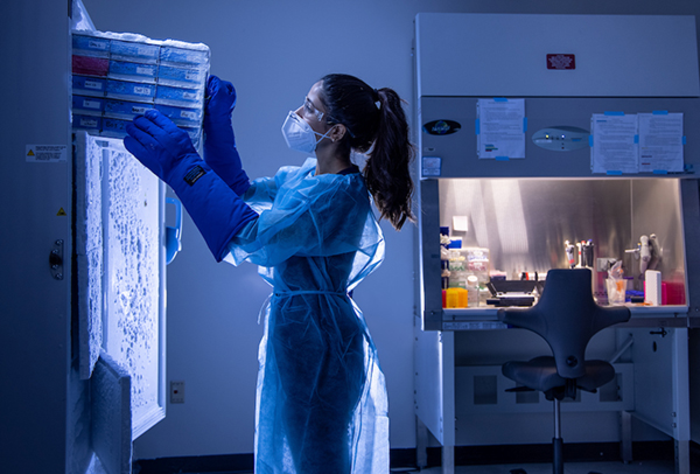
Credit: (Photo by Robert Seale)
A $3.7 million grant to identify patients at risk for developing chronic consequences of COVID-19 infection and discover potential underlying mechanisms leading to neuropsychiatric symptoms (NPS) has been awarded to Louise McCullough, MD, PhD, and Fudong Liu, MD, MSN, by the National Institutes of Health (NIH).
McCullough, professor and the Roy M. and Phyllis Gough Huffington Distinguished Chair in the Department of Neurology with McGovern Medical School at The University of Texas Health Science Center at Houston (UTHealth Houston), and Liu, an associate professor in the Department of Neurology, will study whether sex-specific immune responses to SARS-CoV-2, the virus that causes COVID-19, lead to chronic neurologic symptoms in individuals. These include NPS symptoms such as depression and sleep impairment.
“This grant will allow us to understand the mechanisms that contribute to long-term consequences of COVID-19 infection, and how they differ in men and women,” said McCullough, who sees patients at UTHealth Neurosciences. “Obtaining this award, in addition to the philanthropic support from the Huffington Foundation that helped us develop this biobank, has allowed us to develop a very unique resource. This will be invaluable as we develop new strategies to address the long-term consequence of COVID infection.”
The research team includes H. Alex Choi, MD, with the Department of Neurology and Vivian L. Smith Department of Neurosurgery at McGovern Medical School; Jude Savarraj, PhD, with the neurosurgery department; and Hilda Ahnstedt, PhD, with the neurology department.
The longitudinal, prospective study will assess the impact of acute and chronic inflammation on markers of brain injury and long-term NPS for up to two years after COVID-19 infection. To accomplish this, the team will leverage a biorepository that has enrolled more than 800 hospitalized COVID-19 subjects from three different hospitals. Follow-up will occur with enrolled patients in the COVID-19 Center of Excellence clinic at UTHealth Houston.
Sex differences in outcomes from COVID-19 are already increasingly evident, McCullough said. Men have worse outcomes with acute COVID-19 infection, with higher hospitalization rates and mortality – an effect seen globally. However, according to McCullough’s preliminary data, women may be disproportionally affected by the chronic effects of infection, including higher rates of chronic symptoms.
Both clinical and experimental studies in McCullough’s and Liu’s groups have also shown that sex differences in immune responses underlie differences in acute disease course. Men have a more robust innate immune response to acute COVID-19 infection, with increased circulating neutrophils and monocytes and higher serum levels of inflammatory cytokines and markers of brain injury. Meanwhile, women have more circulating T and B cells in response to acute infection compared to men, hallmarks of an antigen-specific immune response.
“Given that male and female COVID-19 patients mount different immune responses, and also have different outcomes, it is very promising to develop sex-specific therapeutic strategies that may be more effective for these patients,” Liu said. “Our NIH-funded COVID-19 research project aims to help develop these strategies.”
To date, more than 15 million Americans have been infected with the virus that causes COVID-19. While the vast majority survive the acute illness, many are at risk for experiencing long-term, acute neurologic symptoms afterward, such as encephalitis, stroke and seizure.
Yet more and more, even survivors without acute neurologic symptoms are reporting NPS from their illness. Interestingly, the incidence and factors that influence the development of long-term NPS are unknown.
What is known is that infection triggers a systemic pro-inflammatory response termed a “cytokine storm,” or an uncontrolled release of pro-inflammatory molecules. But the consequences of uncontrolled systemic inflammation on the brain and the link to long-term NPS after COVID-19 is also unknown.
The research team believes this work is critical to solving the puzzle and enhancing the health of millions of COVID-19 survivors.
“Men and women have very different immune responses to infection, and this is one of the first studies to examine the immune response and how it changes over time in the COVID-19 disease,” McCullough said. “If we can identify early biomarkers that predict later cognitive outcomes, we may be able to intervene to prevent long-term consequences of COVID-19.”