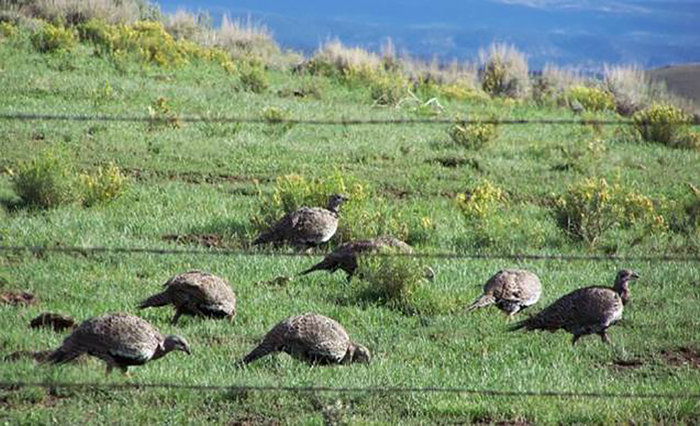
A thorough review of the history of sage grouse hunting and populations across the Intermountain West shows that declines in the bird’s numbers have prompted significant reductions in hunting opportunities in recent decades — with mixed results for grouse populations.
Credit: Jeff Beck
A thorough review of the history of sage grouse hunting and populations across the Intermountain West shows that declines in the bird’s numbers have prompted significant reductions in hunting opportunities in recent decades — with mixed results for grouse populations.
Research led by University of Wyoming Professor Jeff Beck and Oregon State University Assistant Professor Jonathan Dinkins, a former UW postdoctoral researcher, examined the history of grouse hunting regulations in 11 U.S. states and two Canadian provinces — and the impact of hunting restrictions on growth rates of the iconic Western species in recent decades.
The scientists’ findings are detailed in two articles published in PLOS ONE, a journal published by the Public Library of Science. The articles may be found here and here.
“We found that wildlife agencies throughout western North America have set increasingly more conservative harvest regulations over the past 25 years to conserve sage grouse,” Beck says. “Regarding the effect of hunting season regulations on population growth rates, we found mixed results.”
Sage grouse once numbered in the millions across the Intermountain West, but rapidly dwindling numbers prompted state wildlife agencies to impose hunting restrictions in the 1930s and 1940s. In the past 50-plus years, loss and fragmentation of the bird’s sagebrush habitat have been the primary causes of declining grouse numbers, which also are affected by climatic conditions such as drought and spring snowfall, as well as disease such as West Nile Virus.
As the federal government has considered several petitions to protect sage grouse under the Endangered Species Act, state wildlife agencies have responded by reducing hunter bag and possession limits, and hunting season lengths — and by setting season start dates later in September to avoid concentrating hunters on females with young broods. In some cases, such as for Gunnison sage grouse in Utah and Colorado and greater sage grouse in Canada and Washington state, they’ve eliminated grouse hunting altogether — although that action is less common.
“It appears that, overall, agencies are doing well with adjusting the timing of hunting seasons, reducing season lengths and maintaining later hunting seasons as supported by previous research,” Dinkins says. “Also, by retaining hunting seasons but lowering bag and possession limits, agencies continue to bring in important funding for conservation from hunting permits while ensuring hunter take is limited to sustain populations.”
To determine the impact of hunting restrictions on grouse populations, the researchers compared counts of the birds from 22 distinct population segments on spring breeding grounds, or leks, in nine U.S. states and two Canadian provinces. They also assessed the impact of weather conditions; human activity such as oil and gas development; and habitat loss due to fire.
While there were no overall trends in the impact of hunting restrictions on grouse numbers, the researchers’ findings did align with previous studies on the impact of human activity, habitat loss, fire and precipitation.
“Our results suggest that discontinuing harvest in the largest population (in central Idaho) resulted in greater population growth rates; however, this was not consistently the case for smaller populations,” the researchers wrote. “To no surprise, not all sage grouse populations were influenced by the same environmental change or human disturbance factors.”
The researchers say their population trend models will help management agencies better understand patterns and focus conservation efforts on factors that may lead to increasing adult female survival, nest success and chick survival.
###
Journal
PLoS ONE
DOI
10.1371/journal.pone.0257198
Method of Research
Data/statistical analysis
Subject of Research
Animals
Article Title
Influence of environmental change, harvest exposure, and human disturbance on population trends of greater sage-grouse
Article Publication Date
24-Sep-2021