Grégoire Courtine doesn’t hesitate to use the word “revolutionary” when describing the emerging field of optogenetics – a technology that uses pulses of light to control individual neural activity – and what it could mean for neuroscience. Courtine, director of the NeuroRestore research center (with neurosurgeon Jocelyne Bloch), is currently developing an optogenetic implant together with Stéphanie Lacour, who holds the Bertarelli Foundation Chair in Neuroprosthetic Technology. “Our system allows us to control the activity of any neuron in the spinal cord,” says Courtine. “In turn, this helps us to understand the role it plays in the overall functioning of the nervous system.”
Credit: EPFL
Grégoire Courtine doesn’t hesitate to use the word “revolutionary” when describing the emerging field of optogenetics – a technology that uses pulses of light to control individual neural activity – and what it could mean for neuroscience. Courtine, director of the NeuroRestore research center (with neurosurgeon Jocelyne Bloch), is currently developing an optogenetic implant together with Stéphanie Lacour, who holds the Bertarelli Foundation Chair in Neuroprosthetic Technology. “Our system allows us to control the activity of any neuron in the spinal cord,” says Courtine. “In turn, this helps us to understand the role it plays in the overall functioning of the nervous system.”
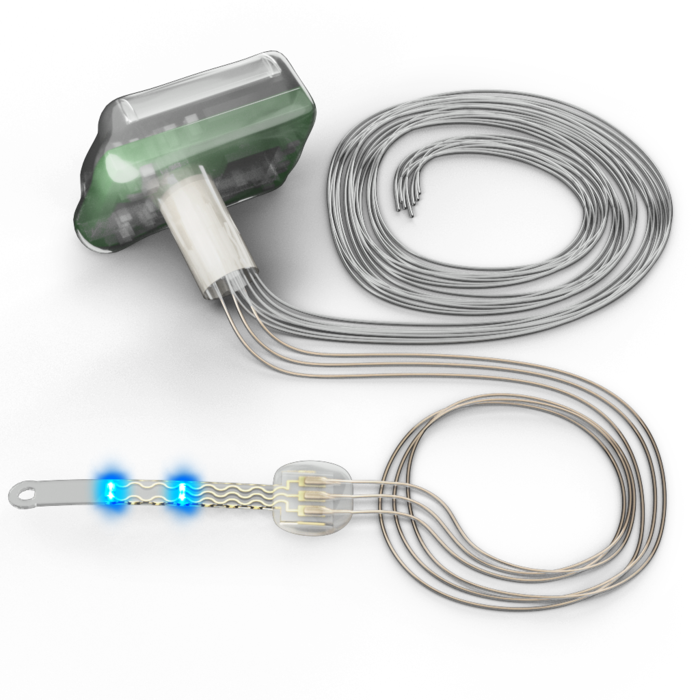
The key to their breakthrough is the new implant technology developed by Lacour’s research group. “We found a way to encapsulate miniaturized LEDs in a flexible implant that is thin yet sturdy enough to be applied on the surface of a mouse’s spinal cord by sliding it underneath the vertebrae along the entire lumbar section,” she says. “Then we worked with our colleagues at ETH Zurich to create a wireless electronic circuit that can be used to switch on one or more LEDs and control the duration and intensity of the emitted light with extreme precision. Finally, through a customized embedded system-on-chip, the light pulses can be managed naturally, for example in response to muscular activity or some other physiological signal.” The optoelectronic implantable system is controlled via Bluetooth.
Behaving as naturally as possible
Courtine stresses that the system’s ability to run autonomously is crucial. “That frees us from the wire-based systems that are generally needed for this kind of research. Now we can observe mice as they move about freely and examine the role that neurons play in complex movements like walking and swimming, in an ecological environment.”
One of the biggest challenges in developing the technology was finding a way to administer light pulses that penetrate into the depth of the spinal cord without being absorbed and reflected by nerve fibers. To solve that problem, the research team modified the LEDs to emit red light – a color that is much less easily impacted by nerve fibers than the blue light typically emitted by the diodes.
On the path to new therapies
Courtine and Lacour’s discovery is likely to boost the development of new therapeutic applications for optogenetics. The ability to stimulate or inhibit specific spinal-cord neurons using light pulses will eventually allow doctors to reduce pain, improve autonomic function and even treat paralysis. There may still be a long way to go before their implants are used clinically, but the research team is confident that a version of their implant will be available for human patients in the not-too-distant future.
Reference :
‘Wireless closed-loop optogenetics across the entire dorsoventral spinal cord in mice. Nature Biotechnology, September 27th, 2021, DOI: 10.1038/s41587-021-01019-x
Journal
Nature Biotechnology
DOI
10.1038/s41587-021-01019-x
Method of Research
Experimental study
Subject of Research
Animals
Article Title
Wireless closed-loop optogenetics across the entire dorsoventral spinal cord in mice.
Article Publication Date
27-Sep-2021