Microorganisms, plants, and animals accomplish great feats every day. For example, by decomposing material, producing plant biomass, or pollinating flowers, they keep nature ‘up and running,’ thereby securing the livelihood of humans. Numerous studies have shown that a high biodiversity can have a positive impact on these as well as on other ecosystem functions.
Credit: Andreas Hemp
Microorganisms, plants, and animals accomplish great feats every day. For example, by decomposing material, producing plant biomass, or pollinating flowers, they keep nature ‘up and running,’ thereby securing the livelihood of humans. Numerous studies have shown that a high biodiversity can have a positive impact on these as well as on other ecosystem functions.
“But there is another important factor at play. If the environmental conditions of an ecosystem are heterogeneous, for example, in terms of soil properties and climate, this could give an additional boost to the positive effect of biodiversity on ecosystem functions,” says Dr. Jörg Albrecht of the Senckenberg Biodiversity and Climate Research Centre.
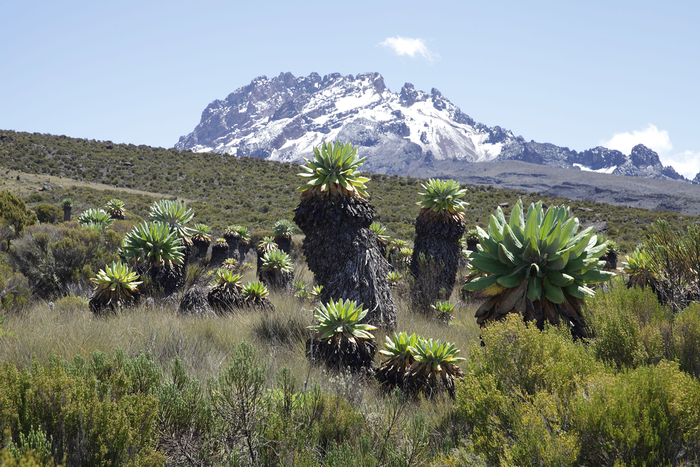
Teaming up with other researchers, Albrecht examined whether the degree of environmental heterogeneity influences the positive effect of biodiversity on ecosystem functions. To this end, the researchers analyzed data from 13 natural and man-made ecosystems on Africa’s highest mountain, Mount Kilimanjaro. It is one of the first studies to investigate such a question in real ecosystems along an elevational gradient of more than 3500 meters.
“The data show that the positive effect of biodiversity on ecosystem functions is about 20 percent higher in a heterogeneous environment,” explains Albrecht, and he continues, “This means that, if the global trend towards land-use intensification continues, the positive effect of biodiversity on ecosystem functions could be diminished.”
In addition, the researchers examined which aspect of biodiversity is most beneficial to the provision of ecosystem functions: Changes in species richness or species turnover, that is, changes in the species composition along the elevational gradient. It became apparent that species richness plays a greater role in ecosystem functions than species turnover.
“Frankly, this came as a surprise to us, since in theory, the opposite had been assumed. Moreover, species communities in the savanna at the foot of the mountain are completely different from those in the cloud forests or at the alpine summit. Thus, species turnover is very high. In contrast, species richness, that is, the number of species that co-occur in an ecosystem, changes to a lesser extent, but is far more important for ecosystem functioning,” says Dr. Marcell Peters of the University of Würzburg.
The researchers consider the results to be evidence that regional conservation efforts should focus on preserving species richness. “Our results confirm that biodiversity is not only important on a small scale as has been shown in experiments, but that these effects become even stronger in real, large-scale landscapes. We were thus able to show that protecting biodiversity is not a luxury, but essential for maintaining functional ecosystems,” concludes Peters.
Journal
Nature Ecology & Evolution
DOI
10.1038/s41559-021-01550-9
Method of Research
Observational study
Subject of Research
Animals
Article Title
Species richness is more important for ecosystem functioning than species turnover along an elevational gradient
Article Publication Date
20-Sep-2021