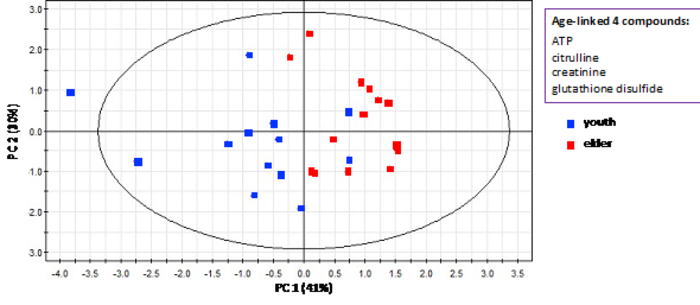
Researchers in Japan have conducted a comprehensive analysis of the metabolites that make up human saliva using samples given voluntarily from a group of 27-to-33-year-old individuals and a group of 72-to-80-year-old individuals. Metabolites are the intermediate or end products from the chemical reactions that occur within our bodies. They can be related energy synthesis, digestion, growth, cell health, and more. Writing in scientific reports, the researchers from the G0 Cell Unit at the Okinawa Institute of Science and Technology Graduate University (OIST) identified 99 metabolites within the samples of saliva. Notably, the quantities of 21 of these metabolites were different between the two groups.
Credit: OIST
- Researchers in Japan looked at saliva samples taken from two different age groups to see if the composition of saliva changes as one ages.
- Despite the difficulties with working with saliva, they identified 99 metabolites in the samples.
- Twenty-one of these differed in quantities between the two age groups.
- Amongst those that differed between the age groups, there were metabolites related to taste and muscle activity, suggesting an age-related lose in taste and decreased swallowing ability.
- The researchers are hoping that saliva could be used to provide early indications of frailty, dementia, and other health problems frequently experienced by the elderly.
Researchers in Japan have conducted a comprehensive analysis of the metabolites that make up human saliva using samples given voluntarily from a group of 27-to-33-year-old individuals and a group of 72-to-80-year-old individuals. Metabolites are the intermediate or end products from the chemical reactions that occur within our bodies. They can be related energy synthesis, digestion, growth, cell health, and more. Writing in scientific reports, the researchers from the G0 Cell Unit at the Okinawa Institute of Science and Technology Graduate University (OIST) identified 99 metabolites within the samples of saliva. Notably, the quantities of 21 of these metabolites were different between the two groups.
“Saliva has not previously been comprehensively studied for the changes that occur as one ages,” explained Prof. Mitsuhiro Yanagida who leads OIST’s G0 Cell Unit. The Unit has already looked at blood and urine and found that the quantities of some metabolites are linked to frailty and dementia. Prof. Yanagida explained that having these indicators means that early diagnosis and intervention should be possible. “Frailty and dementia, conditions that are associated with aging, make the day-to-day lives of patients very difficult. Saliva also has a close connection to mouth health. If a mouth does not function correctly, it can make consuming food challenging, which is highly detrimental to one’s quality of life. I hope through this research we can better support elderly people.”
The sample collection was easy and noninvasive. Twenty-seven volunteers in Okinawa supplied their saliva, which they collected themselves at home. These were transferred to the laboratory for analysis. In general, the concentration of metabolites in saliva is very low compared to that in blood and urine, making it more challenging to detect them. However, using a comprehensive method, the researchers identified 99 metabolites, some of which were previously unreported in saliva. They also found that saliva contains information that reflects biological aging. Twenty metabolites, including those related to antioxidative activity, energy synthesis, and muscle maintenance, were lower in the elderly individuals than the young people, whereas one metabolite actually increased.
“It’s interesting that ATP, the metabolite related to energy production, increased 1.96-fold in the elderly,” commented lead author, Dr. Takayuki Teruya. “This is possibly due to reduced ATP consumption in the elderly individuals. Amongst the metabolites that declined in quantity were two that are related to taste, suggesting that the elderly lose some ability to taste, and others that are related to muscle activity such as swallowing. These age-linked salivary metabolites together illuminate a metabolic network that reflects a decline of oral function during human aging.”
Two metabolites—creatinine and acetyl-carnosine—showed a significant difference between men and women, with women having lower quantities than men. These metabolites are linked to muscle activity.
“In Japan, 90% of people over 90 years of age are women,” said Prof. Yanagida. “And many of them have difficulty with their muscles and cognition. Therefore, when we think about the welfare of the elderly, we must think about women’s health.”
Although this is the first comprehensive analysis to be performed on the metabolites of saliva, the researchers are planning to continue this work. In the future, they hope that saliva will be a sample that can be given readily and easily but could provide an enormous amount of information about an individual’s health.
“In saliva, age-linked metabolites are related to relatively broad metabolic conditions so that age-related information obtained from salivary metabolites may be distinct from that of blood and urine. The results of this study may be useful in the future to assess easily the degree of metabolic aging in humans or to find early indications of age-related diseases.” concluded Prof. Yanagida.
The research was conducted by the G0 Cell Unit, Okinawa Institute of Science and Technology Graduate University, along with Mr. Haruhisa Goga, a trainee from the Department of Criminal Investigation, Okinawa Prefectural Police HQ.
Journal
Scientific Reports
DOI
10.1038/s41598-021-97623-7
Method of Research
Randomized controlled/clinical trial
Subject of Research
People
Article Title
Human age‑declined saliva metabolic markers determined by LC–MS
Article Publication Date
13-Sep-2021