• HOME
  • NEWS
  • EXPLORE
    • CAREER
      • Companies
      • Jobs
    • EVENTS
    • iGEM
      • News
      • Team
    • PHOTOS
    • VIDEO
    • WIKI
  • BLOG
  • COMMUNITY
    • FACEBOOK
    • INSTAGRAM
    • TWITTER
Saturday, February 7, 2026
BIOENGINEER.ORG
No Result
View All Result
  • Login
  • HOME
  • NEWS
  • EXPLORE
    • CAREER
      • Companies
      • Jobs
        • Lecturer
        • PhD Studentship
        • Postdoc
        • Research Assistant
    • EVENTS
    • iGEM
      • News
      • Team
    • PHOTOS
    • VIDEO
    • WIKI
  • BLOG
  • COMMUNITY
    • FACEBOOK
    • INSTAGRAM
    • TWITTER
  • HOME
  • NEWS
  • EXPLORE
    • CAREER
      • Companies
      • Jobs
        • Lecturer
        • PhD Studentship
        • Postdoc
        • Research Assistant
    • EVENTS
    • iGEM
      • News
      • Team
    • PHOTOS
    • VIDEO
    • WIKI
  • BLOG
  • COMMUNITY
    • FACEBOOK
    • INSTAGRAM
    • TWITTER
No Result
View All Result
Bioengineer.org
No Result
View All Result
Home NEWS Science News Biology

Gd-doped Nanoclusters Help Imaging of Early Orthotopic Cancer

Bioengineer by Bioengineer
September 15, 2021
in Biology
Reading Time: 2 mins read
0
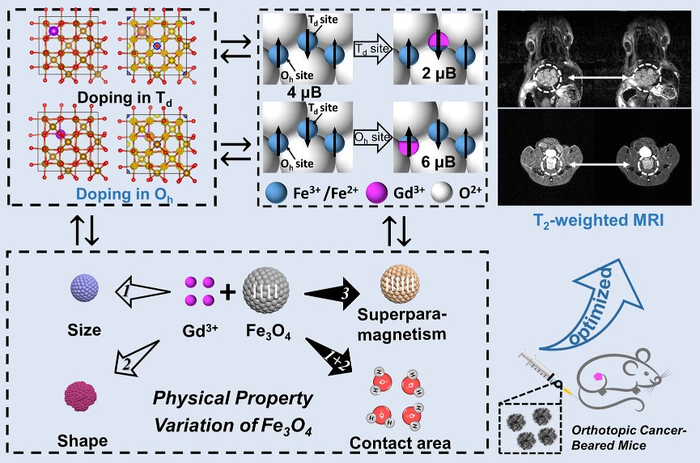
GdxFe3-xO4 Nanoclusters Help Imaging of Early Orthotopic Cancer
Share on FacebookShare on TwitterShare on LinkedinShare on RedditShare on Telegram

To realize precise diagnosis of early-stage cancer for effective treatment and better prognosis, high-resolution magnetic resonance imaging (MRI) is indispensable with the help of contrast agents. Iron-oxide-based T2 MR contrast agent (IOCA) is facing severe question of strong ferromagnetism and thereby weak T2 contrast ability. Although numerous efforts have been devoted to enhance the contrast ability of IOCAs, such as gadolinium ions (Gd3+) doping, the specific role that Gd3+ played in this process remained unclear.
GdxFe3-xO4 Nanoclusters Help Imaging of Early Orthotopic Cancer

Credit: GAN Yuehao

To realize precise diagnosis of early-stage cancer for effective treatment and better prognosis, high-resolution magnetic resonance imaging (MRI) is indispensable with the help of contrast agents. Iron-oxide-based T2 MR contrast agent (IOCA) is facing severe question of strong ferromagnetism and thereby weak T2 contrast ability. Although numerous efforts have been devoted to enhance the contrast ability of IOCAs, such as gadolinium ions (Gd3+) doping, the specific role that Gd3+ played in this process remained unclear.

Researchers led by Prof. WU Zhengyan from the Hefei Institutes of Physical Science (HFIPS) of the Chinese Academy of Sciences (CAS), the Institute of Health and Medical Technology and the Binzhou Medical University fabricated a series of Gd-doped iron oxide nanoclusters to systemically study the inherent mechanism through which Gd doping tune the T2 contrast ability of the nanoclusters.

The researchers found that, with the doping content increased, GdxFe3-xO4 nanocluster featuring ferromagnetism turned into a superparamagnetic one, and the specific surface area of the nanocluster significantly increased, collectively leading to stronger T2 contrast.

“We obtained the highest r2 value, four times higher than that for pristine Fe3O4,” said GAN Yuehao, first author of the study, “the contrast of Gd0.018Fe2.982O4 nanocluster offers possible method to diagnose early orthotopic cancer in mice.”

This work opens a new avenue for the development of atomically precise Gd-doped MMIONs as efficient T2-weighted MRI contrast agents.

This research has been published in Chemical Engineering Journal 


Journal

Chemical Engineering Journal

Article Publication Date

31-Aug-2021

Share12Tweet8Share2ShareShareShare2

Related Posts

Florida Cane Toad: Complex Spread and Selective Evolution

Florida Cane Toad: Complex Spread and Selective Evolution

February 7, 2026
New Study Uncovers Mechanism Behind Burn Pit Particulate Matter–Induced Lung Inflammation

New Study Uncovers Mechanism Behind Burn Pit Particulate Matter–Induced Lung Inflammation

February 6, 2026

DeepBlastoid: Advancing Automated and Efficient Evaluation of Human Blastoids with Deep Learning

February 6, 2026

Navigating the Gut: The Role of Formic Acid in the Microbiome

February 6, 2026

POPULAR NEWS

  • Robotic Ureteral Reconstruction: A Novel Approach

    Robotic Ureteral Reconstruction: A Novel Approach

    82 shares
    Share 33 Tweet 21
  • Digital Privacy: Health Data Control in Incarceration

    63 shares
    Share 25 Tweet 16
  • Study Reveals Lipid Accumulation in ME/CFS Cells

    57 shares
    Share 23 Tweet 14
  • Breakthrough in RNA Research Accelerates Medical Innovations Timeline

    53 shares
    Share 21 Tweet 13

About

We bring you the latest biotechnology news from best research centers and universities around the world. Check our website.

Follow us

Recent News

Evaluating Pediatric Emergency Care Quality in Ethiopia

TPMT Expression Predictions Linked to Azathioprine Side Effects

Improving Dementia Care with Enhanced Activity Kits

Subscribe to Blog via Email

Enter your email address to subscribe to this blog and receive notifications of new posts by email.

Join 73 other subscribers
  • Contact Us

Bioengineer.org © Copyright 2023 All Rights Reserved.

Welcome Back!

Login to your account below

Forgotten Password?

Retrieve your password

Please enter your username or email address to reset your password.

Log In
No Result
View All Result
  • Homepages
    • Home Page 1
    • Home Page 2
  • News
  • National
  • Business
  • Health
  • Lifestyle
  • Science

Bioengineer.org © Copyright 2023 All Rights Reserved.