• HOME
  • NEWS
  • EXPLORE
    • CAREER
      • Companies
      • Jobs
    • EVENTS
    • iGEM
      • News
      • Team
    • PHOTOS
    • VIDEO
    • WIKI
  • BLOG
  • COMMUNITY
    • FACEBOOK
    • INSTAGRAM
    • TWITTER
Saturday, February 7, 2026
BIOENGINEER.ORG
No Result
View All Result
  • Login
  • HOME
  • NEWS
  • EXPLORE
    • CAREER
      • Companies
      • Jobs
        • Lecturer
        • PhD Studentship
        • Postdoc
        • Research Assistant
    • EVENTS
    • iGEM
      • News
      • Team
    • PHOTOS
    • VIDEO
    • WIKI
  • BLOG
  • COMMUNITY
    • FACEBOOK
    • INSTAGRAM
    • TWITTER
  • HOME
  • NEWS
  • EXPLORE
    • CAREER
      • Companies
      • Jobs
        • Lecturer
        • PhD Studentship
        • Postdoc
        • Research Assistant
    • EVENTS
    • iGEM
      • News
      • Team
    • PHOTOS
    • VIDEO
    • WIKI
  • BLOG
  • COMMUNITY
    • FACEBOOK
    • INSTAGRAM
    • TWITTER
No Result
View All Result
Bioengineer.org
No Result
View All Result
Home NEWS Science News Biology

Early-life inflammation induces depression in adolescence

Bioengineer by Bioengineer
July 15, 2021
in Biology
Reading Time: 2 mins read
0
IMAGE
Share on FacebookShare on TwitterShare on LinkedinShare on RedditShare on Telegram

IMAGE

Credit: CAO Peng et al.

Early-life inflammation, such as trauma and viral infections, strongly increases the risk of individual for depression in adulthood, however, the mechanisms are not clear yet.

A team led by Prof. ZHANG Zhi from Division of Life Sciences and Medicine of the University of Science and Technology of China (USTC) of Chinese Academy of Sciences (CAS), collaborating with Prof. XU Lin from CAS, revealed the mechanism by which early-life inflammation induces adolescent depression symptoms. This work has been published in Neuron on July 6th.

Clinically related studies have shown decreased anterior cingulate cortex (ACC) synaptic density and increased inflammation in the brain of depressed patients. Microglial cells are resident immune cells of the brain, and it transforms into reactive states in response to stress challenges. Under the pathological state, activated microglia are the commander of the inflammatory state of the brain tissue, which is closely related to the occurrence and development of depression.

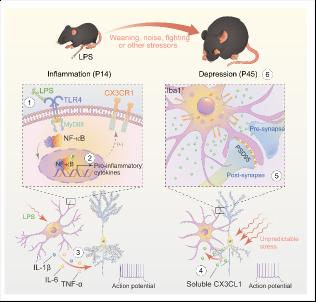
In this work, researchers found that early-life inflammation would lead to the susceptibility of microglial in the ACC to random stress events during adolescent development, and microglia then overengulfed dendritic spines of neurons. This weakened the ability of ACC glutamatergic neuronal (ACCGlu) to fight stress, thus inducing adolescent depression.

To explore the responding and activating model of ACC microglia to stress during mouse development from childhood to adolescence (45 days after birth), researchers established inflammatory model by intraperitoneal administration of lipopolysaccharide (LPS) during the critical time window of mouse brain development (14 days after birth). 6 hours after LPS injection, multiple activation indexes of ACC microglia in mice significantly increased and recovered after 24 hours. Interestingly, during the later development, a series of unpredictable life stress events (such as weaning, caging, noise and fighting) could lead to the re-activation of ACC microglia in LPS mice, being more susceptible than normal mice.

Moreover, before stress, the sharply increase of ACCGlu activity helped mice resist the attack of stress and protect themselves. However, ACC microglia of mice with early-life inflammation were frequently activated by persistent stress in adolescence, and overengulfed the ACCGlu dendritic spines via CX3CR1 signals mediate, consequently reducing the activity of ACCGlu. As a result the body’s ability to cope with stress was impaired, which promoted depression in adolescent mice.

###

Media Contact
Jane FAN Qiong
[email protected]

Related Journal Article

http://dx.doi.org/10.1016/j.neuron.2021.06.012

Tags: Biology
Share12Tweet8Share2ShareShareShare2

Related Posts

Florida Cane Toad: Complex Spread and Selective Evolution

Florida Cane Toad: Complex Spread and Selective Evolution

February 7, 2026
New Study Uncovers Mechanism Behind Burn Pit Particulate Matter–Induced Lung Inflammation

New Study Uncovers Mechanism Behind Burn Pit Particulate Matter–Induced Lung Inflammation

February 6, 2026

DeepBlastoid: Advancing Automated and Efficient Evaluation of Human Blastoids with Deep Learning

February 6, 2026

Navigating the Gut: The Role of Formic Acid in the Microbiome

February 6, 2026
Please login to join discussion

POPULAR NEWS

  • Robotic Ureteral Reconstruction: A Novel Approach

    Robotic Ureteral Reconstruction: A Novel Approach

    82 shares
    Share 33 Tweet 21
  • Digital Privacy: Health Data Control in Incarceration

    63 shares
    Share 25 Tweet 16
  • Study Reveals Lipid Accumulation in ME/CFS Cells

    57 shares
    Share 23 Tweet 14
  • Breakthrough in RNA Research Accelerates Medical Innovations Timeline

    53 shares
    Share 21 Tweet 13

About

We bring you the latest biotechnology news from best research centers and universities around the world. Check our website.

Follow us

Recent News

Digital Health Perspectives from Baltic Sea Experts

Florida Cane Toad: Complex Spread and Selective Evolution

Exploring Decision-Making in Dementia Caregivers’ Mobility

Subscribe to Blog via Email

Enter your email address to subscribe to this blog and receive notifications of new posts by email.

Join 73 other subscribers
  • Contact Us

Bioengineer.org © Copyright 2023 All Rights Reserved.

Welcome Back!

Login to your account below

Forgotten Password?

Retrieve your password

Please enter your username or email address to reset your password.

Log In
No Result
View All Result
  • Homepages
    • Home Page 1
    • Home Page 2
  • News
  • National
  • Business
  • Health
  • Lifestyle
  • Science

Bioengineer.org © Copyright 2023 All Rights Reserved.