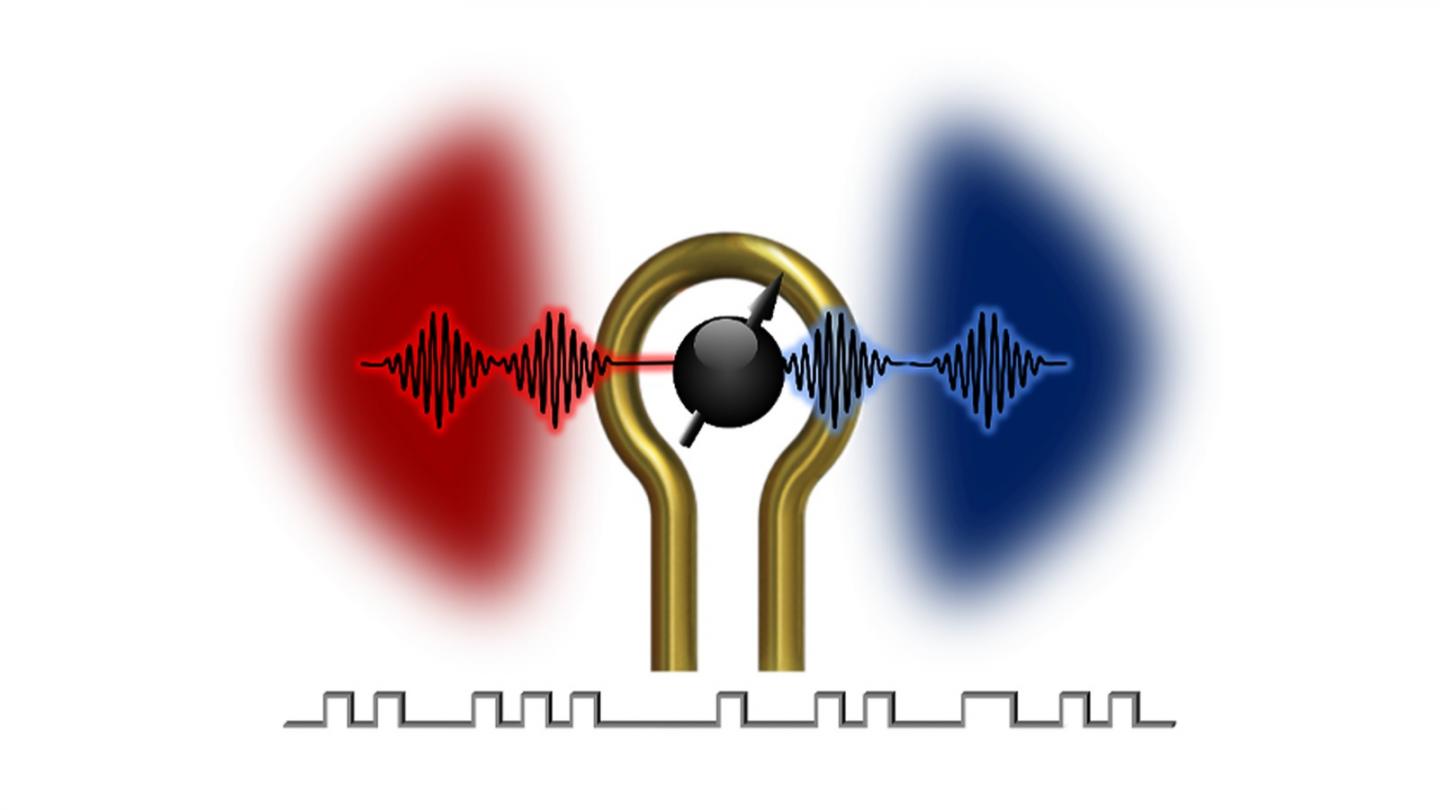
Credit: (Image by Xufeng Zhang, Argonne National Laboratory.)
Many of us swing through gates every day — points of entry and exit to a space like a garden, park or subway. Electronics have gates too. These control the flow of information from one place to another by means of an electrical signal. Unlike a garden gate, these gates require control of their opening and closing many times faster than the blink of an eye.
Scientists at the U.S. Department of Energy’s (DOE) Argonne National Laboratory and the University of Chicago’s Pritzker School of Molecular Engineering have devised a unique means of achieving effective gate operation with a form of information processing called electromagnonics. Their pivotal discovery allows real-time control of information transfer between microwave photons and magnons. And it could result in a new generation of classical electronic and quantum signal devices that can be used in various applications such as signal switching, low-power computing and quantum networking.
“Signal processing that couples spin waves and microwaves is a high-wire act. The signal must remain coherent despite dissipations and other outside effects threatening to throw the system into incoherence.” — Xufeng Zhang, assistant scientist in the Center for Nanoscale Materials
Microwave photons are elementary particles forming the electromagnetic waves employed in, for example, wireless communications. Magnons are the particle-like representatives of ?”spin waves.” That is, wave-like disturbances in an ordered array of microscopically aligned spins that occur in certain magnetic materials.
“Many research groups are combining different types of information carriers for information processing,” said Xufeng Zhang, assistant scientist in the Center for Nanoscale Materials, a DOE Office of Science User Facility at Argonne. “Such hybrid systems would enable practical applications that are not possible with information carriers of a single type.”
“Signal processing that couples spin waves and microwaves is a high-wire act,” added Zhang. “The signal must remain coherent despite energy dissipations and other outside effects threatening to throw the system into incoherence.”
Coherent gate operation (control over on, off and duration of the magnon-photon interaction) has been a long sought-after goal in hybrid magnonic systems. In principle, this can be achieved by rapid tuning of energy levels between the photon and magnon. However, such tuning has depended on changing the geometric configuration of the device. That typically requires much longer than the magnon lifetime — on the order of 100 nanoseconds (one-hundred billionths of a second). This lack of a rapid tuning mechanism for interacting magnons and photons has made it impossible to achieve any real-time gating control.
Using a novel method involving energy-level tuning, the team was able to rapidly switch between magnonic and photonic states over a period shorter than the magnon or photon lifetimes. This period is a mere 10 to 100 nanoseconds.
“We start by tuning the photon and magnon with an electric pulse so that they have the same energy level,” said Zhang. “Then, the information exchange starts between them and continues until the electric pulse is turned off, which shifts the energy level of the magnon away from that of the photon.”
By this mechanism, Zhang said, the team can control the flow of information so that it is all in the photon or all in the magnon or some place in between. This is made possible by a novel device design that allows nanosecond tuning of a magnetic field which controls the magnon energy level. This tunability allows the desired coherent gate operation.
This research points to a new direction for electromagnonics. Most importantly, the demonstrated mechanism not only works in the classical electronics regime, but can also be readily applied for manipulating magnonic states in the quantum regime. This opens opportunities for electromagnonics-based signal processing in quantum computing, communications and sensing.
###
This research was partially supported by the DOE Office of Basic Energy Sciences. It was reported in Physical Review Letters, in a paper titled “Coherent gate operations in hybrid magnonics.” In addition to Zhang, authors include Jing Xu, Changchun Zhong, Xu Han, Dafei Jin and Liang Jiang.
About Argonne’s Center for Nanoscale Materials
The Center for Nanoscale Materials is one of the five DOE Nanoscale Science Research Centers, premier national user facilities for interdisciplinary research at the nanoscale supported by the DOE Office of Science. Together the NSRCs comprise a suite of complementary facilities that provide researchers with state-of-the-art capabilities to fabricate, process, characterize and model nanoscale materials, and constitute the largest infrastructure investment of the National Nanotechnology Initiative. The NSRCs are located at DOE’s Argonne, Brookhaven, Lawrence Berkeley, Oak Ridge, Sandia and Los Alamos National Laboratories. For more information about the DOE NSRCs, please visit https:/
Argonne National Laboratory seeks solutions to pressing national problems in science and technology. The nation’s first national laboratory, Argonne conducts leading-edge basic and applied scientific research in virtually every scientific discipline. Argonne researchers work closely with researchers from hundreds of companies, universities, and federal, state and municipal agencies to help them solve their specific problems, advance America’s scientific leadership and prepare the nation for a better future. With employees from more than 60 nations, Argonne is managed by UChicago Argonne, LLC for the U.S. Department of Energy’s Office of Science.
The U.S. Department of Energy’s Office of Science is the single largest supporter of basic research in the physical sciences in the United States and is working to address some of the most pressing challenges of our time. For more information, visit https:/
Media Contact
Diana Anderson
[email protected]
Original Source
https:/
Related Journal Article
http://dx.