Credit: @Science China Press
In particle physics, a Majorana Fermion is charge neutral and its antiparticle is just itself. In condensed matter physics, a Majorana zero mode (MZM) is a quasi-particle excitation, which appears in the surfaces or edges of topological superconductors. Unlike the ordinary particles or quasi-particles that obey boson or fermion statistics, MZM obeys non-abelian statistics, a key property that makes MZM the building block for realizing topological quantum computation. Currently major experimental efforts focus on heterostructures made of superconductors and spin-orbit coupled systems (such as semiconducting nano-wires and topological insulators), where evidences of MZMs have been found. Unambiguous detection and manipulation of MZMs in these heterostructures, however, heavily rely on the superconducting proximity effect that suffers from the complexity of the interface. Furthermore, the low operation temperature of conventional superconducting materials complicates further manipulation of MZMs.
Iron-based superconductor was discovered in 2008 by the Japanese scientist Hideo Hosono as the second class of high-Tc materials. In the past decade, intensive studies focused on their unconventional superconductivity and strong correlation effect. Recently, the discovery of topological surface states on the surfaces of iron based superconductor Fe(Te,Se) renders it a unique system integrating both high-Tc superconductivity and topology. Therefore, it provides an exciting opportunity to realize MZM at comparably high critical temperature Tc. Moreover, the monolayer Fe(Te,Se) has a maximum Tc of 40 K and good tenability with a large in-plane upper critical field.
In a study published in Beijing-based National Science Review, a research team led by Chaoxing Liu, an associate professor from Pennsylvania State University, proposed to realize MZMs in monolayer Fe(Te,Se) by applying an in-plane magnetic field and electric gating.
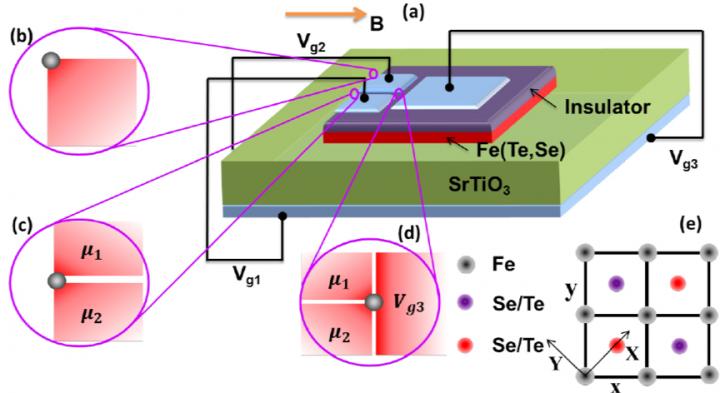
The researchers found that applying an in-plane magnetic field can drive monolayer Fe(Te,Se) into the higher-order topological superconducting phase, in which the MZMs can appear at the corners. Furthermore, through electric gating, MZM can also occur at the domain wall of chemical potentials at one edge and certain type of tri-junction in the two-dimensional bulk (see Figure). According to their estimation, the needed magnetic field is well below the in-plane upper critical magnetic field of monolayer Fe(Te,Se) superconductor. In addition, rotating the magnetic field may provide an efficient approach to perform the braiding operation for the corner MZMs. Therefore, their study demonstrates that monolayer Fe(Te,Se) is a promising Majorana platform with scalability and electrical tunability and within reach of contemporary experimental capability.
###
This research received funding from the Office of Naval Research 330 (Grant No.N00014-18-1-2793), the Kaufman New Initiative research grant of the Pittsburgh Foundation, the German Research Foundation (DFG) through DFG-SFB 1170, project B04 and the Wuerzburg-Dresden Cluster of Excellence on Complexity and Topology in Quantum Matter – ct.qmat (EXC 2147, project-id 39085490).
See the article:
Xianxin Wu, Xin Liu, Ronny Thomale and Chao-Xing Liu
High-Tc superconductor Fe(Se,Te) monolayer: an intrinsic, scalable and electrically tunable Majorana platform
Natl. Sci. Rev. (2021)
https:/
Media Contact
Chaoxing Liu
[email protected]
Original Source
http://doi.
Related Journal Article
http://dx.