• HOME
  • NEWS
  • EXPLORE
    • CAREER
      • Companies
      • Jobs
    • EVENTS
    • iGEM
      • News
      • Team
    • PHOTOS
    • VIDEO
    • WIKI
  • BLOG
  • COMMUNITY
    • FACEBOOK
    • INSTAGRAM
    • TWITTER
Sunday, May 10, 2026
BIOENGINEER.ORG
No Result
View All Result
  • Login
  • HOME
  • NEWS
  • EXPLORE
    • CAREER
      • Companies
      • Jobs
        • Lecturer
        • PhD Studentship
        • Postdoc
        • Research Assistant
    • EVENTS
    • iGEM
      • News
      • Team
    • PHOTOS
    • VIDEO
    • WIKI
  • BLOG
  • COMMUNITY
    • FACEBOOK
    • INSTAGRAM
    • TWITTER
  • HOME
  • NEWS
  • EXPLORE
    • CAREER
      • Companies
      • Jobs
        • Lecturer
        • PhD Studentship
        • Postdoc
        • Research Assistant
    • EVENTS
    • iGEM
      • News
      • Team
    • PHOTOS
    • VIDEO
    • WIKI
  • BLOG
  • COMMUNITY
    • FACEBOOK
    • INSTAGRAM
    • TWITTER
No Result
View All Result
Bioengineer.org
No Result
View All Result
Home NEWS Science News Chemistry

Seeing with radio waves

Bioengineer by Bioengineer
July 9, 2021
in Chemistry
Reading Time: 2 mins read
0
IMAGE
Share on FacebookShare on TwitterShare on LinkedinShare on RedditShare on Telegram

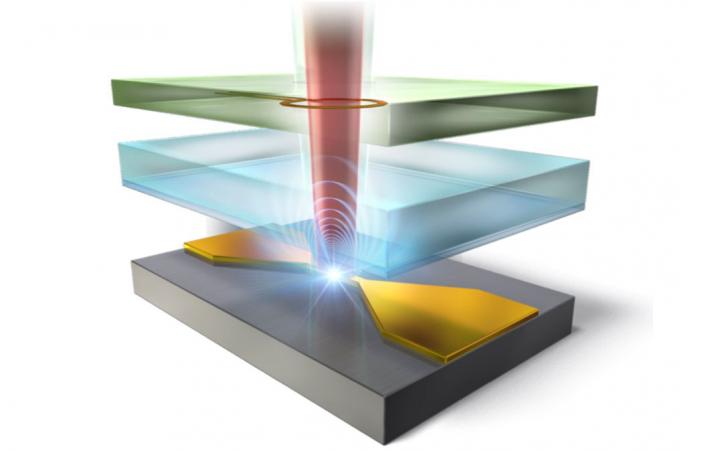
Researchers at the University of Tsukuba use radio-frequency waves to image “spin-locked” defects in diamond with record-breaking resolution, which may lead to advances in material characterization and quantum computing
IMAGE

Credit: University of Tsukuba

Tsukuba, Japan – Scientists from the Division of Physics at the University of Tsukuba used the quantum effect called “spin-locking” to significantly enhance the resolution when performing radio-frequency imaging of nitrogen-vacancy defects in diamond. This work may lead to faster and more accurate material analysis, as well as a path towards practical quantum computers.

Nitrogen-vacancy (NV) centers have long been studied for their potential use in quantum computers. A NV center is a type of defect in the lattice of a diamond, in which two adjacent carbon atoms have been replaced with a nitrogen atom and a void. This leaves an unpaired electron, which can be detected using radio-frequency waves, because its probability of emitting a photon depends on its spin state. However, the spatial resolution of radio wave detection using conventional radio-frequency techniques has remained less than optimal.

Now, researchers at the University of Tsukuba have pushed the resolution to its limit by employing a technique called “spin-locking.” Microwave pulses are used to put the electron’s spin in a quantum superposition of up and down simultaneously. Then, a driving electromagnetic field causes the direction of the spin to precess around, like a wobbling top. The end result is an electron spin that is shielded from random noise but strongly coupled to the detection equipment. “Spin-locking ensures high accuracy and sensitivity of the electromagnetic field imaging,” first author Professor Shintaro Nomura explains. Due to the high density of NV centers in the diamond samples used, the collective signal they produced could be easily picked up with this method. This permitted the sensing of collections of NV centers at the micrometer scale. “The spatial resolution we obtained with RF imaging was much better than with similar existing methods,” Professor Nomura continues, “and it was limited only by the resolution of the optical microscope we used.”

The approach demonstrated in this project may be applied in a broad variety of application areas–for example, the characterizations of polar molecules, polymers, and proteins, as well as the characterization of materials. It might also be used in medical applications–for example, as a new way to perform magnetocardiography.

###

The work is published in Journal of Applied Physics as “Near-field radio-frequency imaging by spin-locking with a nitrogen-vacancy spin sensor” selected as a Featured Article (DOI: 10.1063/5.0052161).

This work was partly supported by a Grant-in-Aid for Scientific Research (Nos. JP18H04283,
291 JP18H01243, JP18K18726, and JP21H01009) from the Japan Society for the Promotion of
292 Science.

Media Contact
Naoko Yamashina
[email protected]

Related Journal Article

http://dx.doi.org/10.1063/5.0052161

Tags: Atomic/Molecular/Particle PhysicsChemistry/Physics/Materials SciencesElectrical Engineering/ElectronicsNanotechnology/MicromachinesOpticsPolymer Chemistry
Share12Tweet8Share2ShareShareShare2

Related Posts

Miniature Sensor Uses Light to Detect Touch — Chemistry

Miniature Sensor Uses Light to Detect Touch

May 8, 2026
Iron Minerals Determine Whether Dissolved Organic Matter Fuels Microbes or Becomes Long-Term Carbon Storage — Chemistry

Iron Minerals Determine Whether Dissolved Organic Matter Fuels Microbes or Becomes Long-Term Carbon Storage

May 8, 2026

Kate Evans Appointed Associate Lab Director for Biological and Environmental Systems Science at ORNL

May 8, 2026

Advancing Multiscale Modeling and Overcoming Operational Challenges in Autothermal COâ‚‚-to-Methanol Reactors

May 8, 2026
Please login to join discussion

POPULAR NEWS

  • Research Indicates Potential Connection Between Prenatal Medication Exposure and Elevated Autism Risk

    840 shares
    Share 336 Tweet 210
  • New Study Reveals Plants Can Detect the Sound of Rain

    727 shares
    Share 290 Tweet 181
  • Scientists Investigate Possible Connection Between COVID-19 and Increased Lung Cancer Risk

    68 shares
    Share 27 Tweet 17
  • Salmonella Haem Blocks Macrophages, Boosts Infection

    61 shares
    Share 24 Tweet 15

About

We bring you the latest biotechnology news from best research centers and universities around the world. Check our website.

Follow us

Recent News

Evaluating Digoxin Use in Patients with Symptomatic Rheumatic Heart Disease

Evaluating the Effectiveness and Safety of Digitalis Glycosides in Treating Heart Failure

Urdu Fall Risk Questionnaire Adapted for Elderly

Subscribe to Blog via Email

Enter your email address to subscribe to this blog and receive notifications of new posts by email.

Join 82 other subscribers
  • Contact Us

Bioengineer.org © Copyright 2023 All Rights Reserved.

Welcome Back!

Login to your account below

Forgotten Password?

Retrieve your password

Please enter your username or email address to reset your password.

Log In
No Result
View All Result
  • Homepages
    • Home Page 1
    • Home Page 2
  • News
  • National
  • Business
  • Health
  • Lifestyle
  • Science

Bioengineer.org © Copyright 2023 All Rights Reserved.