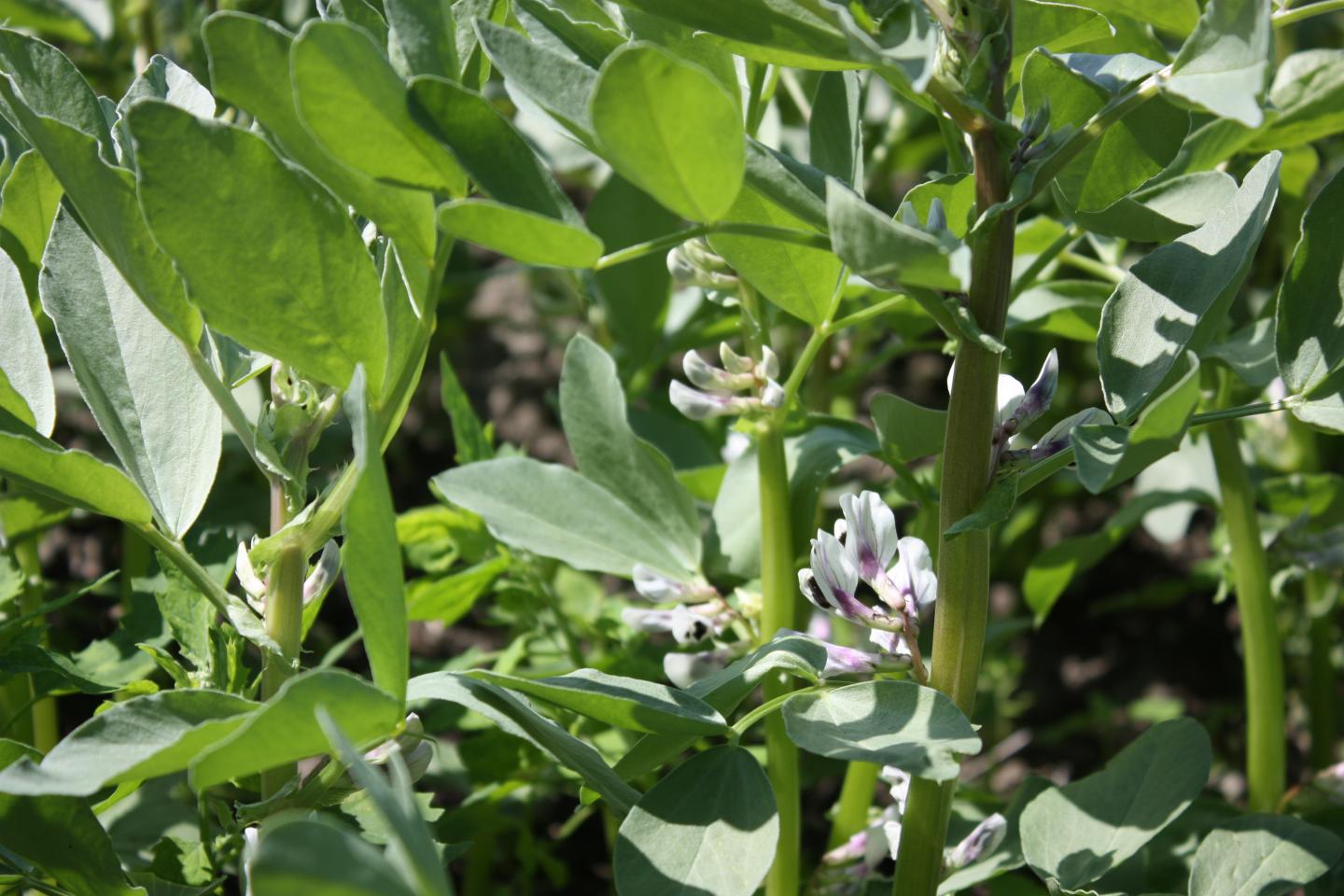
Credit: Fred Stoddard
Faba beans have been an excellent source of food protein since pre-historic times, but about 5% of people, mostly from regions where malaria has been endemic and who carry a certain mutation, can’t eat them. Now, an international team of researchers, led by the Universities of Helsinki and Copenhagen as well as Luke Natural Resources Institute Finland, has identified the gene responsible for the production of vicine and convicine, which are harmful to these people. In the work published in Nature Plants, the team reports that the VC1 gene plays a central role in the biosynthesis these compounds.
Faba beans – Pythagoras and his followers avoided them and Roman priests of Jupiter associated them with death. Today, we know that faba beans produce the anti-nutrients vicine and convicine, which cause a risk for favism – a condition arising from damage to red blood cells – for susceptible individuals. Anti-nutrients are plant compounds that reduce the body’s ability to absorb essential nutrients.
Among legumes – the pod-producing family of plants to which pea, bean, chickpea and soybean also belong – faba beans have the second-highest yield globally. They also have the highest seed protein content of the starch-containing legumes and out-perform soybean in cool climates. Faba beans are consequently a prime protein source for facilitating a global switch to a plant-based diet, considered necessary for significant reductions in carbon emissions.
However, when people deficient in a specific enzyme eat a large portion of uncooked faba beans, the vicine and convicine can cause their red blood cells to burst. The resultant hemolytic anemia, known as favism, has inevitably limited the potential use of faba beans. Although there are a number of faba bean varieties with low levels of vicine and convicine, the gene responsible for this trait was previously unknown. Alan Schulman, one of project leaders and running a joint Luke and University of Helsinki lab, says, “It seems that the ancient Greeks and Romans must have been aware of the occasional serious illness caused by faba beans. It took until today to unlock the secret of that risk.”
Now, the scientists have identified the gene responsible for vicine-convicine content. What is more, they have identified the specific mutation within this gene that causes the reduction in synthesis. They found that all faba bean varieties with a low vicine-convicine content, descended from a single accession found in a genebank. It had two nucleotides – the “letters” that make up DNA – inserted within the VC1 gene. This insertion disrupts VC1 function and is the only known genetic source of low vicine and convicine content.
A promise of a sustainable protein-rich food that everyone can eat
This research paves the way for the complete description of the biosynthetic pathway of vicine and convicine, and ultimately for breeding, production and commercial use of faba bean varieties totally free from these anti-nutritional compounds. The team, comprising leading scientists from Denmark, Finland, Germany, the UK and Canada, are already looking to the future. Fred Stoddard from the University of Helsinki, another of the project leaders, says “Faba beans are an old crop, and now offer new promise as a sustainable protein-rich food that everyone can eat.”
###
Media Contact
Alan Schulman
[email protected]
Original Source
https:/
Related Journal Article
http://dx.