An international research team led by a researcher from the University of Tsukuba proposes that catering to different visitors has influenced flower evolution
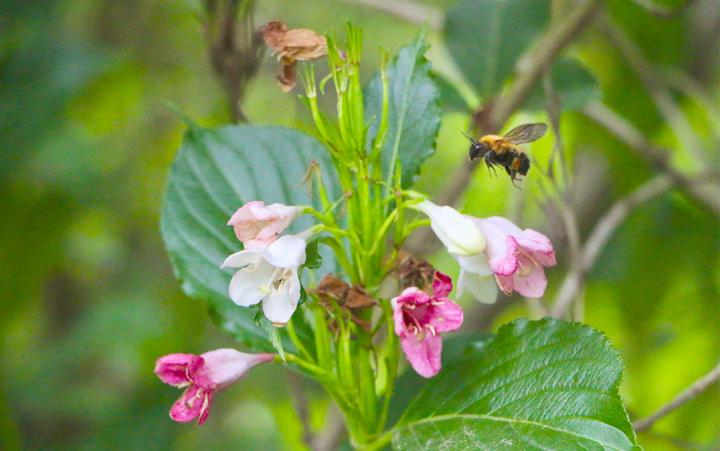
Credit: University of Tsukuba
Ibaraki, Japan – Flowers come in a multitude of shapes and colors. Now, an international research team led by a researcher from Japan has proposed the novel hypothesis that trade-offs caused by different visitors may play an important role in shaping this floral diversity.
In a study published last month, the team explored how the close associations between flowers and the animals that visit them influence flower evolution.
Visitors to flowers may be beneficial, like pollinators, or detrimental, like pollen thieves. All of these visitors interact with flowers in different ways and exert different selection pressures on flower traits such as color and scent. For example, a scent that attracts one pollinator may deter other potential pollinators. In this case, the flower would be expected to cater to the best pollinator.
“On the basis of this theory, you’d expect that flowers would mostly be visited by one particular group of pollinators,” says lead author of the study, Professor Kazuharu Ohashi. “But flowers often host many different visitors at the same time and flowers appear to meet the needs of multiple visitors. The question we wanted to answer is how this happens in nature.”
Balancing the demands of multiple visitors involves trade-offs. For example, diurnal bees and nocturnal moths can both pollinate goat willow but prefer different smells. A floral scent adapted to only one of these animals would mean missed opportunities for pollination by the other. To see how these types of visitor-mediated trade-offs affect the evolution of flowers, the researchers developed a conceptual framework to examine the different types of trade-offs and how flowers might adapt. They then looked at previous studies of flower-animal interactions to see whether the research supported the proposed framework.
What they found was a variety of strategies for mitigating trade-offs. In the case of goat willow, flowers produce different scents during the day and night, and therefore attract both types of pollinator. Another example is floral color change as a strategy to attract both bees and flies. Retaining old flowers could attract opportunistic foragers like flies, while repelling smart foragers like bees. The color change in flowers as they age could reduce this trade-off by allowing bees to select young, rewarding flowers. Many other strategies were noted, all of which involved acquiring novel combinations of traits to attract, or exclude, different visitors.
“Most flowers are ecologically generalized and the assumption to date has been that this is a suboptimal solution,” explains Professor Ohashi. “But our findings suggest that interactions with multiple animals can actually be optimized by minimizing trade-offs in various ways, and such evolutionary processes may have enriched the diversity of flowers.”
The discrepancy between observed flower visitors and those predicted on the basis of a flower’s traits has long been a topic of debate. Taking visitor-mediated trade-offs into account in future studies of flower evolution may help settle that argument.
###
The article, “Trade-off mitigation: a conceptual framework for understanding floral adaptation in multispecies interactions,” was published in Biological Reviews at DOI:10.1111/brv.12754
Media Contact
Naoko Yamashina
[email protected]
Related Journal Article
http://dx.