Scientists from Helmholtz Zentrum München revise the current textbook knowledge about gastrulation, the formation of the basic body plan during embryonic development. Their study in mice has implications for cell replacement strategies and cancer research.
Gastrulation is the formation of the three principal germ layers – endoderm, mesoderm and ectoderm. Understanding the formation of the basic body plan is not only important to reveal how the fertilized egg gives rise to an adult organism, but also how congenital diseases arise. In addition, gastrulation serves as the basis to understand processes during embryonic development called epithelial-to-mesenchymal transition which is known to lead to cancer metastasis in adulthood when dysregulated.
“The famous biologist Lewis Wolpert once said that it is not birth, marriage or death, but gastrulation which is truly the most important time of our life. However, there are many things we still don’t know about this phenomenon,” says study leader Heiko Lickert.
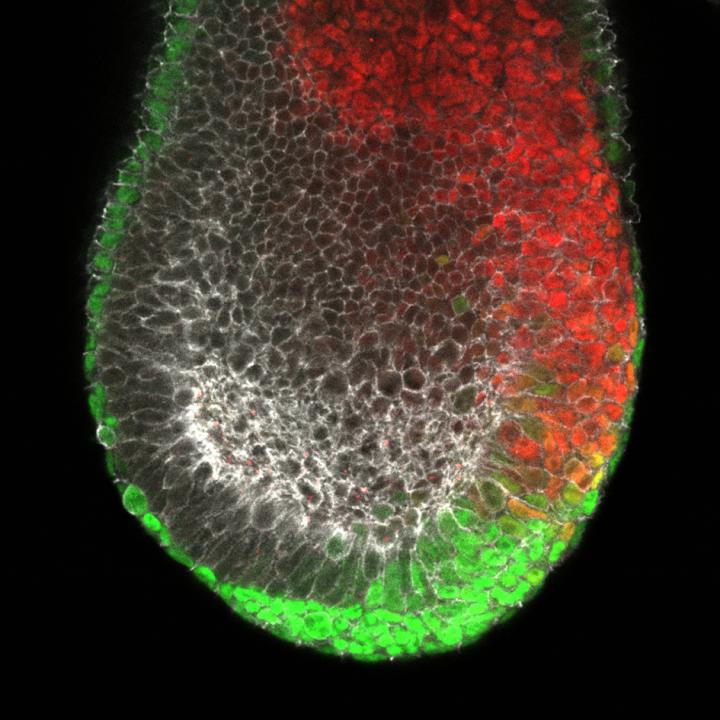
In a new study, researchers could show that the formation of the endoderm germ layer is driven by a different mechanism than it has been assumed for a long time. In contrast to the mesoderm, which undergoes an epithelial-to-mesenchymal transition, the endoderm forms independent of this process. The researchers revealed that its formation is regulated by mechanisms of epithelial cell plasticity that allows cells to leave an epithelium and migrate away. During this process, a gene regulatory protein shields the endoderm from undergoing a mesenchymal transition.
A better understanding of endoderm formation has the potential to advance cell replacement therapy (by improving stem cell differentiation into endoderm in vitro). Moreover, epithelial cell plasticity might be an alternative mechanism of cancer cell metastasis and further studies could identify novel targets for therapeutic intervention.
“Our study has not only revealed further details of germ layer formation, but also has broader implications for stem cell differentiation and cancer metastasis of the most common and deadliest cancers worldwide,” explains first author Katharina Scheibner.
###
About the people
Heiko Lickert is Director of the Institute for Diabetes and Regeneration Research at Helmholtz Zentrum München, Professor of Beta Cell Biology at Technical University of Munich (TUM) and researcher at the German Center for Diabetes Research (DZD). Katharina Scheibner is a Postdoc at Helmholtz Zentrum München who shared first-authorship with Silvia Engert and Ingo Burtscher.
Helmholtz Zentrum München
Helmholtz Zentrum München is a research center with the mission to discover personalized medical solutions for the prevention and therapy of environmentally-induced diseases and promote a healthier society in a rapidly changing world. It investigates major diseases which develop from the interaction of lifestyle, environmental factors and personal genetic background, focusing particularly on diabetes mellitus, allergies and chronic lung diseases. Helmholtz Zentrum München is headquartered in Neuherberg in the north of Munich and has about 2,500 staff members. It is a member of the Helmholtz Association, the largest scientific organization in Germany with more than 43,000 employees at 18 research centers.
Media Contact
Communications Department
[email protected]
Original Source
https:/
Related Journal Article
http://dx.