• HOME
  • NEWS
  • EXPLORE
    • CAREER
      • Companies
      • Jobs
    • EVENTS
    • iGEM
      • News
      • Team
    • PHOTOS
    • VIDEO
    • WIKI
  • BLOG
  • COMMUNITY
    • FACEBOOK
    • INSTAGRAM
    • TWITTER
Saturday, February 7, 2026
BIOENGINEER.ORG
No Result
View All Result
  • Login
  • HOME
  • NEWS
  • EXPLORE
    • CAREER
      • Companies
      • Jobs
        • Lecturer
        • PhD Studentship
        • Postdoc
        • Research Assistant
    • EVENTS
    • iGEM
      • News
      • Team
    • PHOTOS
    • VIDEO
    • WIKI
  • BLOG
  • COMMUNITY
    • FACEBOOK
    • INSTAGRAM
    • TWITTER
  • HOME
  • NEWS
  • EXPLORE
    • CAREER
      • Companies
      • Jobs
        • Lecturer
        • PhD Studentship
        • Postdoc
        • Research Assistant
    • EVENTS
    • iGEM
      • News
      • Team
    • PHOTOS
    • VIDEO
    • WIKI
  • BLOG
  • COMMUNITY
    • FACEBOOK
    • INSTAGRAM
    • TWITTER
No Result
View All Result
Bioengineer.org
No Result
View All Result
Home NEWS Science News Health

A key player in cell death moonlights as a mediator of inflammation

Bioengineer by Bioengineer
September 6, 2025
in Health
Reading Time: 2 mins read
0
IMAGE
Share on FacebookShare on TwitterShare on LinkedinShare on RedditShare on Telegram

Researchers from Kanazawa University find that gasdermin D, a protein known to be involved in cell death, is also crucial for activation and release of the key immune mediator interleukin-1α

Kanazawa, Japan – Interluekin-1α (IL-1α) is an important part of the immune response, but until now it has been unclear how this molecule is processed from its precursor, pro-IL-1α, and exits the cell during inflammasome activation. Now, researchers from Japan have found that gasdermin D, a protein that was already known to mediate pyroptosis, a form of regulated cell death, plays a crucial role in the maturation and release of IL-1α.

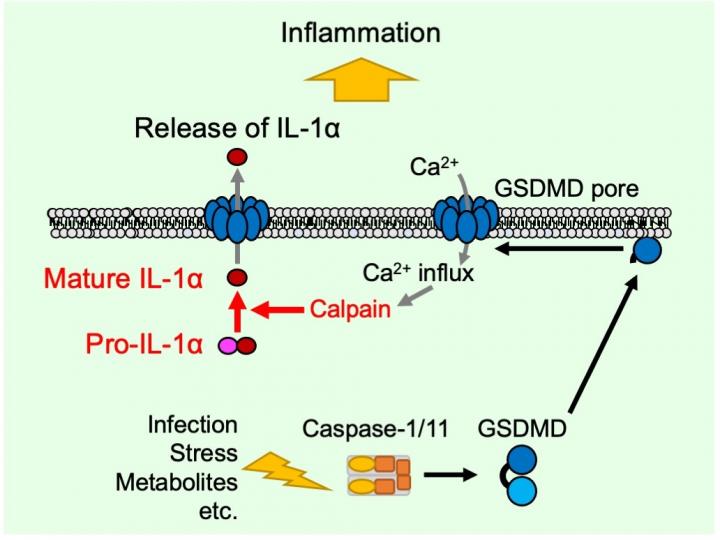
In a study published in March in Cell Reports, researchers from Kanazawa University report that, when the inflammasome (a part of the innate immune system) is activated, gasdermin D forms pores in the cell membrane that allow factors from outside of the cell to flow in, leading to the activation and release of mature IL-1α.

Previous work has shown that inflammasome activation leads to gasdermin D being cut in two by an enzyme, and that one half of the cut protein forms membrane pores. This leads to pyroptosis whereby the pores let water into the cells, causing them to swell and burst.

“We knew that caspase-1 cleaves gasdermin D, and that this enzyme is also important for IL-1α activation,” says lead author of the study Kohsuke Tsuchiya. “We therefore suspected that gasdermin D might be involved in the pathway leading to IL-1α release.”

To test this possibility, the researchers deleted the gene encoding gasdermin D, and found that this almost completely eliminated IL-1α exit from the cells. Unexpectedly, though, they also saw that virtually no mature IL-1α was present inside these cells.

“This made us think that gasdermin D is important not only for IL-1α release, but also IL-1α maturation,” explains Takashi Suda, lead author of the study. “When we looked into this in more detail, we found that gasdermin D did not need to cause cell lysis for these effects to take place. Instead, only its ability to form pores in the membrane was required for both IL-1α maturation and release.”

The researchers went on to show that pore formation by gasdermin D allows calcium influx and activation of calpains (a type of proteases), which promotes processing of the pro-IL-1α precursor into mature IL-1α maturation.

“Our findings provide the missing link between caspase-1 activity and IL-1α maturation,” says Tsuchiya.

Given that inflammasome activation is a key element of both inflammatory diseases and the response to infection, this study provides important insight into essential functions of the human immune system. Identifying gasdermin D as a regulator of immune function as well as cell death increases our understanding of how inflammasome activation ultimately leads to IL-1α release from immune cells.

###

Media Contact
Tomoya Sato
[email protected]

Related Journal Article

http://dx.doi.org/10.1016/j.celrep.2021.108887

Tags: BiologyCell BiologyImmunology/Allergies/AsthmaMicrobiologyMolecular Biology
Share12Tweet8Share2ShareShareShare2

Related Posts

Decoding Prostate Cancer Origins via snFLARE-seq, mxFRIZNGRND

February 7, 2026

Digital Health Perspectives from Baltic Sea Experts

February 7, 2026

Exploring Decision-Making in Dementia Caregivers’ Mobility

February 7, 2026

Succinate Receptor 1 Limits Blood Cell Formation, Leukemia

February 7, 2026
Please login to join discussion

POPULAR NEWS

  • Robotic Ureteral Reconstruction: A Novel Approach

    Robotic Ureteral Reconstruction: A Novel Approach

    82 shares
    Share 33 Tweet 21
  • Digital Privacy: Health Data Control in Incarceration

    63 shares
    Share 25 Tweet 16
  • Study Reveals Lipid Accumulation in ME/CFS Cells

    57 shares
    Share 23 Tweet 14
  • Breakthrough in RNA Research Accelerates Medical Innovations Timeline

    53 shares
    Share 21 Tweet 13

About

We bring you the latest biotechnology news from best research centers and universities around the world. Check our website.

Follow us

Recent News

Decoding Prostate Cancer Origins via snFLARE-seq, mxFRIZNGRND

Digital Health Perspectives from Baltic Sea Experts

Florida Cane Toad: Complex Spread and Selective Evolution

Subscribe to Blog via Email

Enter your email address to subscribe to this blog and receive notifications of new posts by email.

Join 73 other subscribers
  • Contact Us

Bioengineer.org © Copyright 2023 All Rights Reserved.

Welcome Back!

Login to your account below

Forgotten Password?

Retrieve your password

Please enter your username or email address to reset your password.

Log In
No Result
View All Result
  • Homepages
    • Home Page 1
    • Home Page 2
  • News
  • National
  • Business
  • Health
  • Lifestyle
  • Science

Bioengineer.org © Copyright 2023 All Rights Reserved.