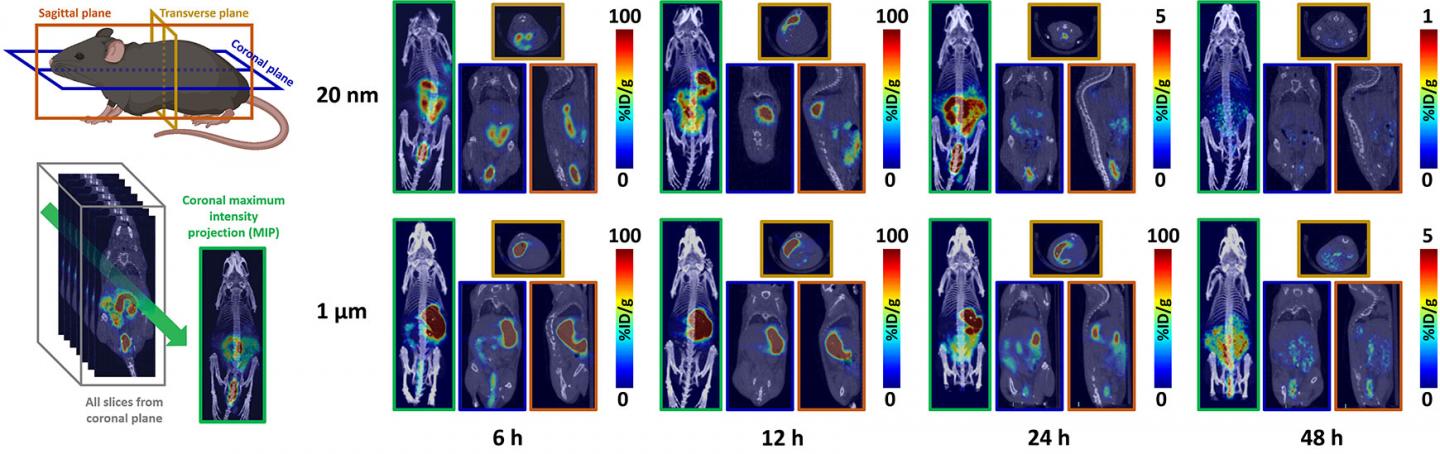
Postdoctoral Researcher Outi Keinänen from the University of Helsinki developed a method to radiolabel plastic particles in order to observe their biodistribution on the basis of radioactivity with the help of positron emission tomography (PET). As a radiochemist, Keinänen has in her previous radiopharmaceutical studies utilised PET imaging combined with computed tomography (CT), which produces a very accurate image of the anatomical location of the radioactivity signal.
In the recently completed study, radiolabelled plastic particles were fed to mice, and their elimination from the body was followed with PET-CT scans. This was the first time that the movement and location of plastic particles in a living mammalian system were observed in real time.
The study utilised polystyrene particles of four different sizes: 20 nm, 220 nm, 1 μm and 6 μm. The journey of the radiolabelled plastic particles through the gastrointestinal tract was followed for two days (48 hours) through PET-CT scans.
The study, which was recently published in Scientific Reports journal, demonstrated that most of the particles had been eliminated from the mice naturally, through faeces within two days. Not much translocation of plastic particles from the gastrointestinal tract to elsewhere in the body was seen, and the smallest particles were eliminated from the body at a faster rate than the larger ones.
In addition to PET imaging, the findings were verified by thoroughly measuring the radioactivity of the tissues and organs of the mice. The persistence of the radiolabel on the surface of the plastic particles was verified by collecting murine gastrointestinal tracts at several different time points after administering the particles. The gastrointestinal tracts of mice that were put down at different timepoints were cut open, ground and separated into several fractions based on size. The share of the non-attached radiolabel was very small compared to the radiolabel still attached to the plastic particles. This was proof that the monitored radiation signal described the passage of the plastic particles well.
First and foremost, the study surveyed the usefulness of PET imaging in the study of micro- and nanoplastics, demonstrating that PET imaging enables accurate and non-invasive observation of plastic particles in living animals. Consequently, PET imaging may well become an important element of investigations into the health effects of plastics on mammals.
“While only a single small dose of polystyrene particles was fed to the mice, people are exposed daily to a range of micro- and nanoplastics. Therefore, we cannot draw direct conclusions on the accumulation of plastics in mammals and their effects on the basis of this study alone,” Keinänen notes.
“In addition to ingesting plastics, the air we breathe contains small particles of plastic. Further studies are in fact in the pipeline,” Keinänen promises.
Next up, the researchers wish to investigate the long-term consequences of daily exposure to micro- and nanoplastics, as well as the accumulation of inhaled plastic particles in mice. In future projects, the aim is to use different plastic materials in addition to polystyrene, the type of plastic used in this study.
###
Article:
Keinänen, O., Dayts, E.J., Rodriguez, C. et al. Harnessing PET to track micro- and nanoplastics in vivo. Scientific Reports 11, 11463 (2021). https:/
Further information:
Outi Keinänen, postdoctoral researcher
University of Helsinki
phone: +1 347 254 0421
email: [email protected]
Media Contact
Riitta-Leena Inki
[email protected]
Original Source
https:/
Related Journal Article
http://dx.