Humans can do lots of things that plants can’t do. We can walk around, we can talk, we can hear and see and touch. But plants have one major advantage over humans: They can make energy directly from the sun.
That process of turning sunlight directly into usable energy – called photosynthesis – may soon be a feat humans are able to mimic to harness the sun’s energy for clean, storable, efficient fuel. If so, it could open a whole new frontier of clean energy. Enough energy hits the earth in the form of sunlight in one hour to meet all human civilization’s energy needs for an entire year.
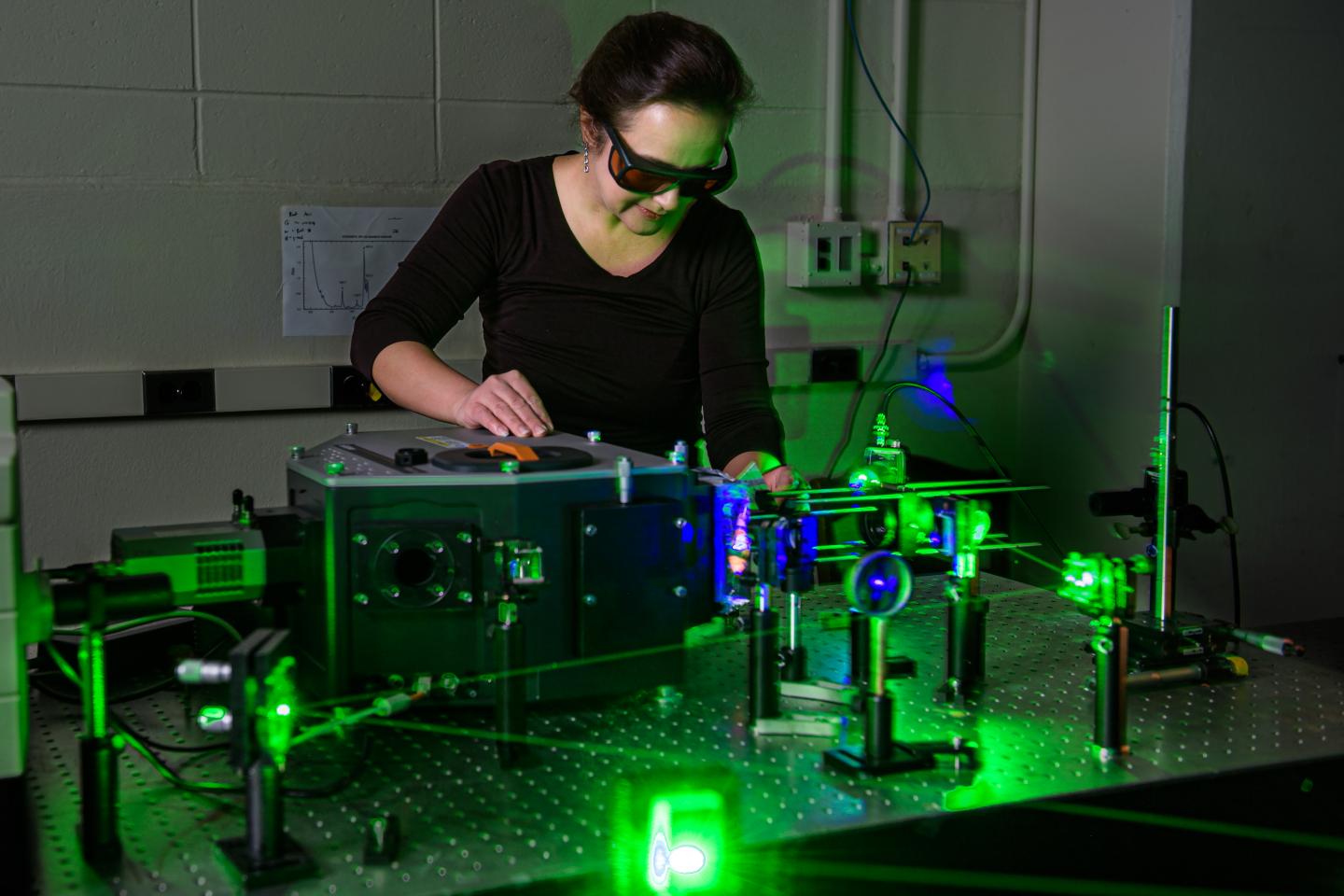
Yulia Puskhar, a biophysicist and professor of physics in Purdue’s College of Science, may have a way to harness that energy by mimicking plants.
Wind power and solar power, harnessed by photovoltaic cells, are the two major forms of clean energy available. Adding a third — synthetic photosynthesis — would dramatically change the renewable energy landscape. The ability to store the energy easily, without requiring bulky batteries, would dramatically improve humans’ ability to power society cleanly and efficiently.
Both wind turbines and photovoltaics have downside in terms of environmental effects and complicating factors. Pushkar hopes that artificial photosynthesis might be able to bypass those pitfalls.
“We and other researchers around the world are working incredibly hard to try to come up with accessible energy,” Pushkar said. “Energy that is clean and sustainable that we can create with nontoxic, easily available elements. Our artificial photosynthesis is the way forward.”
Photosynthesis is a complex dance of processes whereby plants convert the sun’s radiance and water molecules into usable energy in the form of glucose. To do this, they use a pigment, usually the famous chlorophyll, as well as proteins, enzymes and metals.
The closest process to artificial photosynthesis humans have today is photovoltaic technology, where a solar cell converts the sun’s energy into electricity. That process is famously inefficient, able to capture only about 20% of the sun’s energy. Photosynthesis, on the other hand, is radically more efficient; it is capable of storing 60% of the sun’s energy as chemical energy in associated biomolecules.
The efficiency of simple photovoltaic cells – solar panels – is limited by semiconductors’ ability to absorb light energy and by the cell’s ability to produce power. That limit is something scientists could surpass with synthetic photosynthesis.
“With artificial photosynthesis, there are not fundamental physical limitations,” Pushkar said. “You can very easily imagine a system that is 60% efficient because we already have a precedent in natural photosynthesis. And if we get very ambitious, we could even envision a system of up to 80% efficiency.
“Photosynthesis is massively efficient when it comes to splitting water, a first step of artificial photosynthesis. Photosystems II proteins in plants do this a thousand times a second. Blink, and it’s done.”
Pushkar’s group is mimicking the process by building her own artificial leaf analog that collects light and splits water molecules to generate hydrogen. Hydrogen can be used as a fuel by itself via fuel cells or be added to other fuels such as natural gas, or built into fuel cells to power everything from vehicles to houses to small electronic devices, laboratories and hospitals. Her most recent discovery, an insight into the way water molecules split during photosynthesis, was recently published in the journal Chem Catalysis: Cell Press.
Scientists in Pushkar’s lab experiment with natural photosystem II proteins and synthetic catalysts combinations in attempts to understand what works best – and why. She also puts a priority on using compounds and chemicals that are readily abundant on Earth, easily accessible and nontoxic to the planet.
Progress in artificial photosynthesis is complicated, though, by the fact that photosynthesis is so multifaceted, a fact bemoaned by biochemistry students everywhere.
“The reaction is very complex,” Pushkar said. “The chemistry of splitting water molecules is extremely intricate and difficult.”
Scientists have been working on artificial photosynthesis since the 1970s. That’s a long time, but not when you remember that photosynthesis took millions of years to evolve. Not only that, but scientists believe that, unlike flight, communication or intelligence, photosynthesis has evolved only once – about 3 billion years ago, only about 1.5 billion years into Earth’s existence.
Pushkar posits that within the next 10-15 years, enough progress will have been made that commercial artificial photosynthesis systems may begin to come online. Her research is funded by the National Science Foundation.
###
About College of Science
Purdue University’s College of Science is committed to the persistent pursuit of the mathematical and scientific knowledge that forms the very foundation of innovation. Nearly 350 tenure-track faculty conduct world-changing research and deliver a transformative education to more than 1,200 graduate students and 4,300 undergraduates. The college is a community of learners that develops practical solutions to today’s toughest challenges with degree programs in the life sciences, physical sciences, computational sciences, mathematics and data science.
About Purdue University
Purdue University is a top public research institution developing practical solutions to today’s toughest challenges. Ranked the No. 5 Most Innovative University in the United States by U.S. News & World Report, Purdue delivers world-changing research and out-of-this-world discovery. Committed to hands-on and online, real-world learning, Purdue offers a transformative education to all. Committed to affordability and accessibility, Purdue has frozen tuition and most fees at 2012-13 levels, enabling more students than ever to graduate debt-free. See how Purdue never stops in the persistent pursuit of the next giant leap at https:/
Media Contact
Brittany Steff
[email protected]
Original Source
https:/
Related Journal Article
http://dx.