• HOME
  • NEWS
  • EXPLORE
    • CAREER
      • Companies
      • Jobs
    • EVENTS
    • iGEM
      • News
      • Team
    • PHOTOS
    • VIDEO
    • WIKI
  • BLOG
  • COMMUNITY
    • FACEBOOK
    • INSTAGRAM
    • TWITTER
Saturday, February 7, 2026
BIOENGINEER.ORG
No Result
View All Result
  • Login
  • HOME
  • NEWS
  • EXPLORE
    • CAREER
      • Companies
      • Jobs
        • Lecturer
        • PhD Studentship
        • Postdoc
        • Research Assistant
    • EVENTS
    • iGEM
      • News
      • Team
    • PHOTOS
    • VIDEO
    • WIKI
  • BLOG
  • COMMUNITY
    • FACEBOOK
    • INSTAGRAM
    • TWITTER
  • HOME
  • NEWS
  • EXPLORE
    • CAREER
      • Companies
      • Jobs
        • Lecturer
        • PhD Studentship
        • Postdoc
        • Research Assistant
    • EVENTS
    • iGEM
      • News
      • Team
    • PHOTOS
    • VIDEO
    • WIKI
  • BLOG
  • COMMUNITY
    • FACEBOOK
    • INSTAGRAM
    • TWITTER
No Result
View All Result
Bioengineer.org
No Result
View All Result
Home NEWS Science News

Oddly shaped immune cells cause fibrosis

Bioengineer by Bioengineer
December 22, 2016
in Science News
Reading Time: 2 mins read
0
Share on FacebookShare on TwitterShare on LinkedinShare on RedditShare on Telegram
IMAGE

Credit: Osaka University

Scientists at the Immunology Frontier Research Center (IFReC) at Osaka University, Japan, report a new group of monocytes they call SatM. Studies in mice show that SatM may be responsible for causing fibrosis and creates a new drug target for an ailment that has little effective therapies.

Fibrosis is a form of scarring that could if uncontrolled cause deleterious thickening of tissues. Although it is known that fibrosis is caused by an activated immune system, which specific cells are responsible continuous to elude researchers.

Scientists at IFReC may have found this subgroup, as they report in Nature a class of monocyte cells with strange morphology. "The cells had a bi-lobed segmented nuclear shape and many cytoplasmic granules. We therefore called them 'Segregated nucleus atypical monocytes (SatM)'", said IFReC Professor Shizuo Akira.

To identify this subgroup, the researchers looked at immune cell subpopulations that predominantly appeared in fibrosis. "These cells were regulated by C/EBPβ," observed Akira.

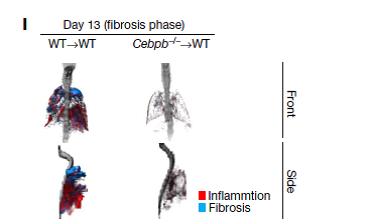
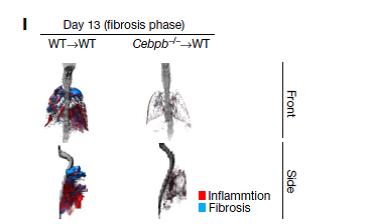
Detailed examination of immune cells showed that the C/EBPβ mutant mice, unlike normal mice, produced no SatM, whereas no other observed immune cell population was changed. The mice were also significantly more resistant to fibrosis. On the other hand, when the mutant mice were exposed to SatM, their susceptibility to fibrosis rose.

Although Dr. Akira, Dr. Satoh and his colleagues describe SatM as a subset of monocytes, SatM showed characteristics that suggested they were hybrids of different immune cells. According to Akira, gene analysis found SatM "showed granulocyte markers, but SatM are definitely not granulocytes. These cell type is one of monocyte."

Additional study found the progenitor cells responsible for producing SatM. Adoptive transfer of these progenitors into mutant mice unable to produce SatM resulted in a SatM population, and C/EBPβ was found to be essential for maintaining the progenitors.

The ability to isolate cells specifically related to fibrosis gives hope for new therapies.

"Decades of research have shown that immune cells are extremely diverse," said Akira. "Clear definitions of the subpopulations are essential for properly diagnosing and treating diseases. Our discovery of SatM should improve therapeutic strategies against fibrosis."

###

Media Contact

Saori Obayashi
[email protected]
81-661-055-886
@osaka_univ_e

http://www.osaka-u.ac.jp/en

############

Story Source: Materials provided by Scienmag

Share12Tweet8Share2ShareShareShare2

Related Posts

Boosting Remote Healthcare: Stepped-Wedge Trial Insights

February 7, 2026

Barriers and Boosters of Seniors’ Physical Activity in Karachi

February 7, 2026

Evaluating Pediatric Emergency Care Quality in Ethiopia

February 7, 2026

TPMT Expression Predictions Linked to Azathioprine Side Effects

February 7, 2026
Please login to join discussion

POPULAR NEWS

  • Robotic Ureteral Reconstruction: A Novel Approach

    Robotic Ureteral Reconstruction: A Novel Approach

    82 shares
    Share 33 Tweet 21
  • Digital Privacy: Health Data Control in Incarceration

    63 shares
    Share 25 Tweet 16
  • Study Reveals Lipid Accumulation in ME/CFS Cells

    57 shares
    Share 23 Tweet 14
  • Breakthrough in RNA Research Accelerates Medical Innovations Timeline

    53 shares
    Share 21 Tweet 13

About

We bring you the latest biotechnology news from best research centers and universities around the world. Check our website.

Follow us

Recent News

Boosting Remote Healthcare: Stepped-Wedge Trial Insights

Barriers and Boosters of Seniors’ Physical Activity in Karachi

Evaluating Pediatric Emergency Care Quality in Ethiopia

Subscribe to Blog via Email

Enter your email address to subscribe to this blog and receive notifications of new posts by email.

Join 73 other subscribers
  • Contact Us

Bioengineer.org © Copyright 2023 All Rights Reserved.

Welcome Back!

Login to your account below

Forgotten Password?

Retrieve your password

Please enter your username or email address to reset your password.

Log In
No Result
View All Result
  • Homepages
    • Home Page 1
    • Home Page 2
  • News
  • National
  • Business
  • Health
  • Lifestyle
  • Science

Bioengineer.org © Copyright 2023 All Rights Reserved.