• HOME
  • NEWS
  • EXPLORE
    • CAREER
      • Companies
      • Jobs
    • EVENTS
    • iGEM
      • News
      • Team
    • PHOTOS
    • VIDEO
    • WIKI
  • BLOG
  • COMMUNITY
    • FACEBOOK
    • INSTAGRAM
    • TWITTER
Thursday, June 25, 2026
BIOENGINEER.ORG
No Result
View All Result
  • Login
  • HOME
  • NEWS
  • EXPLORE
    • CAREER
      • Companies
      • Jobs
        • Lecturer
        • PhD Studentship
        • Postdoc
        • Research Assistant
    • EVENTS
    • iGEM
      • News
      • Team
    • PHOTOS
    • VIDEO
    • WIKI
  • BLOG
  • COMMUNITY
    • FACEBOOK
    • INSTAGRAM
    • TWITTER
  • HOME
  • NEWS
  • EXPLORE
    • CAREER
      • Companies
      • Jobs
        • Lecturer
        • PhD Studentship
        • Postdoc
        • Research Assistant
    • EVENTS
    • iGEM
      • News
      • Team
    • PHOTOS
    • VIDEO
    • WIKI
  • BLOG
  • COMMUNITY
    • FACEBOOK
    • INSTAGRAM
    • TWITTER
No Result
View All Result
Bioengineer.org
No Result
View All Result
Home NEWS Science News Biology

Binding of a second CO molecule observed

Bioengineer by Bioengineer
September 6, 2025
in Biology
Reading Time: 2 mins read
0
IMAGE
Share on FacebookShare on TwitterShare on LinkedinShare on RedditShare on Telegram

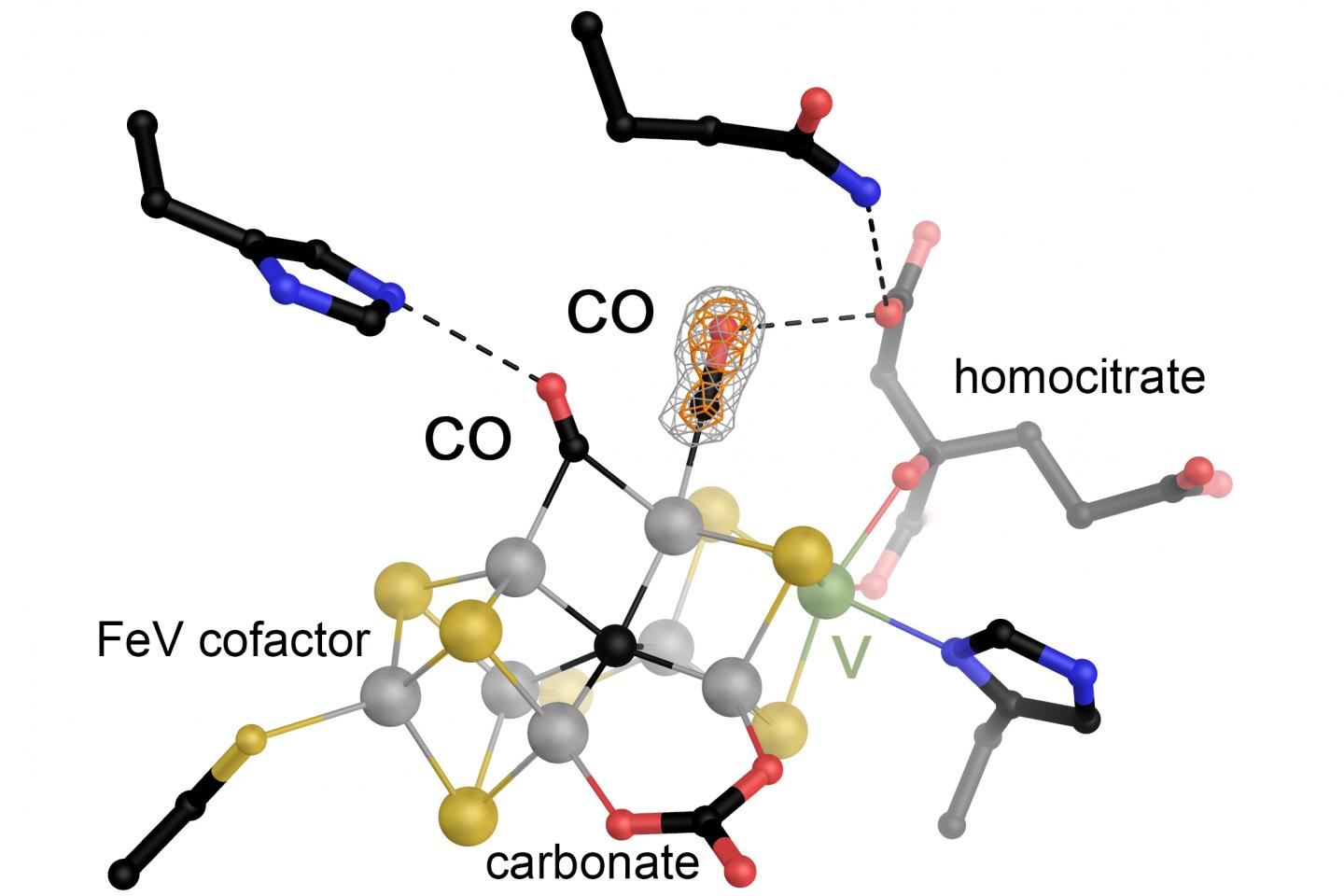
Through the biological fixation of the element nitrogen by the enzyme nitrogenase, organisms gain access to molecular nitrogen (N2) in the Earth’s atmosphere, which is essential for building cellular structures. In addition, a vanadium-dependent variant of nitrogenase can reduce the toxic gas carbon monoxide (CO) to hydrocarbons. These reductions of N2 and CO are among the most important processes in industrial chemistry, as they are used to produce both fertilizers and synthetic fuels. However, researchers have not yet been able to decipher the different pathways of the two reactions. Dr. Michael Rohde from Prof. Dr. Oliver Einsle’s team at the Institute of Biochemistry at the University of Freiburg, in collaboration with two research groups at Freie Universität Berlin, has now been able to show how the active site of the vanadium-dependent nitrogenase is able to bind two CO molecules simultaneously, thereby creating the basis for combining the spatially adjacent carbon atoms of both molecules in a reductive process. The researchers recently presented their results in the journal Science Advances.

The industrial reductions of N2 and CO – known as the Haber-Bosch and Fischer-Tropsch processes, respectively – require high temperatures and pressure. While N2 reduction leads to the bioavailable product ammonium (NH4+), at least two carbon atoms combine during the conversion of CO. The predominant reaction product is ethylene (ethene, C2H4), a colorless gas that plays an important role not only in fuels but also in the production of plastics. Although the cleavage of an N-N bond in nitrogen fixation is chemically quite fundamentally different from the formation of a C-C bond in CO reduction, scientists previously suspected that nitrogenase uses the same basic mechanistic principles for both reactions.

In a previous work, the team led by Rohde and Einsle used nitrogenase to react with CO gas, resulting in the specific binding of a single molecule. In their current study, which builds on this work, the researchers show that they gassed crystals of this first state with CO under pressure and then subjected them to X-ray crystallographic analysis. This allowed them to directly observe how a second CO molecule binds. “The form of nitrogenase obtained in this way, with two CO molecules at the active site, probably represents a blocked state,” Rohde explains, “but it provides direct clues to the mechanism of the enzyme.” As a result, Einsle’s team can now outline a detailed mechanism of CO reduction through nitrogenase.

###

Oliver Einsle serves as professor at the Institute of Biochemistry of the University of Freiburg and is a member of BIOSS Centre for Biological Signalling Studies of the University of Freiburg.

Original publication:
Rohde, M., Laun, K., Zebger, I., Stripp, S. T., Einsle, O. (2021): Two ligand binding sites in CO-reducing vanadium nitrogenase reveal a general mechanistic principle. In: Science Advances, Vol. 7, No. 22. DOI: 10.1126/sciadv.abg4474

Media Contact
Prof. Dr. Oliver Einsle
[email protected]

Original Source

https://www.pr.uni-freiburg.de/pm-en/press-releases-2021/binding-of-a-second-co-molecule-observed

Related Journal Article

http://dx.doi.org/10.1126/sciadv.abg4474

Tags: BiochemistryBiologyChemistry/Physics/Materials Sciences
Share13Tweet8Share2ShareShareShare2

Related Posts

Natural Hallucinogens: Evolution’s Ecological Tools, Not Mere Chemical Byproducts

June 25, 2026

This Famous Butterfly Revealed: Three Distinct Species Hidden in One

June 25, 2026

Scientists Attack Soybean Cyst Nematode by Starving Its Food Source

June 25, 2026

Decoding the Secret Code of a Crucial Immune Sensor

June 24, 2026
Please login to join discussion

POPULAR NEWS

  • Saying Goodbye to PGY-6: Pediatric Fellowship Realities

    103 shares
    Share 41 Tweet 26
  • Multi-Hospital Study Reveals Long Covid Burden Is Twice as High as Current Estimates

    92 shares
    Share 36 Tweet 23
  • Detection of EDCs in Breast Milk and Infant Urine Up to Six Months Highlights Early Exposure Risks

    77 shares
    Share 31 Tweet 19
  • New Drug Candidate Developed at McMaster Shows Potential for Treating Brain Cancer

    58 shares
    Share 23 Tweet 15

About

We bring you the latest biotechnology news from best research centers and universities around the world. Check our website.

Follow us

Recent News

Tracking Lanthanide-Labeled Microplastics in Plants

POSTECH Researchers Slash Cost of Reconstituted Cell-Free Systems by 95%

AI and Physics Collaborate to Design Advanced Hydrogen Storage Materials

Subscribe to Blog via Email

Success! An email was just sent to confirm your subscription. Please find the email now and click 'Confirm' to start subscribing.

Join 82 other subscribers
  • Contact Us

Bioengineer.org © Copyright 2023 All Rights Reserved.

Welcome Back!

Login to your account below

Forgotten Password?

Retrieve your password

Please enter your username or email address to reset your password.

Log In
No Result
View All Result
  • Homepages
    • Home Page 1
    • Home Page 2
  • News
  • National
  • Business
  • Health
  • Lifestyle
  • Science

Bioengineer.org © Copyright 2023 All Rights Reserved.