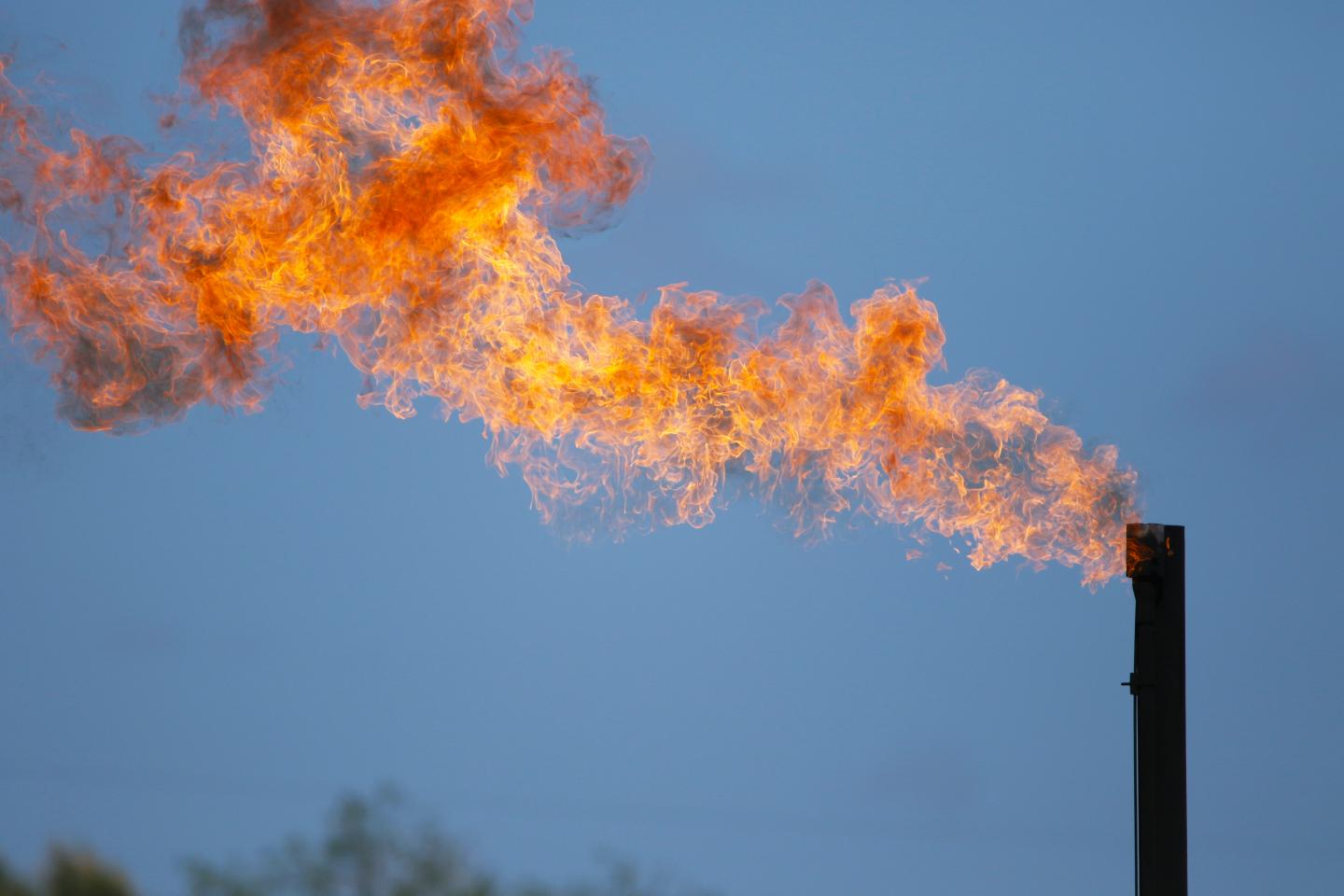
The Permian Basin, located in western Texas and southeastern New Mexico, is the largest oil- and gas-producing region in the U.S. The oilfield operations emit methane, but quantifying the greenhouse gas is difficult because of the large area and the fact that many sources are intermittent emitters. Now, researchers reporting in ACS’ Environmental Science & Technology Letters have conducted an extensive airborne campaign with imaging spectrometers and identified large methane sources across this area.
According to the U.S. Energy Information Administration, 38% of the nation’s total oil and 17% of natural gas production took place in the Permian Basin in 2020. Therefore, quantifying emissions from these operations, which continue to expand rapidly, is of great interest to environmental scientists. Previous studies have tried to estimate methane leakage in the Permian Basin through satellite images or mobile field studies, but either the spatial resolution was too coarse to quantify methane coming from individual sources, or the studies were limited to small areas or timeframes. So Daniel Cusworth and colleagues from the NASA Jet Propulsion Laboratory, the University of Arizona and Arizona State University formed a collaboration. They wanted to quantify strong methane point source emissions (greater than 22-44 pounds of methane per hour) in the Permian Basin using airborne imaging spectrometry, a technology that would allow high-resolution mapping of those sources across large areas and multiple overflights.
From September to November 2019, the researchers conducted repeated flights in airplanes carrying imaging spectrometers, covering about 21,000 square miles and 60,000 active wells in the Permian Basin. The spectrometers detected 1,100 unique large methane point sources that were sampled at least three times. Most of these sources were highly intermittent (detected 25% or fewer of the times sampled). However, sources that were routinely persistent (detected 50-100% of the time) comprised 11% of the methane emitters but 29% of the total detected emissions, possibly indicating leaking equipment that needs repair. Half of the detected methane came from oil and gas production wells, 38% from pipelines and other equipment used to collect and transport oil and gas, and 12% from processing plants. These results show that frequent, high-resolution monitoring is necessary to understand intermittent methane emitters across large areas and to pinpoint persistent leaks for mitigation, the researchers say.
###
The authors acknowledge funding from NASA, the University of Arizona, Carbon Mapper Inc. and the High Tide Foundation.
The paper’s abstract will be available on June 2 at 8 a.m. Eastern time here: http://pubs.
The American Chemical Society (ACS) is a nonprofit organization chartered by the U.S. Congress. ACS’ mission is to advance the broader chemistry enterprise and its practitioners for the benefit of Earth and all its people. The Society is a global leader in promoting excellence in science education and providing access to chemistry-related information and research through its multiple research solutions, peer-reviewed journals, scientific conferences, eBooks and weekly news periodical Chemical & Engineering News. ACS journals are among the most cited, most trusted and most read within the scientific literature; however, ACS itself does not conduct chemical research. As a leader in scientific information solutions, its CAS division partners with global innovators to accelerate breakthroughs by curating, connecting and analyzing the world’s scientific knowledge. ACS’ main offices are in Washington, D.C., and Columbus, Ohio.
To automatically receive news releases from the American Chemical Society, contact [email protected].
Follow us: Twitter | Facebook
Media Contact
Katie Cottingham
[email protected]