• HOME
  • NEWS
  • EXPLORE
    • CAREER
      • Companies
      • Jobs
    • EVENTS
    • iGEM
      • News
      • Team
    • PHOTOS
    • VIDEO
    • WIKI
  • BLOG
  • COMMUNITY
    • FACEBOOK
    • INSTAGRAM
    • TWITTER
Thursday, June 25, 2026
BIOENGINEER.ORG
No Result
View All Result
  • Login
  • HOME
  • NEWS
  • EXPLORE
    • CAREER
      • Companies
      • Jobs
        • Lecturer
        • PhD Studentship
        • Postdoc
        • Research Assistant
    • EVENTS
    • iGEM
      • News
      • Team
    • PHOTOS
    • VIDEO
    • WIKI
  • BLOG
  • COMMUNITY
    • FACEBOOK
    • INSTAGRAM
    • TWITTER
  • HOME
  • NEWS
  • EXPLORE
    • CAREER
      • Companies
      • Jobs
        • Lecturer
        • PhD Studentship
        • Postdoc
        • Research Assistant
    • EVENTS
    • iGEM
      • News
      • Team
    • PHOTOS
    • VIDEO
    • WIKI
  • BLOG
  • COMMUNITY
    • FACEBOOK
    • INSTAGRAM
    • TWITTER
No Result
View All Result
Bioengineer.org
No Result
View All Result
Home NEWS Science News Chemistry

Study reveals diverse magnetic fields in solar-type star-forming cores

Bioengineer by Bioengineer
September 6, 2025
in Chemistry
Reading Time: 2 mins read
0
IMAGE
Share on FacebookShare on TwitterShare on LinkedinShare on RedditShare on Telegram

Magnetic fields are ubiquitous throughout our Milky Way Galaxy and play a crucial role in all dynamics of interstellar medium. However, questions like how Solar-type stars form out of magnetized molecular clouds, whether the role of magnetic fields changes at various scales and densities of molecular clouds, and what factors can change the morphology of magnetic fields in low-mass dense cores still remain unclear.

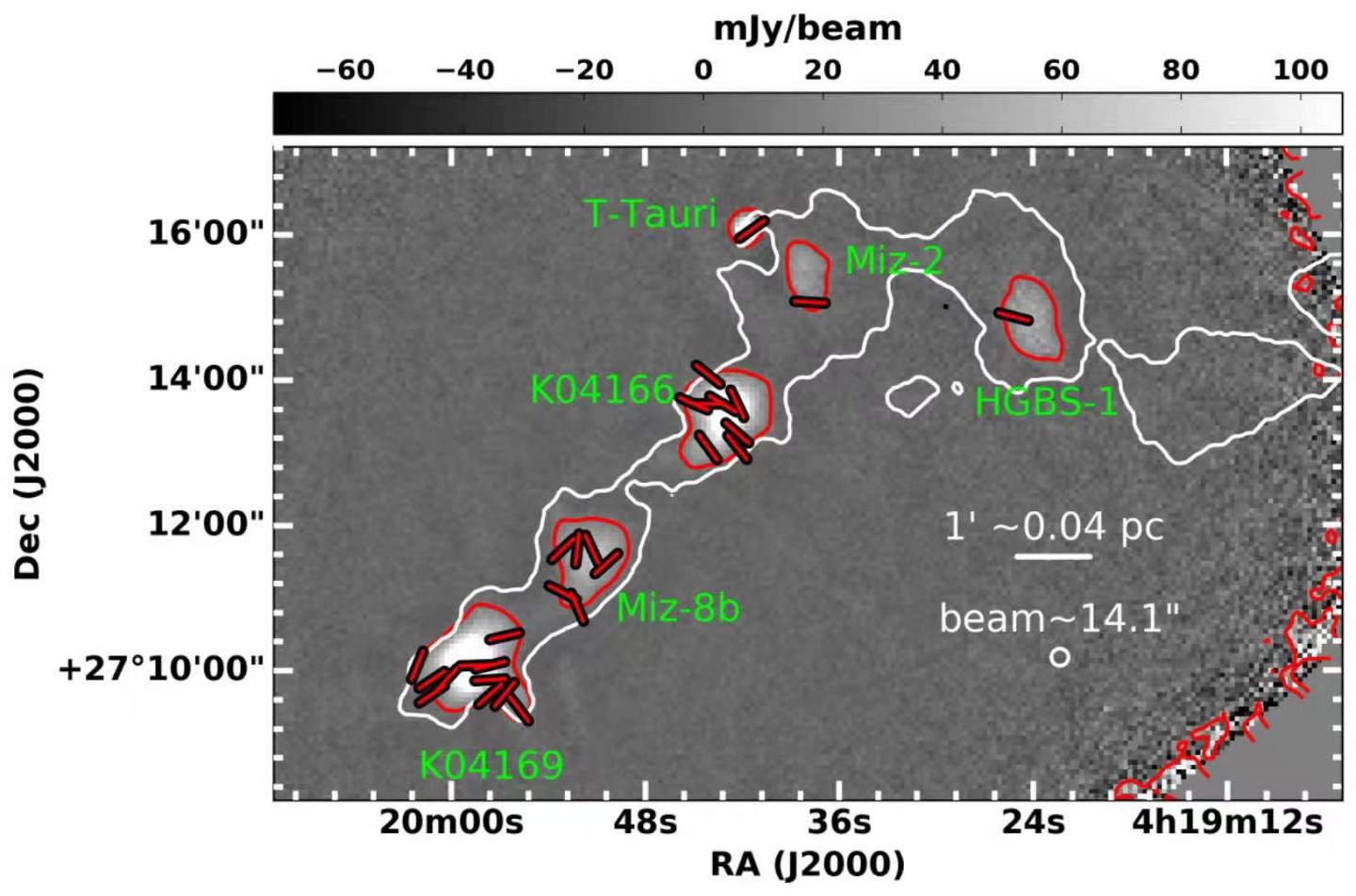
A new study led by Dr. Eswaraiah Chakali from Prof. LI Di’s research group at the National Astronomical Observatories of the Chinese Academy of Sciences (NAOC) has partially answered these questions. The study reveals the diverse magnetic field morphologies in Solar-type star forming cores in the Taurus B213 region.

This study was published in The Astrophysical Journal Letters on May 10.

The researchers used high-resolution and sensitive 850-micron dust emission polarization data acquired by the James Clerk Maxwell Telescope (JCMT) using the SCUBA-2 camera along with the POL-2 polarimeter.

The observations were conducted as a part of a large international program called B-fields In STar-forming Region Observations (BISTRO).

“Although formed out of the same filamentary cloud, Taurus/B213, among the three dense cores having more polarization measurements, only one remembers the relatively uniform large-scale magnetic field threading the parental cloud,” said Dr. Eswaraiah Chakali, lead author of the study.

This is in contrast to expectations based on the theory that magnetic fields regulate star formation. If a large-scale magnetic field dominates throughout cloud accumulation, core collapse and star formation, the mean position angle of the magnetic field should be similar across various spatial scales.

Further analysis of the gas velocity gradient revealed that the kinematics due to gas accretion flows onto the parental filament could have altered the magnetic field configuration.

“Even in the presence of substantial magnetic flux, local physical conditions can significantly affect magnetic field morphology and their role in star formation,” said Prof. LI Di, co-corresponding author of the study.

“Our current observations represent one of the deepest sub-millimeter polarimetry images ever taken using a single dish telescope toward a Galactic region,” said Prof. QIU Keping of Nanjing University, co-PI of the BISTRO project and a coauthor of the study.

Prof. LI Di also highlighted “more comprehensive analyses, in combination with Planck data and stellar polarimetry, may give more insights into the evolution of magnetic fields in this stereotypical low-mass star-forming region.”

###

Media Contact
XU Ang
[email protected]

Original Source

https://english.cas.cn/

Related Journal Article

http://dx.doi.org/10.3847/2041-8213/abeb1c

Tags: AstrophysicsSpace/Planetary ScienceStars/The Sun
Share12Tweet8Share2ShareShareShare2

Related Posts

AI and Physics Collaborate to Design Advanced Hydrogen Storage Materials

June 25, 2026

International Team Including Dresden Scientists Develops Novel Designer Proteins for Advanced Study of Living Tissue

June 25, 2026

New Study Uncovers Key Factors Driving Water Chemistry in Nanoscale Environments

June 25, 2026

Plasma Technology Extends Catalyst Lifespan in Hydrogen Production

June 24, 2026
Please login to join discussion

POPULAR NEWS

  • Saying Goodbye to PGY-6: Pediatric Fellowship Realities

    103 shares
    Share 41 Tweet 26
  • Multi-Hospital Study Reveals Long Covid Burden Is Twice as High as Current Estimates

    92 shares
    Share 36 Tweet 23
  • Detection of EDCs in Breast Milk and Infant Urine Up to Six Months Highlights Early Exposure Risks

    77 shares
    Share 31 Tweet 19
  • New Drug Candidate Developed at McMaster Shows Potential for Treating Brain Cancer

    58 shares
    Share 23 Tweet 15

About

We bring you the latest biotechnology news from best research centers and universities around the world. Check our website.

Follow us

Recent News

Tracking Lanthanide-Labeled Microplastics in Plants

POSTECH Researchers Slash Cost of Reconstituted Cell-Free Systems by 95%

AI and Physics Collaborate to Design Advanced Hydrogen Storage Materials

Subscribe to Blog via Email

Success! An email was just sent to confirm your subscription. Please find the email now and click 'Confirm' to start subscribing.

Join 82 other subscribers
  • Contact Us

Bioengineer.org © Copyright 2023 All Rights Reserved.

Welcome Back!

Login to your account below

Forgotten Password?

Retrieve your password

Please enter your username or email address to reset your password.

Log In
No Result
View All Result
  • Homepages
    • Home Page 1
    • Home Page 2
  • News
  • National
  • Business
  • Health
  • Lifestyle
  • Science

Bioengineer.org © Copyright 2023 All Rights Reserved.