A paper by Kazan Federal University appeared in IET Microwaves, Antennas & Propagation
Credit: Kazan Federal University
Problems for eigenmodes of a two-layered dielectric microcavity have become widespread thanks to the research of A.I. Nosich, E.I. Smotrova, S.V. Boriskina and others since the beginning of the 21st century. The KFU team first tackled this topic in 2014; undergraduates started working under the guidance of Evgeny Karchevsky, Professor of the Department of Applied Mathematics of the Institute of Computational Mathematics and Information Technology.
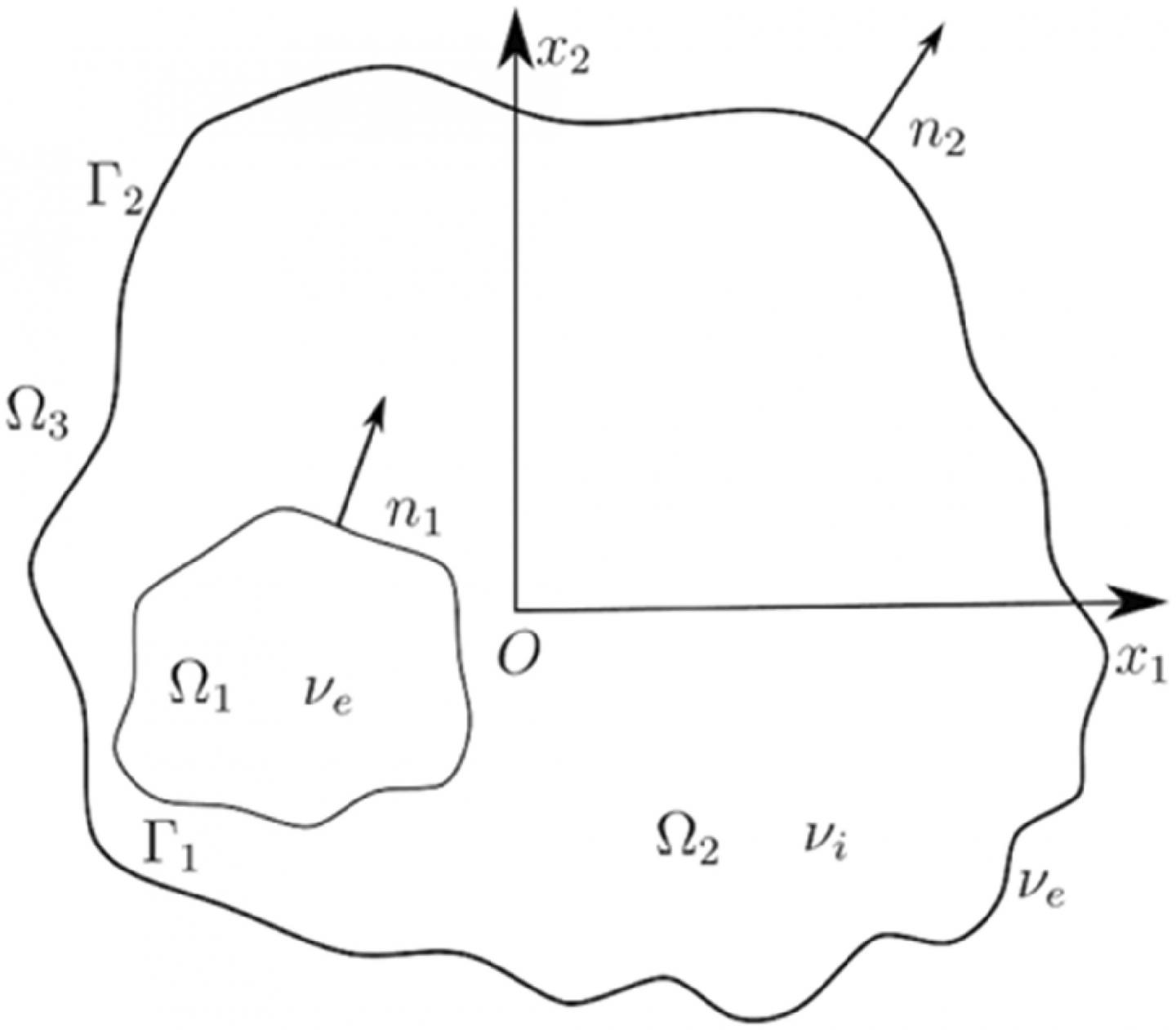
In this paper, the researchers discuss a model of a 2D active microcavity with a piercing hole and the possibility of a compromise between high directionality of radiation and low threshold gain. The analysis performed is based on the lasing eigenvalue problem (LEP) formalism. This LEP is a boundary value problem for the system of Maxwell equations with boundary and radiation conditions, adapted to study the threshold modes of open resonators with active regions. In LEP, each eigenvalue is a pair of two real numbers: the emission frequency and the threshold gain in the active region. This combination fits perfectly with the experimental results, which show that each mode has its own defined threshold, and that it is directly related to the field diagram and the location of the active region. When analyzing cavities of complex shape, we use the analytical regularization method in the form of a set of Müller boundary integral equations and reduce LEP to a nonlinear eigenvalue problem for a set of Fredholm integral equations of the second kind. To find a solution, a fast and accurate Galerkin method designed for this task is used. This method makes it possible to study symmetric and asymmetric modes separately, at the threshold of radiation that is not damped in time. The numerical results show that the directionality of the radiation of the operating modes in a given frequency range, together with their threshold gain values, is controlled by the size and location of the air hole in the resonator. In the developed code to study solutions of symmetric and asymmetric modes, the sine and cosine functions in the Galerkin scheme are used instead of exponentials. This makes the code resistant to jumps between mode families when numerically searching for eigenvalues and allows much smaller matrix equations to be used for computations with the order of machine precision. These modifications form the basis of this work. In addition, since the boundaries of the cavity and the hole are circles, this approach allows one to obtain explicit formulas for the matrix elements instead of double integrals. Thanks to all this, the algorithm is extremely fast and accurate. This makes it possible to perform an elementary optimization of the microlaser geometry, which ensures high directionality of the mode radiation while maintaining a low threshold value of the gain in the active region. This code is a promising engineering tool for microring lasers.
Dielectric microcavities have been the objects of intensive research in photonics and nano-optics for over 30 years. Laser radiation arising from the propagation of whispering gallery modes along the circumference of the microdisk resonators is not unidirectional. Due to a change in the structure of the laser (microcavity), it is possible to achieve unidirectional radiation with high directivity and low thresholds of its generation, which, in combination with its small size, the possibility of single-frequency generation and temperature stability, provides a wide range of applications. As an example, the authors can offer a quantum dot microcavity, which can be used to implement optical data transmission inside or between integrated circuits.
This topic can be expanded by considering and analyzing microcavities of complex structures. For example, a microcavity with several piercing holes arranged in a certain order (photonic crystal microcavity), or a microcavity with a quantum dot. Such complications will make it possible to generalize the results or to discover new dependencies.
###
Media Contact
Yury Nurmeev
[email protected]
Original Source
https:/
Related Journal Article
http://dx.