• HOME
  • NEWS
  • EXPLORE
    • CAREER
      • Companies
      • Jobs
    • EVENTS
    • iGEM
      • News
      • Team
    • PHOTOS
    • VIDEO
    • WIKI
  • BLOG
  • COMMUNITY
    • FACEBOOK
    • INSTAGRAM
    • TWITTER
Saturday, February 7, 2026
BIOENGINEER.ORG
No Result
View All Result
  • Login
  • HOME
  • NEWS
  • EXPLORE
    • CAREER
      • Companies
      • Jobs
        • Lecturer
        • PhD Studentship
        • Postdoc
        • Research Assistant
    • EVENTS
    • iGEM
      • News
      • Team
    • PHOTOS
    • VIDEO
    • WIKI
  • BLOG
  • COMMUNITY
    • FACEBOOK
    • INSTAGRAM
    • TWITTER
  • HOME
  • NEWS
  • EXPLORE
    • CAREER
      • Companies
      • Jobs
        • Lecturer
        • PhD Studentship
        • Postdoc
        • Research Assistant
    • EVENTS
    • iGEM
      • News
      • Team
    • PHOTOS
    • VIDEO
    • WIKI
  • BLOG
  • COMMUNITY
    • FACEBOOK
    • INSTAGRAM
    • TWITTER
No Result
View All Result
Bioengineer.org
No Result
View All Result
Home NEWS Science News

ANU helps find supercluster of galaxies near Milky Way

Bioengineer by Bioengineer
December 21, 2016
in Science News
Reading Time: 2 mins read
0
Share on FacebookShare on TwitterShare on LinkedinShare on RedditShare on Telegram
IMAGE

Credit: Supplied by the research team

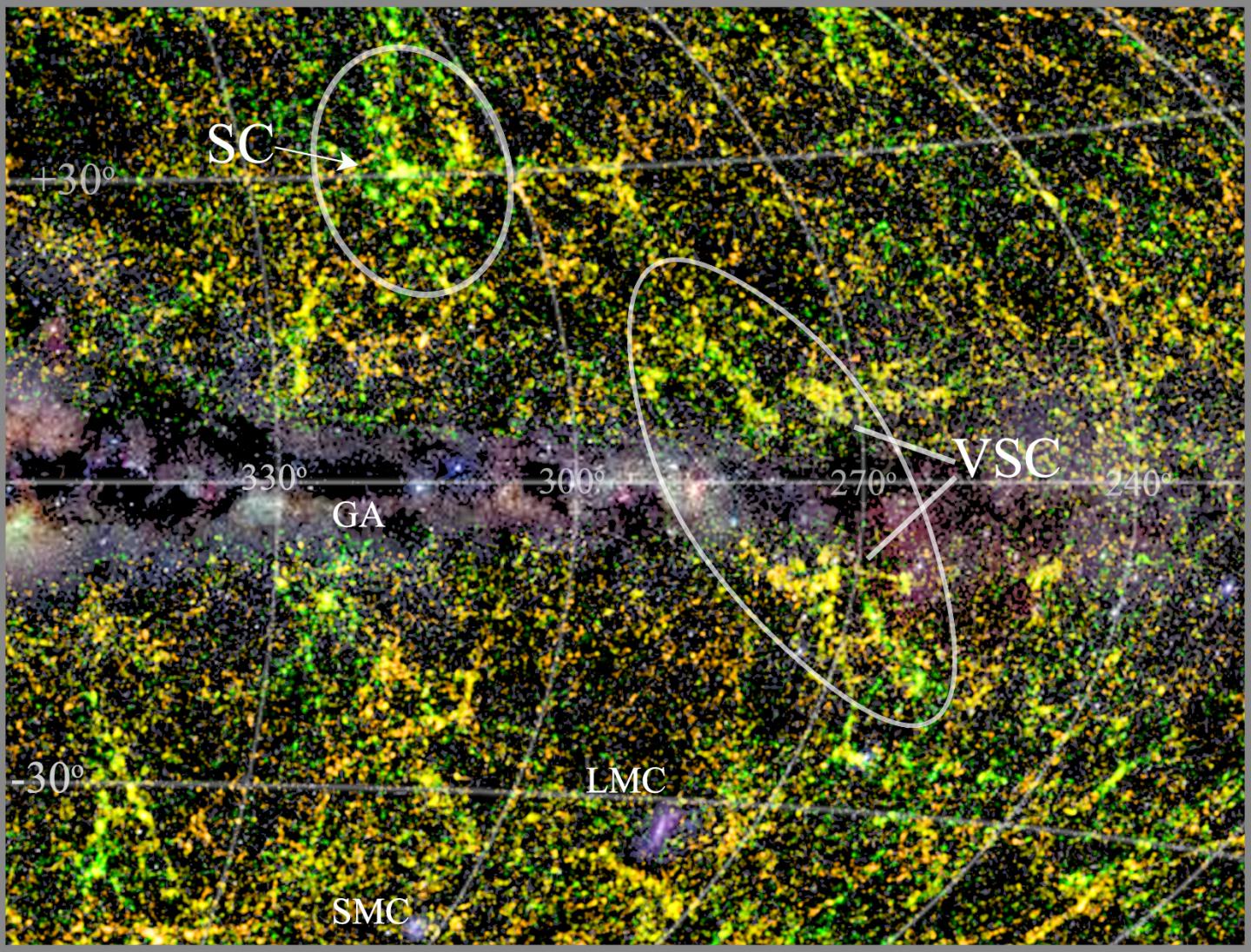
The Australian National University (ANU) is part of an international team of astronomers that found one of the Universe's biggest superclusters of galaxies near the Milky Way.

Professor Matthew Colless from ANU said the Vela supercluster, which had previously gone undetected as it was hidden by stars and dust in the Milky Way, was a huge mass that influenced the motion of our Galaxy.

"This is one of the biggest concentrations of galaxies in the Universe – possibly the biggest in the neighbourhood of our Galaxy, but that will need to be confirmed by further study," said Professor Colless from the ANU Research School of Astronomy and Astrophysics.

"The gravity of the Vela supercluster may explain the difference between the measured motion of the Milky Way through space and the motion predicted from the distribution of previously mapped galaxies."

Professor Colless used the Anglo-Australian Telescope to measure distances for many galaxies to confirm earlier predictions that Vela was a supercluster. He also helped to estimate the supercluster's effect on the motion of the Milky Way.

The research involved astronomers based in South Africa, Australia and Europe. Two new Australian surveys starting in 2017 will confirm the size of the Vela supercluster.

"The Taipan optical survey will measure galaxy distances over a bigger area around Vela, while the WALLABY radio survey will be able to peer through the densest parts of the Milky Way into the supercluster's heart," Professor Colless said.

The research is published in Monthly Notices of the Royal Astronomical Society.

###

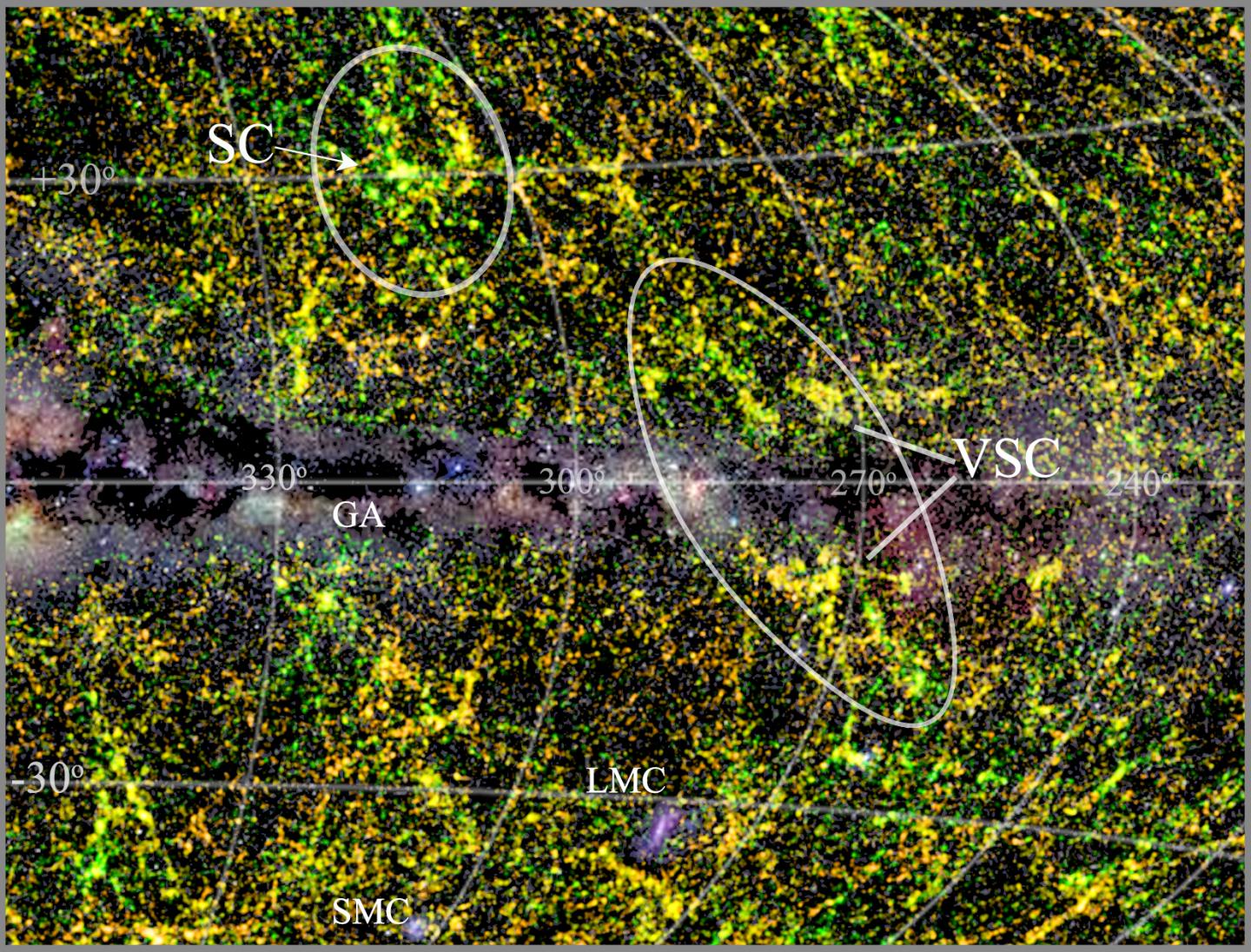
Picture description: The white/blue image is the Milky Way, with the central bulge on the left and the plane of the disk running horizontally across the region; the yellow/green dots are the distribution of galaxies in the nearby universe; the Vela supercluster (VSC) region is indicated, running across the Galactic plane; also shown is the location of the Shapley supercluster (SC), the other massive structure in the nearby universe.

FOR INTERVIEW:

Professor Matthew Colless
ANU Research School of Astronomy and Astrophysics
T: +61 2 6125 0266
M: +61 43 189 8345
E: [email protected]

FOR MEDIA ASSISTANCE:

Will Wright
ANU media team
T: +61 2 6125 7979
M: +61 478 337 740
E: [email protected]

Media Contact

Matthew Colless
[email protected]
61-431-898-345
@ANUmedia

http://www.anu.edu.au/media

############

Story Source: Materials provided by Scienmag

Share12Tweet8Share2ShareShareShare2

Related Posts

Digital Health Perspectives from Baltic Sea Experts

February 7, 2026
Florida Cane Toad: Complex Spread and Selective Evolution

Florida Cane Toad: Complex Spread and Selective Evolution

February 7, 2026

Exploring Decision-Making in Dementia Caregivers’ Mobility

February 7, 2026

Succinate Receptor 1 Limits Blood Cell Formation, Leukemia

February 7, 2026
Please login to join discussion

POPULAR NEWS

  • Robotic Ureteral Reconstruction: A Novel Approach

    Robotic Ureteral Reconstruction: A Novel Approach

    82 shares
    Share 33 Tweet 21
  • Digital Privacy: Health Data Control in Incarceration

    63 shares
    Share 25 Tweet 16
  • Study Reveals Lipid Accumulation in ME/CFS Cells

    57 shares
    Share 23 Tweet 14
  • Breakthrough in RNA Research Accelerates Medical Innovations Timeline

    53 shares
    Share 21 Tweet 13

About

We bring you the latest biotechnology news from best research centers and universities around the world. Check our website.

Follow us

Recent News

Digital Health Perspectives from Baltic Sea Experts

Florida Cane Toad: Complex Spread and Selective Evolution

Exploring Decision-Making in Dementia Caregivers’ Mobility

Subscribe to Blog via Email

Enter your email address to subscribe to this blog and receive notifications of new posts by email.

Join 73 other subscribers
  • Contact Us

Bioengineer.org © Copyright 2023 All Rights Reserved.

Welcome Back!

Login to your account below

Forgotten Password?

Retrieve your password

Please enter your username or email address to reset your password.

Log In
No Result
View All Result
  • Homepages
    • Home Page 1
    • Home Page 2
  • News
  • National
  • Business
  • Health
  • Lifestyle
  • Science

Bioengineer.org © Copyright 2023 All Rights Reserved.