• HOME
  • NEWS
  • EXPLORE
    • CAREER
      • Companies
      • Jobs
    • EVENTS
    • iGEM
      • News
      • Team
    • PHOTOS
    • VIDEO
    • WIKI
  • BLOG
  • COMMUNITY
    • FACEBOOK
    • INSTAGRAM
    • TWITTER
Saturday, November 14, 2026
BIOENGINEER.ORG
No Result
View All Result
  • Login
  • HOME
  • NEWS
  • EXPLORE
    • CAREER
      • Companies
      • Jobs
        • Lecturer
        • PhD Studentship
        • Postdoc
        • Research Assistant
    • EVENTS
    • iGEM
      • News
      • Team
    • PHOTOS
    • VIDEO
    • WIKI
  • BLOG
  • COMMUNITY
    • FACEBOOK
    • INSTAGRAM
    • TWITTER
No Result
View All Result
Bioengineer.org
No Result
View All Result
Home NEWS Science News Chemistry

Excitation spectral microscopy integrates multi-target imaging and quantitative biosensing

Bioengineer by Bioengineer
May 12, 2021
in Chemistry
Reading Time: 2 mins read
0
IMAGE
Share on FacebookShare on TwitterShare on LinkedinShare on RedditShare on Telegram

IMAGE

Credit: by Kun Chen, Rui Yan, Limin Xiang, and Ke Xu

The multiplexing capability of fluorescence microscopy is severely limited by the broad fluorescence spectral width. Spectral imaging offers potential solutions, yet typical approaches to disperse the local emission spectra notably impede the attainable throughput and place substantial constraints on temporal resolution. Tunable bandpass filters provide a possibility to scan through the emission wavelength in the wide field. However, applying narrow bandpasses to the fluorescence emission results in inefficient use of the scarce signal.

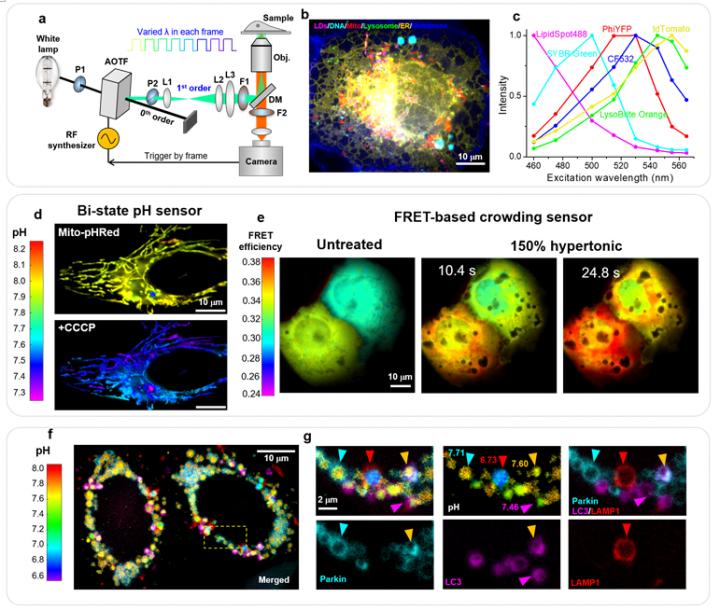
In a new paper published in Light: Science & Application, a team of scientists, led by Professor Ke Xu from College of Chemistry, University of California, Berkeley, USA have demonstrated that using a single, fixed fluorescence emission detection band, through frame-synchronized fast scanning of the excitation wavelength from a white lamp via an acousto-optic tunable filter (AOTF), up to 6 subcellular targets, labeled by common fluorophores of substantial spectral overlap, can be simultaneously imaged in live cells with low (~1%) crosstalks and high temporal resolutions (down to ~10 ms). The demonstrated capability to quantify the abundances of different fluorophores in the same sample through unmixing the excitation spectra next enabled them to devise novel, quantitative imaging schemes for both bi-state and FRET (Förster resonance energy transfer) fluorescent biosensors in live cells. They thus achieved full-frame high sensitivities and spatiotemporal resolutions in quantifying the mitochondrial matrix pH and the intracellular macromolecular crowding. They thus unveiled significant spatial heterogeneities in both parameters, including spontaneous sudden jumps in the mitochondrial matrix pH accompanied by dramatic mitochondrial shape changes. They further demonstrated, for the first time, the multiplexing of absolute pH imaging with three additional target organelles/proteins to elucidate the complex, Parkin-mediated mitophagy pathway.

“The potential extension of our approach to even more fluorophores may be achieved by further increasing the number of excitation wavelengths or integrating emission dispersion” “Whereas in this work we focused on a facile system based on a lamp-operated epifluorescence microscope, the fast multi-fluorophore and quantitative biosensor imaging capabilities we demonstrated here should be readily extendable to other systems, including light-sheet fluorescence microscopy and structured illumination microscopy” the scientists discussed.

Together, these results “unveil the exceptional opportunities excitation spectral microscopy provides for highly multiplexed fluorescence imaging.” “The prospect of acquiring fast spectral images in the wide-field without the need for fluorescence dispersion or the care for the spectral response of the detector offers tremendous potential.”

###

Media Contact
Ke Xu
xuk@berkeley.edu

Related Journal Article

http://dx.doi.org/10.1038/s41377-021-00536-3

Tags: Chemistry/Physics/Materials SciencesOptics
Share13Tweet8Share2ShareShareShare2

Related Posts

Computational Modeling Identifies Quinolinol Analogues Outperforming Tamoxifen Against Breast Cancer Target

Computational Modeling Identifies Quinolinol Analogues Outperforming Tamoxifen Against Breast Cancer Target

November 14, 2026
Optimizing Bacterial Nitrate Reductase Boosts Silver Nanoparticle Synthesis for Food Packaging

Optimizing Bacterial Nitrate Reductase Boosts Silver Nanoparticle Synthesis for Food Packaging

November 14, 2026

Oven Drying Tuning Enhances Green Cobalt Oxide Electrocatalysis and Antibacterial Action

November 14, 2026

Machine Learning Identifies Glycogene Patterns That Define Early Breast Cancer Subtypes

November 14, 2026
Please login to join discussion

POPULAR NEWS

  • Mitochondrial Cristae System Proposed as Checkpoint in Retinal Pigment Epithelial Degeneration

    Mitochondrial Cristae System Proposed as Checkpoint in Retinal Pigment Epithelial Degeneration

    29 shares
    Share 12 Tweet 7
  • Molecular Profiling Uncovers Key Genes Linked to Triple-Negative Breast Cancer Recurrence

    29 shares
    Share 12 Tweet 7
  • Three Baseline Factors Predict Low-Frequency Hearing Levels in Menière’s Disease

    29 shares
    Share 12 Tweet 7
  • Mixed Lung Patterns Link to Higher Recurrence and Treatment in Sarcoidosis

    29 shares
    Share 12 Tweet 7

About

We bring you the latest biotechnology news from best research centers and universities around the world. Check our website.

Follow us

Recent News

Extra-Early Cowpea Trials in Niger Reveal Distinct Environments and Stable Genotypes

Fecal Microbiota Transplantation Shows Higher Response Rates in Pediatric Abdominal Pain Trial

Susceptibility Map-Weighted MRI Accurately Identifies Neurodegenerative Parkinsonism With Artificial Intelligence Support

Subscribe to Blog via Email

Enter your email address to subscribe to this blog and receive notifications of new posts by email.

Join 87 other subscribers
  • Contact Us

Bioengineer.org © Copyright 2023 All Rights Reserved.

Welcome Back!

Login to your account below

Forgotten Password?

Retrieve your password

Please enter your username or email address to reset your password.

Log In
No Result
View All Result
  • Homepages
    • Home Page 1
    • Home Page 2
  • News
  • National
  • Business
  • Health
  • Lifestyle
  • Science

Bioengineer.org © Copyright 2023 All Rights Reserved.