• HOME
  • NEWS
  • EXPLORE
    • CAREER
      • Companies
      • Jobs
    • EVENTS
    • iGEM
      • News
      • Team
    • PHOTOS
    • VIDEO
    • WIKI
  • BLOG
  • COMMUNITY
    • FACEBOOK
    • INSTAGRAM
    • TWITTER
Monday, December 1, 2025
BIOENGINEER.ORG
No Result
View All Result
  • Login
  • HOME
  • NEWS
  • EXPLORE
    • CAREER
      • Companies
      • Jobs
        • Lecturer
        • PhD Studentship
        • Postdoc
        • Research Assistant
    • EVENTS
    • iGEM
      • News
      • Team
    • PHOTOS
    • VIDEO
    • WIKI
  • BLOG
  • COMMUNITY
    • FACEBOOK
    • INSTAGRAM
    • TWITTER
  • HOME
  • NEWS
  • EXPLORE
    • CAREER
      • Companies
      • Jobs
        • Lecturer
        • PhD Studentship
        • Postdoc
        • Research Assistant
    • EVENTS
    • iGEM
      • News
      • Team
    • PHOTOS
    • VIDEO
    • WIKI
  • BLOG
  • COMMUNITY
    • FACEBOOK
    • INSTAGRAM
    • TWITTER
No Result
View All Result
Bioengineer.org
No Result
View All Result
Home NEWS Science News

Blockchain as ‘TechQuity’: How tech solutions have the power to help the homeless

Bioengineer by Bioengineer
May 3, 2021
in Science News
Reading Time: 3 mins read
0
IMAGE
Share on FacebookShare on TwitterShare on LinkedinShare on RedditShare on Telegram

IMAGE

Credit: Dell Medical School at the University of Texas at Austin

AUSTIN, Texas — For people experiencing homelessness, missing proof of identity can be a major barrier to receiving critical services, from housing to food assistance to health care. Physical documents such as driver’s licenses are highly susceptible to loss, theft or damage. However, researchers from Dell Medical School at The University of Texas at Austin say new technology solutions such as blockchain can be used to keep important health care information secure and portable.

“Health care institutions and social services are so fragmented and siloed they’re unable to accurately collect, share or verify basic identity information about a person experiencing homelessness,” said Tim Mercer, M.D., MPH, director of the Global Health Program in the Department of Population Health at Dell Med and co-author of a new commentary published in the Journal of Health Care for the Poor and Underserved. “This puts the burden on the most underserved people in our communities to navigate complex bureaucracies, just to prove their identities.”

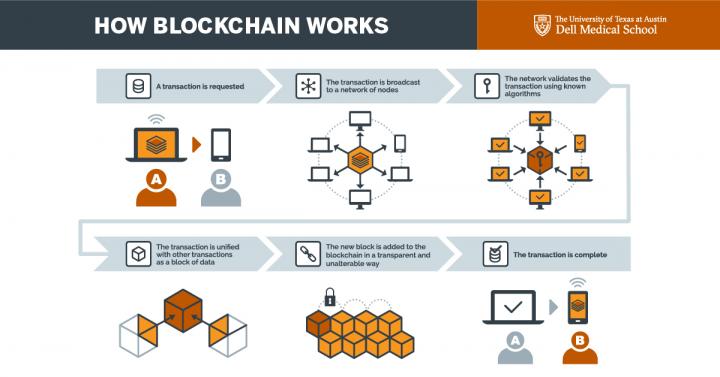
How Blockchain Works

Mercer and co-author Anjum Khurshid, M.D., Ph.D., say blockchain holds great potential as “techQuity”– technology that provides innovative solutions to advance health equity. Blockchain is a decentralized, digital ledger system that uses encryption to share information or transactions across a network of computers. Once verified, each “block” of new information is linked to the existing block, creating a chain of secure data that a person can access anytime, anywhere.

“The architecture of blockchain technology makes it a unique solution for managing identities of vulnerable people, allowing them to secure their information and control when and where that data gets shared,” said Khurshid, director of data integration in Dell Med’s Department of Population Health. “For instance, if you need to prove you’re over 18 years old, that information can be validated through blockchain without having to share your driver’s license.”

Putting the Technology to the Test

In 2018, the City of Austin worked with a team at Dell Med to test the feasibility of blockchain technology to establish an identity system for people experiencing homelessness. The results of the study showed that blockchain allowed them to upload and share documents with service providers, while holding their personal information as an asset in their blockchain account.

In the commentary, Mercer and Khurshid propose a research agenda to address unresolved issues, including:

  • Defining the scope of the problem,

  • Mapping infrastructure requirements,

  • Understanding legal and ethical considerations, and

  • Testing the overall effectiveness of blockchain to not only solve identity management problems, but also to improve health equity for people experiencing homelessness.

“While blockchain is seeing increased applications across the health care and social sectors, this is still largely uncharted territory,” said Mercer. “We have an incredible opportunity to partner with the private technology sector to solve this pernicious problem that plagues one of society’s most vulnerable populations.”

###

Media Contact
Adria Johnson
[email protected]

Original Source

https://dellmed.utexas.edu/news/blockchain-as-techquity-how-innovative-tech-solutions-have-the-power-to-help-the-homeless

Tags: Computer ScienceDemographyElectrical Engineering/ElectronicsHomelessnessInformation Management/Tracking SystemsInternetResearch/DevelopmentSocioeconomicsTechnology TransferTechnology/Engineering/Computer Science
Share13Tweet8Share2ShareShareShare2

Related Posts

Serum Intestinal Fatty Acid Protein Rises in NEC

Serum Intestinal Fatty Acid Protein Rises in NEC

December 1, 2025

RNA Interference Shows Promise for Hepatitis B Cure

December 1, 2025

Advanced Hybrid Model Boosts Brain Tumor Classification

December 1, 2025

RPPH1 Drives High-Risk AML via NF-κB, Th17

December 1, 2025
Please login to join discussion

POPULAR NEWS

  • New Research Unveils the Pathway for CEOs to Achieve Social Media Stardom

    New Research Unveils the Pathway for CEOs to Achieve Social Media Stardom

    203 shares
    Share 81 Tweet 51
  • Scientists Uncover Chameleon’s Telephone-Cord-Like Optic Nerves, A Feature Missed by Aristotle and Newton

    120 shares
    Share 48 Tweet 30
  • Neurological Impacts of COVID and MIS-C in Children

    106 shares
    Share 42 Tweet 27
  • MoCK2 Kinase Shapes Mitochondrial Dynamics in Rice Fungal Pathogen

    67 shares
    Share 27 Tweet 17

About

We bring you the latest biotechnology news from best research centers and universities around the world. Check our website.

Follow us

Recent News

Serum Intestinal Fatty Acid Protein Rises in NEC

RNA Interference Shows Promise for Hepatitis B Cure

Advanced Hybrid Model Boosts Brain Tumor Classification

Subscribe to Blog via Email

Enter your email address to subscribe to this blog and receive notifications of new posts by email.

Join 69 other subscribers
  • Contact Us

Bioengineer.org © Copyright 2023 All Rights Reserved.

Welcome Back!

Login to your account below

Forgotten Password?

Retrieve your password

Please enter your username or email address to reset your password.

Log In
No Result
View All Result
  • Homepages
    • Home Page 1
    • Home Page 2
  • News
  • National
  • Business
  • Health
  • Lifestyle
  • Science

Bioengineer.org © Copyright 2023 All Rights Reserved.