• HOME
  • NEWS
  • EXPLORE
    • CAREER
      • Companies
      • Jobs
    • EVENTS
    • iGEM
      • News
      • Team
    • PHOTOS
    • VIDEO
    • WIKI
  • BLOG
  • COMMUNITY
    • FACEBOOK
    • INSTAGRAM
    • TWITTER
Tuesday, October 6, 2026
BIOENGINEER.ORG
No Result
View All Result
  • Login
  • HOME
  • NEWS
  • EXPLORE
    • CAREER
      • Companies
      • Jobs
        • Lecturer
        • PhD Studentship
        • Postdoc
        • Research Assistant
    • EVENTS
    • iGEM
      • News
      • Team
    • PHOTOS
    • VIDEO
    • WIKI
  • BLOG
  • COMMUNITY
    • FACEBOOK
    • INSTAGRAM
    • TWITTER
No Result
View All Result
Bioengineer.org
No Result
View All Result
Home NEWS Science News

Safe and inexpensive hydrogen production as a future energy source

Bioengineer by Bioengineer
December 20, 2016
in Science News
Reading Time: 2 mins read
0
Share on FacebookShare on TwitterShare on LinkedinShare on RedditShare on Telegram
IMAGE

Credit: Osaka University

Osaka, Japan – Hydrogen gas is a promising alternative energy source to overcome our reliance on carbon-based fuels, and has the benefit of producing only water when it is reacted with oxygen. However, hydrogen is highly reactive and flammable, so it requires careful handling and storage. Typical hydrogen storage materials are limited by factors like water sensitivity, risk of explosion, difficulty of control of hydrogen-generation. Hydrogen gas can be produced efficiently from organosilanes, some of which are suitably air-stable, non-toxic, and cheap. Catalysts that can efficiently produce hydrogen from organosilanes are therefore desired with the ultimate goal of realizing safe, inexpensive hydrogen production in high yield. Ideally, the catalyst should also operate at room temperature under aerobic conditions without the need for additional energy input.

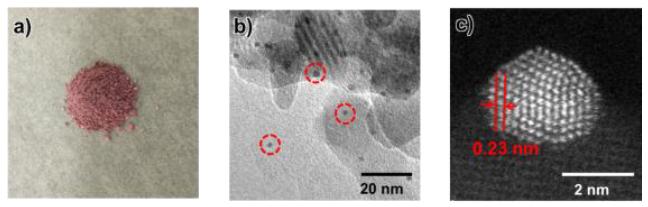
A research team led by Kiyotomi Kaneda and Takato Mitsudome at Osaka University have now developed a catalyst that realizes efficient environmentally friendly hydrogen production from organosilanes. The catalyst is composed of gold nanoparticles with a diameter of around 2 nm supported on hydroxyapatite. The catalyst was synthesized from chloroauric acid using glutathione as a capping agent to prevent nanoparticle aggregation, resulting the formation of small size of gold nanoparticles. Glutathione-capped gold nanoparticles were then adsorbed on hydroxyapatite and glutathione was removed by subsequent calcination.

The team then added the nanoparticle catalyst to solutions of different organosilanes to measure its ability to induce hydrogen production. The nanoparticle catalyst displayed the highest turnover frequency and number attained to date for hydrogen production catalysts from organosilanes. For example, the nanoparticle catalyst converted 99% of dimethylphenylsilane to the corresponding silanol in just 9 min at room temperature, releasing an equimolar amount of hydrogen gas at the same time. Importantly, the catalyst was recyclable without loss of activity. On/off switching of hydrogen production was achieved using the nanoparticle catalyst because it could be easily separated from its organosilane substrate by filtration. The activity of the catalyst increased as the nanoparticle size decreased.

A prototype portable hydrogen fuel cell containing the nanoparticle catalyst and an organosilane substrate was fabricated. The fuel cell generated power in air at room temperature and could be switched on and off as desired. Images of the catalyst after use in the fuel cell resembled those of the unused catalyst, indicating that the hydroxyapatite-supported nanoparticle catalyst readily resisted aggregation.

Generation of hydrogen from inexpensive organosilane substrates under ambient conditions without additional energy input represents an exciting advance towards the goal of using hydrogen as a green energy source.

###

The article "On-demand Hydrogen Production from Organosilanes at Ambient Temperature Using Heterogeneous Gold Catalysts" was published in Scientific Reports (DOI: 10.1038/srep37682).

Media Contact

Saori Obayashi
[email protected]
81-661-055-886
@osaka_univ_e

http://www.osaka-u.ac.jp/en

############

Story Source: Materials provided by Scienmag

Share12Tweet8Share2ShareShareShare2

Related Posts

Hidden Mental Health Crisis: Women With PCOS Face Sharply Elevated Suicide Risk, Major Analysis Finds

Hidden Mental Health Crisis: Women With PCOS Face Sharply Elevated Suicide Risk, Major Analysis Finds

October 6, 2026
Hidden Heart Pathway Behind Failed Pulsed Field Ablation Revealed in Rare Case

Hidden Heart Pathway Behind Failed Pulsed Field Ablation Revealed in Rare Case

October 6, 2026

How Often People Use Substances May Reveal a Wider Web of Mental Health Risk

October 6, 2026

Gentle Breathing First? Evidence Review Tests Intubation Rule for Mild Diaphragmatic Hernia

October 6, 2026
Please login to join discussion

POPULAR NEWS

  • Alloys That Shrink Their Own Grains: New PIX Mechanism Refines Metals With Heat Alone

    Alloys That Shrink Their Own Grains: New PIX Mechanism Refines Metals With Heat Alone

    29 shares
    Share 12 Tweet 7
  • Endurance Exercise Reshapes the Liver in Males and Females Through Distinct Molecular Routes

    29 shares
    Share 12 Tweet 7
  • Single Transcription Factor PU.1 Rapidly Converts Fibroblasts into Macrophage-Lineage Cells

    29 shares
    Share 12 Tweet 7
  • New Scale Measures How Ready Nurse Educators Really Are for the AI Era

    29 shares
    Share 12 Tweet 7

About

We bring you the latest biotechnology news from best research centers and universities around the world. Check our website.

Follow us

Recent News

Alloys That Shrink Their Own Grains: New PIX Mechanism Refines Metals With Heat Alone

Endurance Exercise Reshapes the Liver in Males and Females Through Distinct Molecular Routes

Single Transcription Factor PU.1 Rapidly Converts Fibroblasts into Macrophage-Lineage Cells

Subscribe to Blog via Email

Success! An email was just sent to confirm your subscription. Please find the email now and click 'Confirm' to start subscribing.

Join 85 other subscribers
  • Contact Us

Bioengineer.org © Copyright 2023 All Rights Reserved.

Welcome Back!

Login to your account below

Forgotten Password?

Retrieve your password

Please enter your username or email address to reset your password.

Log In
No Result
View All Result
  • Homepages
    • Home Page 1
    • Home Page 2
  • News
  • National
  • Business
  • Health
  • Lifestyle
  • Science

Bioengineer.org © Copyright 2023 All Rights Reserved.