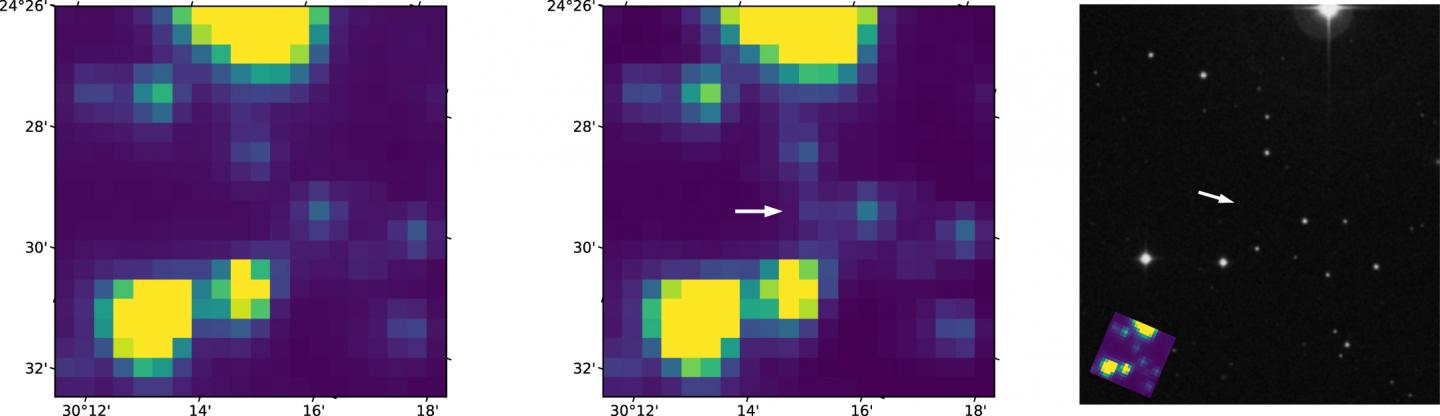
Credit: The Astrophysical Journal
DALLAS (SMU) – NASA has a long tradition of unexpected discoveries, and the space program’s TESS mission is no different. SMU astrophysicist and her team have discovered a particularly bright gamma-ray burst using a NASA telescope designed to find exoplanets – those occurring outside our solar system – particularly those that might be able to support life.
It’s the first time a gamma-ray burst has been found this way.
Gamma-ray bursts are the brightest explosions in the universe, typically associated with the collapse of a massive star and the birth of a black hole. They can produce as much radioactive energy as the sun will release during its entire 10-billion-year existence.
Krista Lynne Smith, an assistant professor of physics at Southern Methodist University, and her team confirmed the blast – called GRB 191016A – happened on Oct. 16 and also determined its location and duration. A study on the discovery has been published in The Astrophysical Journal.
“Our findings prove this TESS telescope is useful not just for finding new planets, but also for high-energy astrophysics,” said Smith, who specializes in using satellites like TESS (Transiting Exoplanet Survey Satellite) to study supermassive black holes and gas that surrounds them. Such studies shed light on the behavior of matter in the deeply warped spacetime around black holes and the processes by which black holes emit powerful jets into their host galaxies.
Smith calculated that GRB 191016A had a peak magnitude of 15.1, which means it was 10,000 times fainter than the faintest stars we can see with the naked eyes.
That may sound quite dim, but the faintness has to do with how far away the burst occurred. It is estimated that light from GRB 191016A’s galaxy had been travelling 11.7 billion years before becoming visible in the TESS telescope.
Most gamma ray bursts are dimmer – closer to 160,000 times fainter than the faintest stars.
The burst reached its peak brightness sometime between 1,000 and 2,600 seconds, then faded gradually until it fell below the ability of TESS to detect it some 7000 seconds after it first went off.
This gamma-ray burst was first detected by a NASA’s satellite called Swift-BAT, which was built to find these bursts. But because GRB 191016A occurred too close to the moon, the Swift-BAT couldn’t do the necessary follow-up it normally would have to learn more about it until hours later.
NASA’s TESS happened to be looking at that same part of the sky. That was sheer luck, as TESS turns its attention to a new strip of the sky every month.
While exoplanet researchers at a ground-base for TESS could tell right away that a gamma-ray burst had happened, it would be months before they got any data from the TESS satellite on it. But since their focus was on new planets, these researchers asked if any other scientists at a TESS conference in Sydney, Australia were interested in doing more digging on the blast.
Smith was one of the few high-energy astrophysics specialists there at that time and quickly volunteered.
“The TESS satellite has a lot of potential for high-energy applications, and this was too good an example to pass up,” she said. High-energy astrophysics studies the behavior of matter and energy in extreme environments, including the regions around black holes, powerful relativistic jets, and explosions like gamma-ray bursts.
TESS is an optical telescope that collects light curves on everything in its field of view, every half hour. Light curves are a graph of light intensity of a celestial object or region as a function of time. Smith analyzed three of these light curves to be able to determine how bright the burst was.
She also used data from ground-based observatories and the Swift gamma-ray satellite to determine the burst’s distance and other qualities about it.
“Because the burst reached its peak brightness later and had a peak brightness that was higher than most bursts, it allowed the TESS telescope to make multiple observations before the burst faded below the telescope’s detection limit,” Smith said. “We’ve provided the only space-based optical follow-up on this exceptional burst.”
###
About SMU
SMU is the nationally ranked global research university in the dynamic city of Dallas. SMU’s alumni, faculty and nearly 12,000 students in eight degree-granting schools demonstrate an entrepreneurial spirit as they lead change in their professions, communities and the world.
Media Contact
Monifa Thomas-Nguyen
[email protected]
Original Source
https:/
Related Journal Article
http://dx.