


Analysis reveals complex forest connections that underscore diversity’s role in protecting ecosystem health
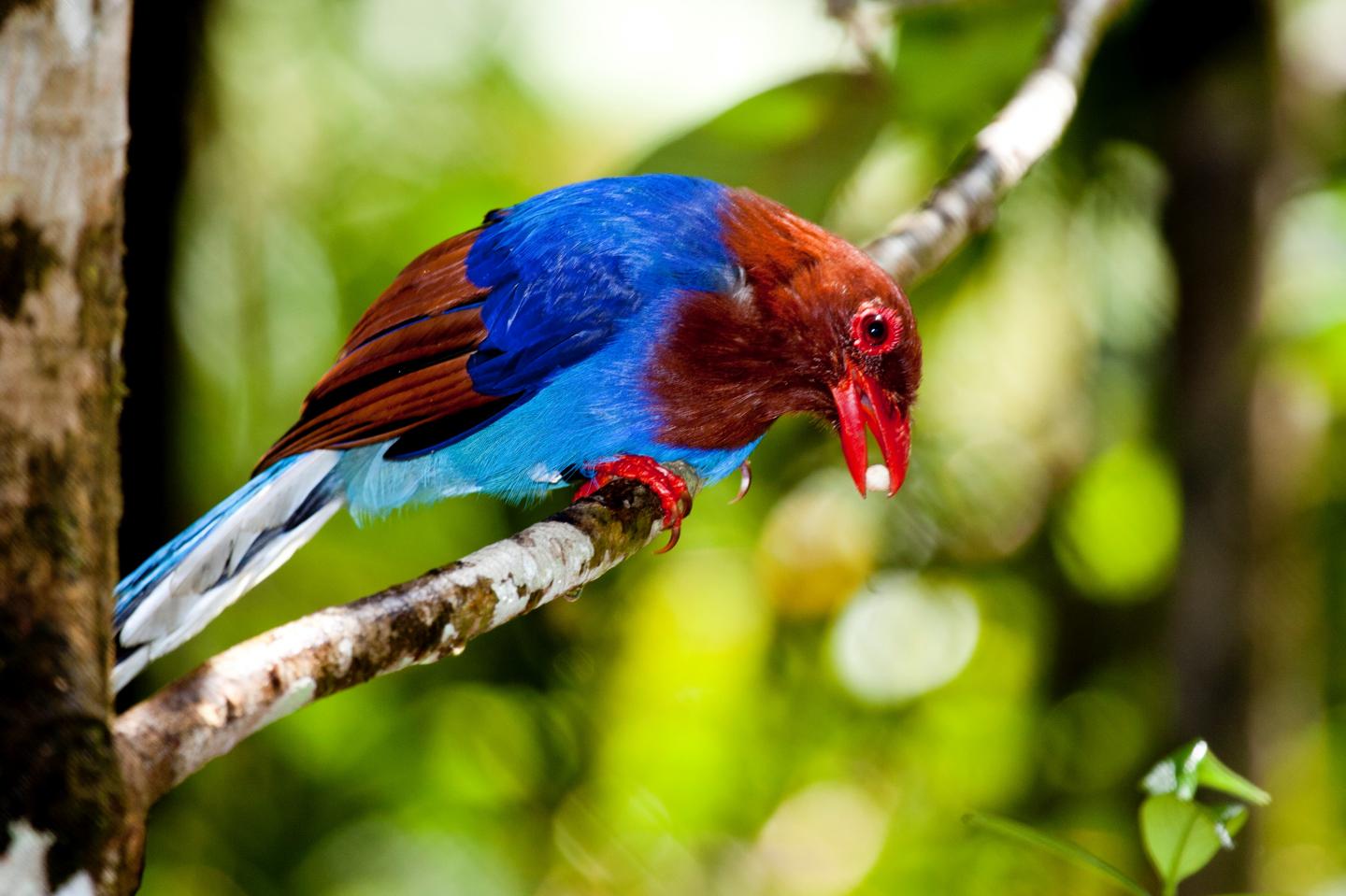
Credit: Christopher Wills, UC San Diego
As the health of ecosystems in regions around the globe declines due to a variety of rising threats, scientists continue to seek clues to help prevent future collapses.
A new analysis by scientists from around the world, led by a researcher at the University of California San Diego, is furthering science’s understanding of species interactions and how diversity contributes to the preservation of ecosystem health.
A coalition of 49 researchers examined a deep well of data describing tree species in forests located across a broad range of countries, ecosystems and latitudes. Information about the 16 forest diversity plots in Panama, China, Sri Lanka, Puerto Rico and other locations–many in remote, inaccessible areas–had been collected by hundreds of scientists and students over decades.
Lead researcher Christopher Wills, an evolutionary biologist and professor emeritus in the UC San Diego Division of Biological Sciences, says the new study addresses large questions about these complex ecosystems–made up of trees, animals, insects and even bacteria and viruses–and how such stunning diversity is maintained to support the health of the forest.
The new analysis, believed to be the most detailed study of such an enormous set of ecological data, is published in the journal PLOS Computational Biology.
“Observational and experimental evidence shows that all ecosystems are characterized by strong interactions between and among their many species. These webs of interactions can be important contributors to the preservation of ecosystem diversity,” said Wills.
The authors note, however, that many of these interactions–including those involving microscopic pathogens and the chemical defenses mounted by their prey–are not easy to identify and analyze in ecosystems that feature tens to hundreds of millions of inhabitants.
The researchers employed a detailed computational tool to extract hidden details from the forest census data. Their new “equal-area-annulus” method identifies pairs and groups of tree species that show unusually high or low levels of between-species interactions affecting their recruitment, mortality and growth. The authors found, unexpectedly, that closely-related pairs of tree species in a forest often interact weakly with each other, while distantly-related pairs can often interact with surprising strength. Such new information enables the design of further fieldwork and experiments to identify the many other species of organisms that have the potential to influence these interactions. These studies will in turn pave a path to understanding the roles of these webs of interactions in ecosystem stability.
Most of the thousands of significant interactions that the new analysis revealed were of types that give advantages to the tree species if they are rare. The advantages disappear, however, when those species become common. Some well-studied examples of such disappearing advantages involve diseases of certain species of tree. These specialized diseases are less likely to spread when their host trees are rare, and more likely to spread when the hosts are plentiful. Such interaction patterns can help to maintain many different host tree species simultaneously in an ecosystem.
“We explored how our method can be used to identify the between-species interactions that play the largest roles in the maintenance of ecosystems and their diversity,” said Wills. “The interplay we have found between and among species helps to explain how the numerous species in these complex ecosystems can buffer the ecosystems against environmental changes, enabling the ecosystems themselves to survive.”
Moving forward, the scientists plan to continue using the data to help tease out specific influences that are essential to ecosystem health.
“We want to show how we can maintain the diversity of the planet at the same time as we are preserving ecosystems that will aid our own survival,” said Wills.
###
The full coauthor list includes: Christopher Wills, Bin Wang, Shuai Fang, Yunquan Wang, Yi Jin, James Lutz, Jill Thompson, Kyle Harms, Sandeep Pulla, Bonifacio Pasion, Sara Germain, Heming Liu, Joseph Smokey, Sheng-Hsin Su, Nathalie Butt, Chengjin Chu, George Chuyong, Chia-Hao Chang-Yang, H. S. Dattaraja, Stuart Davies, Sisira Ediriweera, Shameema Esufali, Christine Dawn Fletcher, Nimal Gunatilleke, Savi Gunatilleke, Chang-Fu Hsieh, Fangliang He, Stephen Hubbell, Zhanqing Hao, Akira Itoh, David Kenfack, Buhang Li, Xiankun Li, Keping Ma, Michael Morecroft, Xiangcheng Mi, Yadvinder Malhi, Perry Ong, Lillian Jennifer Rodriguez, H. S. Suresh, I Fang Sun, Raman Sukumar, Sylvester Tan, Duncan Thomas, Maria Uriarte, Xihua Wang, Xugao Wang, T.L. Yao, Jess Zimmermann.
Media Contact
Mario Aguilera
[email protected]
Original Source
https:/
Related Journal Article
http://dx.


