• HOME
  • NEWS
  • EXPLORE
    • CAREER
      • Companies
      • Jobs
    • EVENTS
    • iGEM
      • News
      • Team
    • PHOTOS
    • VIDEO
    • WIKI
  • BLOG
  • COMMUNITY
    • FACEBOOK
    • INSTAGRAM
    • TWITTER
Sunday, May 10, 2026
BIOENGINEER.ORG
No Result
View All Result
  • Login
  • HOME
  • NEWS
  • EXPLORE
    • CAREER
      • Companies
      • Jobs
        • Lecturer
        • PhD Studentship
        • Postdoc
        • Research Assistant
    • EVENTS
    • iGEM
      • News
      • Team
    • PHOTOS
    • VIDEO
    • WIKI
  • BLOG
  • COMMUNITY
    • FACEBOOK
    • INSTAGRAM
    • TWITTER
  • HOME
  • NEWS
  • EXPLORE
    • CAREER
      • Companies
      • Jobs
        • Lecturer
        • PhD Studentship
        • Postdoc
        • Research Assistant
    • EVENTS
    • iGEM
      • News
      • Team
    • PHOTOS
    • VIDEO
    • WIKI
  • BLOG
  • COMMUNITY
    • FACEBOOK
    • INSTAGRAM
    • TWITTER
No Result
View All Result
Bioengineer.org
No Result
View All Result
Home NEWS Science News Chemistry

Experimental proof for Zeeman spin-orbit coupling in antiferromagnetics

Bioengineer by Bioengineer
April 26, 2021
in Chemistry
Reading Time: 2 mins read
0
IMAGE
Share on FacebookShare on TwitterShare on LinkedinShare on RedditShare on Telegram

IMAGE

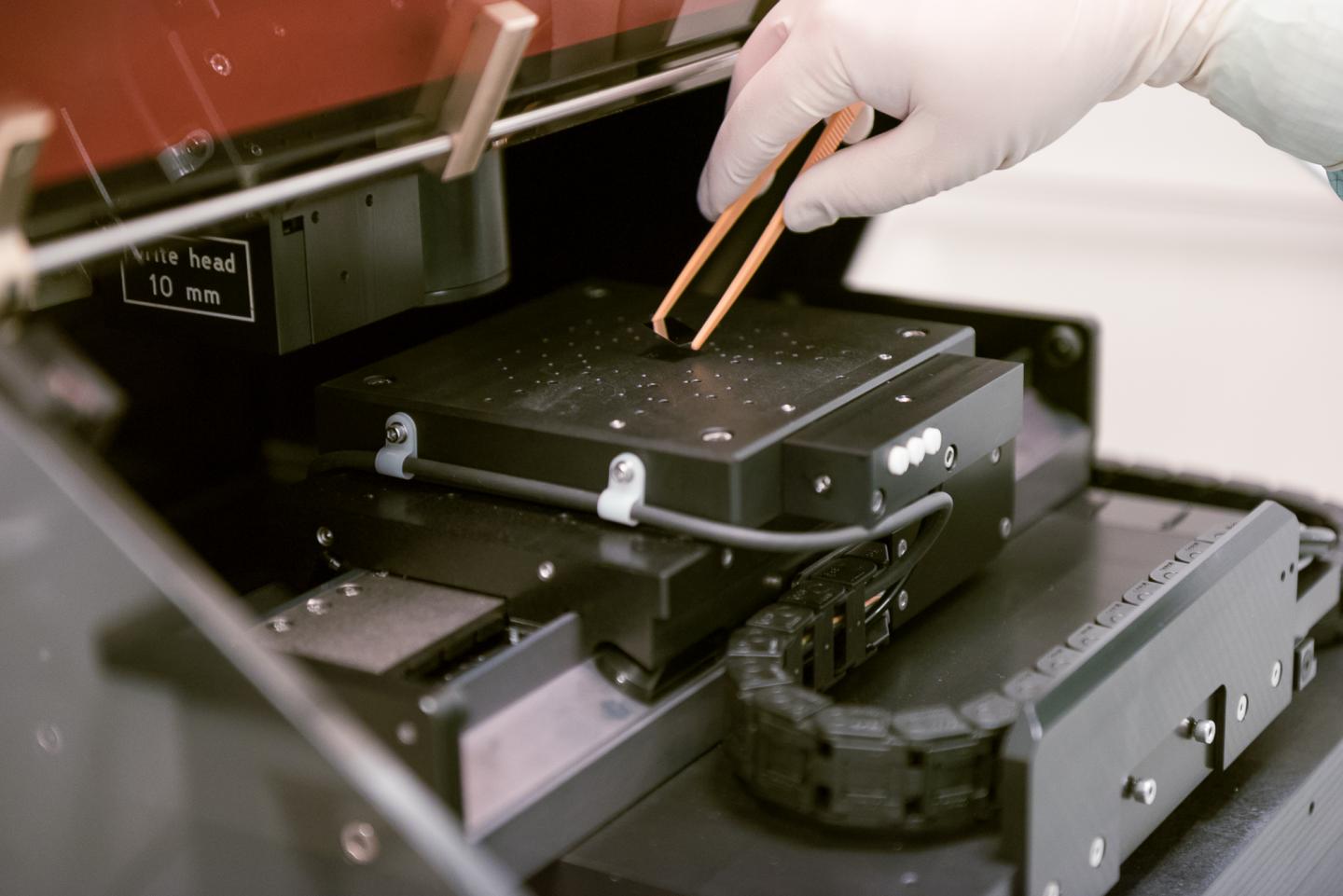
Credit: Sergey Gnuskov/NUST MISIS

A NUST MISIS professor was part of an international research team that has found evidence for the existence of the Zeeman spin-orbit coupling in antiferromagnetic conductors. This work may pave the way for the next generation of electronics. The study was published in npj Quantum Materials.

The electron possesses two fundamental properties: charge and spin. Conventional electronic devices use only the charge of electron for information processing. In recent years, an enormous research effort has been focused on building fundamentally new electronic devices (often called “spintronic devices”) that would specifically exploit spin properties in addition to charge degrees of freedom. Transfer from conventional electronics to spintronics technology opens the possibilities to construct devices with high storage density and fast operation. The two-component nature of spin-based systems makes them potentially applicable for quantum computing.

Current effort in designing spintronic devices is focusing on understanding and making use of spin-orbit coupling, an interaction between the orbital angular momentum and the spin angular momentum of an individual particle, such as an electron. However, spin-orbit coupling occurring in many compounds is often weak or its emergence requires the use of heavy components. One way to overcome spin-orbit coupling related challenges could be the use of antiferromagnetics. A spin-orbit coupling of an unusual nature, termed Zeeman spin-orbit coupling is expected to manifest itself in a wide range of ferromagnetic conductors. Being proportional to the applied magnetic field, the coupling is tunable. Yet, experimental proof of this phenomenon has been lacking.

The collaboration of a NUST MISIS physicist with colleagues from Germany, France and Japan produced, for the first time, experimental evidence of Zeeman spin-orbit coupling in two very different layered conductors: an organic antiferromagnetic superconductor, and a prominent electron-doped superconductor that belongs to the family of high-temperature cuprate superconducting materials. Obtained on two very different materials, the results of this work demonstrate the generic nature of the Zeeman spin–orbit coupling. In addition to its fundamental importance, the Zeeman spin-orbit coupling opens new possibilities for spin manipulation, much sought after in the current effort to harness electron spin for future spintronic applications.

“The Zeeman spin-orbit coupling can be significantly stronger than other known kinds of spin-orbit coupling, thus providing new avenues for the development of fundamentally new electronic devices”, noted Pavel Grigoriev, Professor at the NUST MISIS Department of Theoretical Physics and Quantum Technologies, senior researcher at Landau Institute for Theoretical Physics.

###

Media Contact
Lyudmila Dozhdikova
[email protected]

Original Source

https://en.misis.ru/university/news/science/2021-04/7294/

Related Journal Article

http://dx.doi.org/10.1038/s41535-021-00309-6

Tags: Chemistry/Physics/Materials SciencesComputer ScienceMaterialsResearch/DevelopmentSuperconductors/SemiconductorsTechnology/Engineering/Computer ScienceTheory/Design
Share12Tweet8Share2ShareShareShare2

Related Posts

Miniature Sensor Uses Light to Detect Touch — Chemistry

Miniature Sensor Uses Light to Detect Touch

May 8, 2026
Iron Minerals Determine Whether Dissolved Organic Matter Fuels Microbes or Becomes Long-Term Carbon Storage — Chemistry

Iron Minerals Determine Whether Dissolved Organic Matter Fuels Microbes or Becomes Long-Term Carbon Storage

May 8, 2026

Kate Evans Appointed Associate Lab Director for Biological and Environmental Systems Science at ORNL

May 8, 2026

Advancing Multiscale Modeling and Overcoming Operational Challenges in Autothermal COâ‚‚-to-Methanol Reactors

May 8, 2026
Please login to join discussion

POPULAR NEWS

  • Research Indicates Potential Connection Between Prenatal Medication Exposure and Elevated Autism Risk

    840 shares
    Share 336 Tweet 210
  • New Study Reveals Plants Can Detect the Sound of Rain

    727 shares
    Share 290 Tweet 181
  • Scientists Investigate Possible Connection Between COVID-19 and Increased Lung Cancer Risk

    68 shares
    Share 27 Tweet 17
  • Salmonella Haem Blocks Macrophages, Boosts Infection

    61 shares
    Share 24 Tweet 15

About

We bring you the latest biotechnology news from best research centers and universities around the world. Check our website.

Follow us

Recent News

Evaluating Digoxin Use in Patients with Symptomatic Rheumatic Heart Disease

Evaluating the Effectiveness and Safety of Digitalis Glycosides in Treating Heart Failure

Urdu Fall Risk Questionnaire Adapted for Elderly

Subscribe to Blog via Email

Enter your email address to subscribe to this blog and receive notifications of new posts by email.

Join 82 other subscribers
  • Contact Us

Bioengineer.org © Copyright 2023 All Rights Reserved.

Welcome Back!

Login to your account below

Forgotten Password?

Retrieve your password

Please enter your username or email address to reset your password.

Log In
No Result
View All Result
  • Homepages
    • Home Page 1
    • Home Page 2
  • News
  • National
  • Business
  • Health
  • Lifestyle
  • Science

Bioengineer.org © Copyright 2023 All Rights Reserved.