A team of scientists studied the interactions between human proteins and one of the proteins which is typical of different subtypes of cancerogenic human papillomaviruses (HPV).
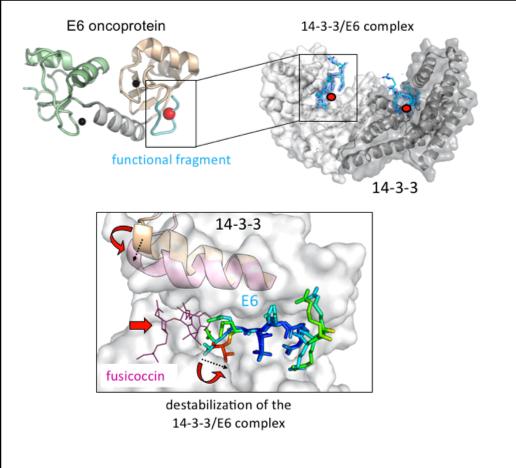
Credit: Gogl et al. / Nature Communications, 2021
Although most oncological diseases are not infectious, some viruses can cause cancer. According to the World Health Organization, two HPV subtypes account for 70% of cervical cancer cases and pre-existing conditions. Moreover, HPV considerably increases the risks of other types of cancer. Within an infected cell, a viral protein called E6 binds with human proteins from the 14-3-3 family. 14-3-3 proteins are present in cells of all eukaryotic organisms and can interact with hundreds of other important players of intracellular processes to regulate cell division, gene activity, metabolism, cell death, and intracellular signaling. If the activity of 14-3-3 proteins is disturbed, cells can become susceptible to viruses or cancer, which is a double danger in the case of HPV.
“14-3-3 proteins are abundantly present in most tissues of the human body. These proteins come in seven types (isoforms) with very similar structures and properties. For years scientists have been trying to understand why there are several practically identical substances. Understanding the mechanisms of interactions between the E6 oncoprotein and these isoforms could help develop novel antiviral therapies,” said Nikolai Sluchanko, a Ph.D. in Biology, the lead researcher of the study, and the head of the group “Protein-Protein Interactions” at the Federal Research Center for Biotechnology of the Russian Academy of Sciences.
In their work, the biologists studied a complex of different human 14-3-3 isoforms with the HPV E6 protein using X-ray crystallography. Based on the obtained data, they developed an accurate model of the spatial structure of the complex that consisted of a 14-3-3 protein and the main functional fragment of a E6 protein, which is responsible for promoting oncogenic transformation. Then, the researchers used a natural compound called fusicoccin to experimentally prove that the complex stability could be significantly affected by small therapeutic molecules. In principle, this confirms the possibility to develop a drug against HPV, a virus that is carried or infected by up to 90% of the human population.
The stability of the studied complex varied greatly depending on the 14-3-3 isoform type. Having identified this pattern, the biologists ranged the isoforms by the strength of the interaction in a descending order. Importantly, the pattern in the interaction of 14-3-3 isoforms was observed not only with E6 from different HPV subtypes, but also with many other partners of 14-3-3. The team also found confirmations of their conclusions in the data of other scientific publications and in recent proteomic studies.
“We managed to identify a global pattern of interaction between the seven human 14-3-3 isoforms and their partner proteins or fragments thereof. This fundamental discovery suggests that the repertoire of 14-3-3 isoforms is cell-specific and is tightly associated with cell functions. It is likely to change when a cell adapts to external conditions or progresses through its life cycle,” concluded Nikolai Sluchanko.
###
Media Contact
Elena Sokolova
[email protected]
Related Journal Article
http://dx.