• HOME
  • NEWS
  • EXPLORE
    • CAREER
      • Companies
      • Jobs
    • EVENTS
    • iGEM
      • News
      • Team
    • PHOTOS
    • VIDEO
    • WIKI
  • BLOG
  • COMMUNITY
    • FACEBOOK
    • INSTAGRAM
    • TWITTER
Saturday, February 7, 2026
BIOENGINEER.ORG
No Result
View All Result
  • Login
  • HOME
  • NEWS
  • EXPLORE
    • CAREER
      • Companies
      • Jobs
        • Lecturer
        • PhD Studentship
        • Postdoc
        • Research Assistant
    • EVENTS
    • iGEM
      • News
      • Team
    • PHOTOS
    • VIDEO
    • WIKI
  • BLOG
  • COMMUNITY
    • FACEBOOK
    • INSTAGRAM
    • TWITTER
  • HOME
  • NEWS
  • EXPLORE
    • CAREER
      • Companies
      • Jobs
        • Lecturer
        • PhD Studentship
        • Postdoc
        • Research Assistant
    • EVENTS
    • iGEM
      • News
      • Team
    • PHOTOS
    • VIDEO
    • WIKI
  • BLOG
  • COMMUNITY
    • FACEBOOK
    • INSTAGRAM
    • TWITTER
No Result
View All Result
Bioengineer.org
No Result
View All Result
Home NEWS Science News

Mimicking biological movements with soft robots

Bioengineer by Bioengineer
December 19, 2016
in Science News
Reading Time: 2 mins read
0
Share on FacebookShare on TwitterShare on LinkedinShare on RedditShare on Telegram
IMAGE

Credit: Harvard SEAS

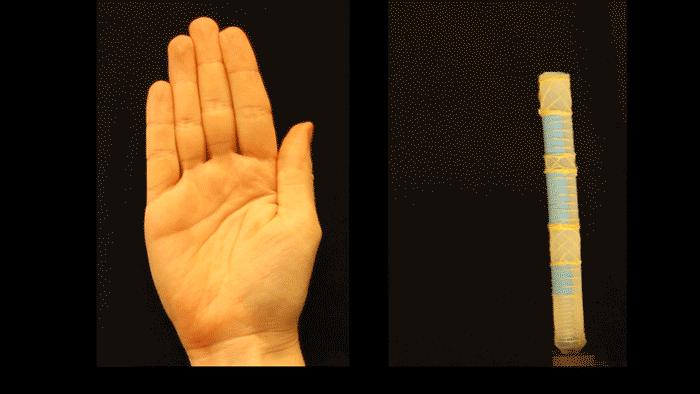
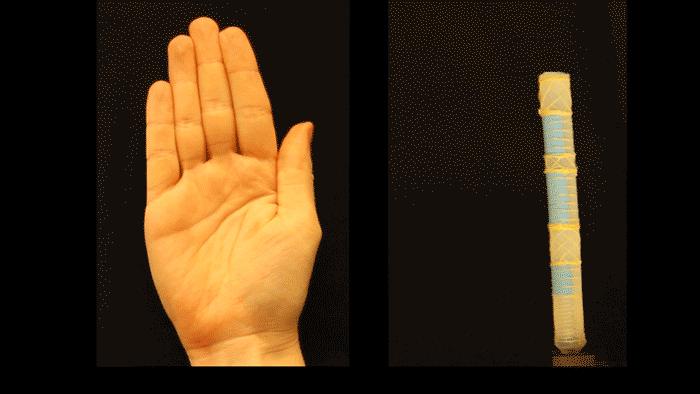
Designing a soft robot to move organically — to bend like a finger or twist like a wrist — has always been a process of trial and error. Now, researchers from the Harvard John A. Paulson School of Engineering and Applied Sciences and the Wyss Institute for Biologically Inspired Engineering have developed a method to automatically design soft actuators based on the desired movement.

The research is published in The Proceedings of the National Academy of Sciences.

"Rather than designing these actuators empirically, we wanted a tool where you could plug in a motion and it would tell you how to design the actuator to achieve that motion," said Katia Bertoldi, the John L. Loeb Associate Professor of the Natural Sciences and coauthor of the paper.

Designing a soft robot that can bend like a finger or knee may seem simple but the motion is actually incredibly complex.

"The design is so complicated because one actuator type is not enough to produce complex motions," said Fionnuala Connolly, a graduate student at SEAS and first author of the paper. "You need a sequence of actuator segments, each performing a different motion and you want to actuate them using a single input."

The method developed by the team uses mathematical modeling of fluid-powered, fiber-reinforced actuators to optimize the design of an actuator to perform a certain motion. The team used this model to design a soft robot that bends like an index finger and twists like a thumb when powered by a single pressure source.

"This research streamlines the process of designing soft robots that can perform complex movements," said Conor Walsh, the John L. Loeb Associate Professor of Engineering and Applied Sciences, Core Faculty Member at the Wyss Institute for Biologically Inspired Engineering and coauthor of the paper. "It can be used to design a robot arm that moves along a certain path or a wearable robot that assists with motion of a limb."

The new methodology will be included in the Soft Robotic Toolkit, an online, open-source resource developed at SEAS to assist researchers, educators and budding innovators to design, fabrication, model, characterize and control their own soft robots.

###

Media Contact

Leah Burrows
[email protected]
617-496-1351
@hseas

http://www.seas.harvard.edu/

############

Story Source: Materials provided by Scienmag

Share12Tweet8Share2ShareShareShare2

Related Posts

Inflammasome Protein ASC Drives Pancreatic Cancer Metabolism

February 7, 2026

Phage-Antibiotic Combo Beats Resistant Peritoneal Infection

February 7, 2026

Boosting Remote Healthcare: Stepped-Wedge Trial Insights

February 7, 2026

Barriers and Boosters of Seniors’ Physical Activity in Karachi

February 7, 2026
Please login to join discussion

POPULAR NEWS

  • Robotic Ureteral Reconstruction: A Novel Approach

    Robotic Ureteral Reconstruction: A Novel Approach

    82 shares
    Share 33 Tweet 21
  • Digital Privacy: Health Data Control in Incarceration

    63 shares
    Share 25 Tweet 16
  • Study Reveals Lipid Accumulation in ME/CFS Cells

    57 shares
    Share 23 Tweet 14
  • Breakthrough in RNA Research Accelerates Medical Innovations Timeline

    53 shares
    Share 21 Tweet 13

About

We bring you the latest biotechnology news from best research centers and universities around the world. Check our website.

Follow us

Recent News

Inflammasome Protein ASC Drives Pancreatic Cancer Metabolism

Phage-Antibiotic Combo Beats Resistant Peritoneal Infection

Boosting Remote Healthcare: Stepped-Wedge Trial Insights

Subscribe to Blog via Email

Enter your email address to subscribe to this blog and receive notifications of new posts by email.

Join 73 other subscribers
  • Contact Us

Bioengineer.org © Copyright 2023 All Rights Reserved.

Welcome Back!

Login to your account below

Forgotten Password?

Retrieve your password

Please enter your username or email address to reset your password.

Log In
No Result
View All Result
  • Homepages
    • Home Page 1
    • Home Page 2
  • News
  • National
  • Business
  • Health
  • Lifestyle
  • Science

Bioengineer.org © Copyright 2023 All Rights Reserved.