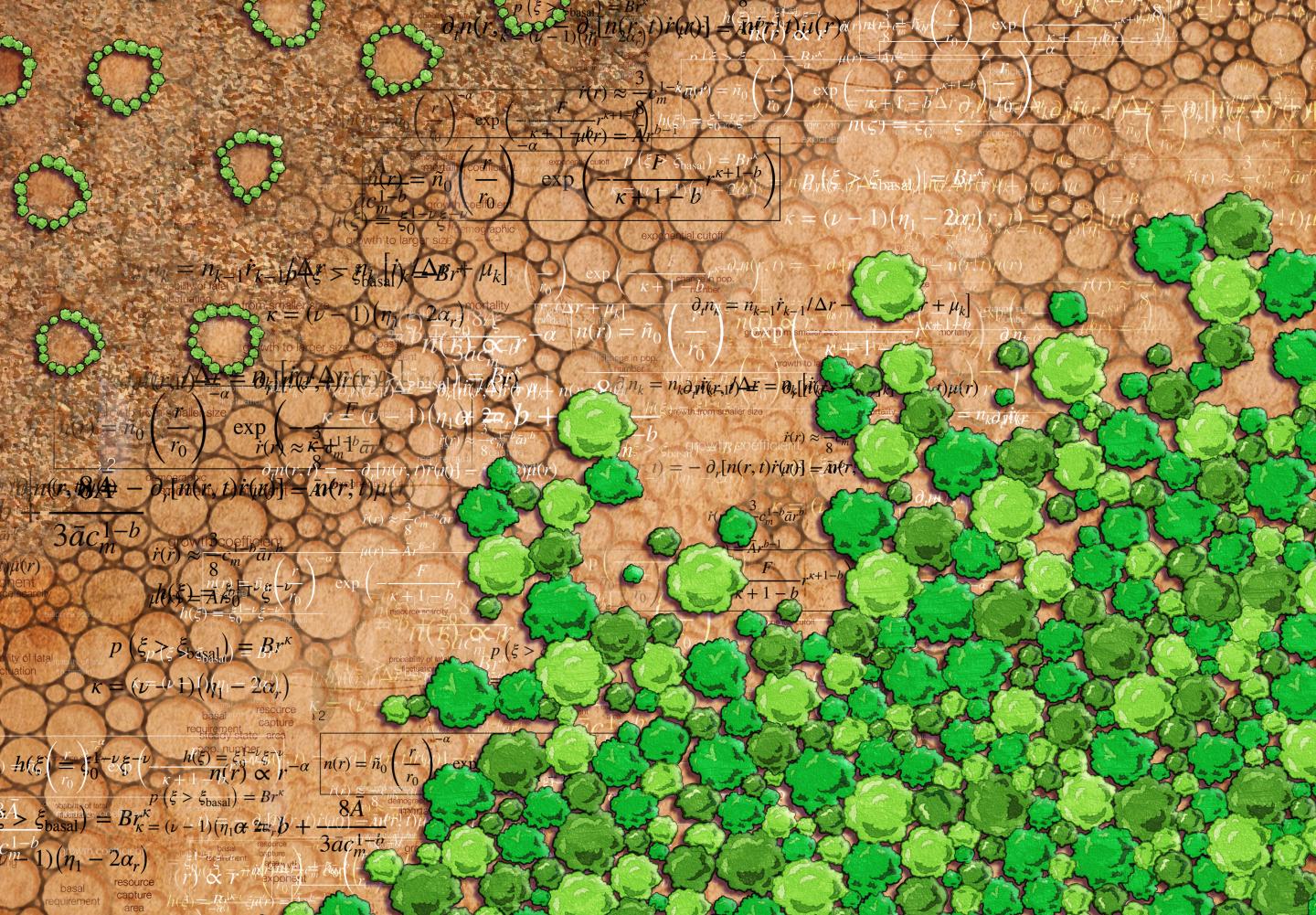
Credit: Illustration: Mesa Schumacher for the Santa Fe Institute
A forest looks like a hotbed of randomness, with trees and plants scattered in wild and capricious diversity. But appearances can be deceiving, say a trio of complexity researchers at the Santa Fe Institute (SFI). Underneath that apparent messiness lurk extraordinary regularities, governed by the biological mechanisms that drive universal forces of growth, death, and competition.
In a paper published April 9 in the journal PNAS, the SFI group, led by Program Postdoctoral Fellow and now Complexity Science Hub Vienna Postdoctoral Scientist Eddie Lee, describes a new framework that can reproduce those spatial and temporal patterns that emerge in places and spaces where plants grow together. The framework uses computational and statistical tools to connect metabolic principles, which control how an individual organism lives and thrives, to the diverse arrangements of trees, shrubs, and other vegetation readily observed in landscapes, forests and beyond.
“This paper goes a long way in showing how things that look arbitrary and capricious can in fact be understood within a mathematical framework,” says SFI Distinguished Shannan Professor and former President Geoffrey West, who collaborated with Lee and Chris Kempes, SFI Professor, on the model.
Scientists have long sought mathematical laws that connect the similar patterns that emerge at large and small scales of existence. “If you look at the microscopic structure of multicellular life, you see a lot of the same patterns playing out,” says Lee. The metabolic rate of an organism follows a power scaling law with its mass, for example. Previous attempts at establishing such mathematical laws for the assemblage of plants in a forest have been a source of vociferous debate.
In previous work, West and others have developed models that start with the metabolic constraints on a single, optimized tree to make predictions about patterns that might emerge in a community of such trees. The model accurately showed how features like growth rate or canopy size might change with plant size — and how those features might affect competition with other organisms or change the structure of the entire forest.
Kempes says that this idealized model paved the way for connecting biological principles like metabolism to mathematical, macro-level patterns, but over time researchers began to focus on how real-world situations differ in detail from that model. Not every tree or population follows the optimal rules, though, leading researchers like Lee to investigate new ways to generalize the core tenets.
“What happens when that law for scaling deviates for individual species, or for different contexts? How does that work?” says Kempes. “How do all those fit together?”
The new model extends essential ideas from earlier works for how to set up a model informed by the biological principles of growth, death, and resource competition, but it also allows a user to generalize those ideas to a wide range of species and situations, says Kempes. A user might relax certain assumptions about tree allometries — relationships between size and shape — or incorporate ideas about how trees interact with other organisms, like termites.
By turning these “knobs” on the simulation, Lee says, researchers can more closely reproduce the diverse ways that forests diverge from the idealized model. They can also clearly connect biological principles at the level of the organism to how forest structure plays out on larger scales.
West says the new approach will not only reveal scaling laws that have been previously gone unnoticed but also shine a light on new areas of investigation. “One of the great things about having an analytical model of this kind is that it points to where data is missing, or where data is poor,” he says, “and the kinds of things people should be measuring.”
The model also shows how a physics-inspired approach — which often focuses on idealized situations — can contribute to advances in understanding biological complexity. “There is this marvelous interplay between the fields,” West says.
###
Media Contact
J Marshall
[email protected]
Related Journal Article
http://dx.