Study suggests that high social status contributes to accelerated aging in baboons, despite its other advantages
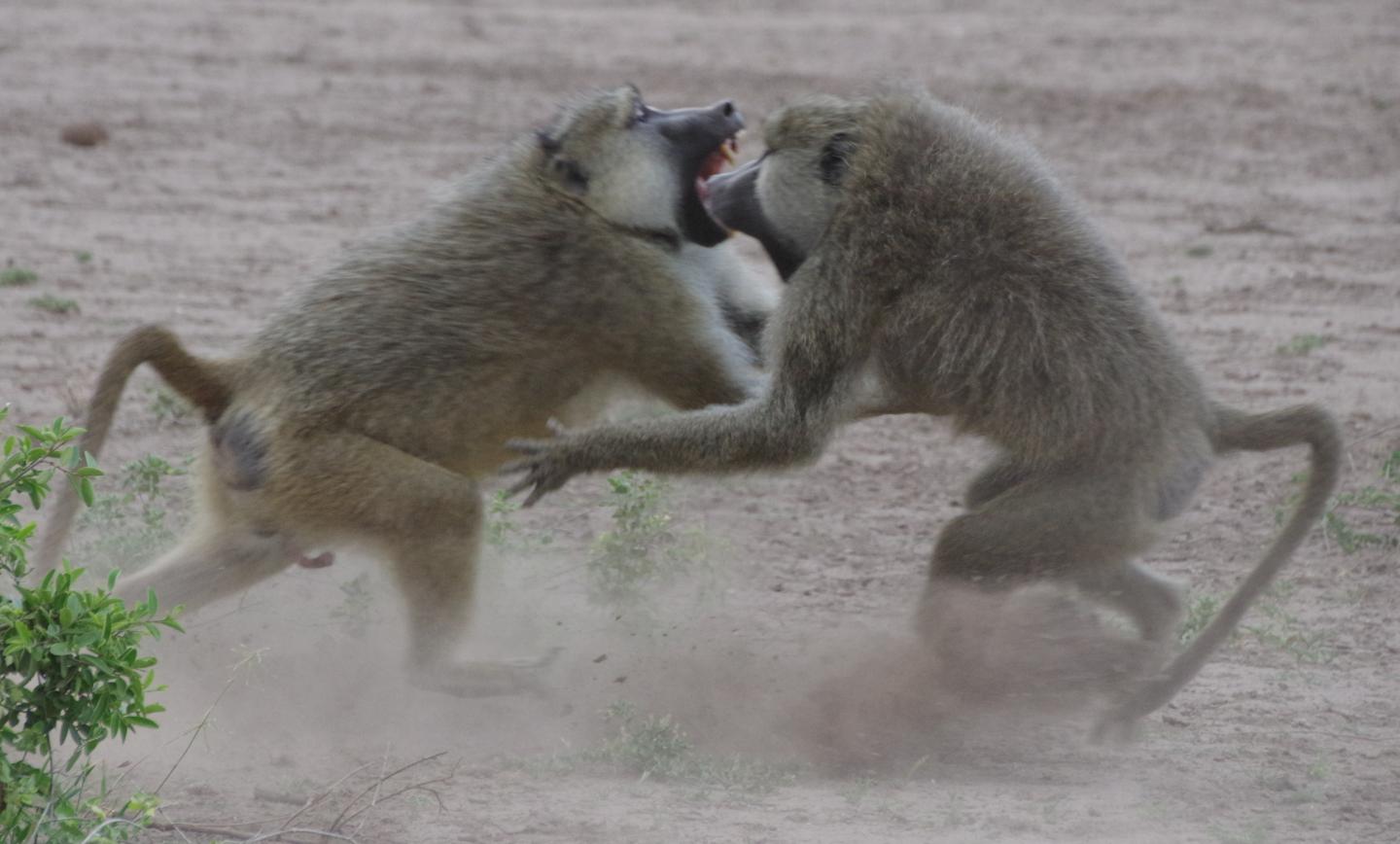
Credit: Beth Archie (CC BY 4.0)
Battling other male baboons to achieve high social status comes with physiological costs that accelerate aging, according to study published today in eLife.
The findings suggest that current life circumstances may be more important contributors to premature aging than early life hardship, at least in baboons.
Chemical changes to DNA, also called epigenetic changes, can be used as a kind of ‘clock’ to measure aging. While these epigenetic changes usually correspond with age, they can also be used to detect signs of premature aging.
“Environmental stressors can make the clock tick faster, so that some individuals appear biologically older than their actual age and experience a higher risk of age-related disease,” explains co-first author Jordan Anderson, a PhD student in Evolutionary Anthropology at Duke University, Durham, North Carolina, US. “We sought to answer what social or early life experiences contribute to accelerated aging in baboons.”
The team measured aging in 245 wild baboons from a well-studied population in Kenya using the epigenetic clock and other methods. They found that the epigenetic clock was a good predictor of chronological age overall. But contrary to what they expected, early life adversity was not a good predictor of accelerated aging in the animals.
Instead, they found that the highest-ranking males showed signs of accelerated aging. Higher body mass index, which is associated with having more lean muscle mass in baboons, was also associated with accelerated aging, likely because of the physical demands of maintaining high status. The team was also able to show that the epigenetic clock sped up as the animals climbed the social ladder and slowed down as they moved down it.
“Our results argue that achieving high rank for male baboons – the best predictor of reproductive success in these animals – imposes costs that are consistent with a ‘live fast, die young,’ life history strategy,” says co-first author Rachel Johnston, Postdoctoral Associate in Evolutionary Anthropology at Duke University.
“While the findings reveal how social pressures can influence aging for males, we don’t see the same effect of rank in female baboons, who are born into their social rank rather than having to fight for it,” adds senior author Jenny Tung, Associate Professor in the Departments of Evolutionary Anthropology and Biology at Duke University, and a Faculty Associate of the Duke University Population Research Institute.
“Our results have important implications for research on the social determinants of health in humans and other animals because they show that ‘high status’ can mean very different things in different contexts. They also highlight the importance of examining the effects of both early life and current life environments on biological aging,” Tung concludes.
###
This study will be published as part of ‘Evolutionary Medicine: A Special Issue’ from eLife. For more information, visit https:/
Media contact
Emily Packer, Media Relations Manager
eLife
[email protected]
+44 (0)1223 855373
About eLife
eLife is a non-profit organisation created by funders and led by researchers. Our mission is to accelerate discovery by operating a platform for research communication that encourages and recognises the most responsible behaviours. We aim to publish work of the highest standards and importance in all areas of biology and medicine, including Evolutionary Biology, and Genetics and Genomics, while exploring creative new ways to improve how research is assessed and published. eLife receives financial support and strategic guidance from the Howard Hughes Medical Institute, the Knut and Alice Wallenberg Foundation, the Max Planck Society and Wellcome. Learn more at https:/
To read the latest Evolutionary Biology research published in eLife, visit https:/
And for the latest in Genetics and Genomics, see https:/
Media Contact
Emily Packer
[email protected]
Original Source
https:/
Related Journal Article
http://dx.