• HOME
  • NEWS
  • EXPLORE
    • CAREER
      • Companies
      • Jobs
    • EVENTS
    • iGEM
      • News
      • Team
    • PHOTOS
    • VIDEO
    • WIKI
  • BLOG
  • COMMUNITY
    • FACEBOOK
    • INSTAGRAM
    • TWITTER
Friday, May 22, 2026
BIOENGINEER.ORG
No Result
View All Result
  • Login
  • HOME
  • NEWS
  • EXPLORE
    • CAREER
      • Companies
      • Jobs
        • Lecturer
        • PhD Studentship
        • Postdoc
        • Research Assistant
    • EVENTS
    • iGEM
      • News
      • Team
    • PHOTOS
    • VIDEO
    • WIKI
  • BLOG
  • COMMUNITY
    • FACEBOOK
    • INSTAGRAM
    • TWITTER
  • HOME
  • NEWS
  • EXPLORE
    • CAREER
      • Companies
      • Jobs
        • Lecturer
        • PhD Studentship
        • Postdoc
        • Research Assistant
    • EVENTS
    • iGEM
      • News
      • Team
    • PHOTOS
    • VIDEO
    • WIKI
  • BLOG
  • COMMUNITY
    • FACEBOOK
    • INSTAGRAM
    • TWITTER
No Result
View All Result
Bioengineer.org
No Result
View All Result
Home NEWS Science News Chemistry

Commercially available ultralong organic room-temperature phosphorescence

Bioengineer by Bioengineer
April 2, 2021
in Chemistry
Reading Time: 2 mins read
0
IMAGE
Share on FacebookShare on TwitterShare on LinkedinShare on RedditShare on Telegram

IMAGE

Credit: ©Science China Press

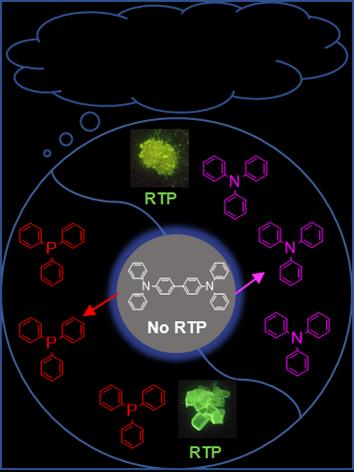
Purely organic room-temperature phosphorescence (RTP) materials have been a hot research topic. Currently, the pure RTP materials have been realized by the introduction of heavy halogen atoms, carbonyls groups or some heteroatoms, hydrogen bonding, H-aggregation, strong intermolecular electronic coupling, molecular packing, host-guest interaction, etc. However, the complicated synthesis and high expenditure are still inevitable in these systems. In addition, their performances in air are not satisfactory and the introduction of halogen atoms is generally necessary. Therefore, a new facile and robust host-guest strategy utilizing only electron-rich materials is a promising alternative for constructing RTP systems.

Very recently, Zheng and Qin et al. developed a series of novel host-guest organic phosphorescence systems, in which N,N,N’,N’-tetraphenylbenzidine (TPB) acted as a guest, triphenylphosphine (TPP) or triphenylamine (TPA) served as a host. The maximum phosphorescence efficiency and the longest lifetime could reach 23.6% and 362 ms, respectively. Experimental results and theoretical calculation revealed that the host molecules not only play a vital role in providing a rigid environment and suppressing non-radiative decay of the guest, but also show a synergistic effect to the guest in the photo-physical process through Förster resonance energy transfer (FRET). These new host-guest RTP systems enjoy the integrated merits of commercially available compounds with electron-rich features and low cost, absence of halogen atoms, facile preparation and excellent performances, etc., which shows great potentials in practical applications. Therefore, this work broadens the way for the fabrication of purely organic RTP materials and offers a novel platform for the development of diverse applications.

###

See the article: Ning Y, Yang J, Si H, Wu H, Zheng X, Qin A, Tang BZ. Ultralong organic room-temperature phosphorescence of electron-donating and commercially available host and guest molecules through efficient Förster resonance energy transfer. Sci China Chem., 2021, 64, https://doi.org/10.1007/s11426-020-9980-4
http://engine.scichina.com/doi/10.1007/s11426-020-9980-4

Media Contact
Anjun Qin
[email protected]

Related Journal Article

http://dx.doi.org/10.1007/s11426-020-9980-4

Tags: Chemistry/Physics/Materials Sciences
Share12Tweet8Share2ShareShareShare2

Related Posts

Scientists Achieve Breakthrough in Molecular ‘Sandwich’ Assembly — Chemistry

Scientists Achieve Breakthrough in Molecular ‘Sandwich’ Assembly

May 21, 2026
Advancing In Vivo and In Situ Monitoring: Science Bulletin Highlights Host-Based Antifouling Gold Nanotube Sensor for Selective Detection of Mechanically Sensitive Serotonin Release in Intestinal Mucosa — Chemistry

Advancing In Vivo and In Situ Monitoring: Science Bulletin Highlights Host-Based Antifouling Gold Nanotube Sensor for Selective Detection of Mechanically Sensitive Serotonin Release in Intestinal Mucosa

May 20, 2026

How Magnetic Orientation Could Influence the Building Blocks of Life

May 20, 2026

Breaking a 200-Year-Old Belief: Novel Surface Design Achieves Two Distinct Wetting States on One Substrate

May 20, 2026
Please login to join discussion

POPULAR NEWS

  • blank

    New Study Reveals Plants Can Detect the Sound of Rain

    734 shares
    Share 293 Tweet 183
  • ESMO 2025: mRNA COVID Vaccines Enhance Efficacy of Cancer Immunotherapy

    309 shares
    Share 124 Tweet 77
  • Research Indicates Potential Connection Between Prenatal Medication Exposure and Elevated Autism Risk

    847 shares
    Share 339 Tweet 212
  • Breastmilk Balances E. coli and Beneficial Bacteria in Infant Gut Microbiomes

    58 shares
    Share 23 Tweet 15

About

We bring you the latest biotechnology news from best research centers and universities around the world. Check our website.

Follow us

Recent News

Amino Acid Clock Reveals Insights into Aging

Branched-Chain Amino Acids: Key in Obesity?

Transplantable Large-Scale Functional Human Gut Tissues

Subscribe to Blog via Email

Enter your email address to subscribe to this blog and receive notifications of new posts by email.

Join 82 other subscribers
  • Contact Us

Bioengineer.org © Copyright 2023 All Rights Reserved.

Welcome Back!

Login to your account below

Forgotten Password?

Retrieve your password

Please enter your username or email address to reset your password.

Log In
No Result
View All Result
  • Homepages
    • Home Page 1
    • Home Page 2
  • News
  • National
  • Business
  • Health
  • Lifestyle
  • Science

Bioengineer.org © Copyright 2023 All Rights Reserved.