• HOME
  • NEWS
  • EXPLORE
    • CAREER
      • Companies
      • Jobs
    • EVENTS
    • iGEM
      • News
      • Team
    • PHOTOS
    • VIDEO
    • WIKI
  • BLOG
  • COMMUNITY
    • FACEBOOK
    • INSTAGRAM
    • TWITTER
Saturday, February 7, 2026
BIOENGINEER.ORG
No Result
View All Result
  • Login
  • HOME
  • NEWS
  • EXPLORE
    • CAREER
      • Companies
      • Jobs
        • Lecturer
        • PhD Studentship
        • Postdoc
        • Research Assistant
    • EVENTS
    • iGEM
      • News
      • Team
    • PHOTOS
    • VIDEO
    • WIKI
  • BLOG
  • COMMUNITY
    • FACEBOOK
    • INSTAGRAM
    • TWITTER
  • HOME
  • NEWS
  • EXPLORE
    • CAREER
      • Companies
      • Jobs
        • Lecturer
        • PhD Studentship
        • Postdoc
        • Research Assistant
    • EVENTS
    • iGEM
      • News
      • Team
    • PHOTOS
    • VIDEO
    • WIKI
  • BLOG
  • COMMUNITY
    • FACEBOOK
    • INSTAGRAM
    • TWITTER
No Result
View All Result
Bioengineer.org
No Result
View All Result
Home NEWS Science News Chemistry

In-situ nanoscale insights into the evolution of solid electrolyte interphase shells

Bioengineer by Bioengineer
April 2, 2021
in Chemistry
Reading Time: 2 mins read
0
IMAGE
Share on FacebookShare on TwitterShare on LinkedinShare on RedditShare on Telegram

IMAGE

Credit: ©Science China Press

The interfacial decomposition products forming the so-called solid-electrolyte interphase (SEI) during the first charging/discharging significantly determine the electrochemical performances of lithium (Li) batteries. To date, the dynamic evolutions, chemical compositions, stabilities and the influencing factors of the SEI films have been captured tremendous attentions.

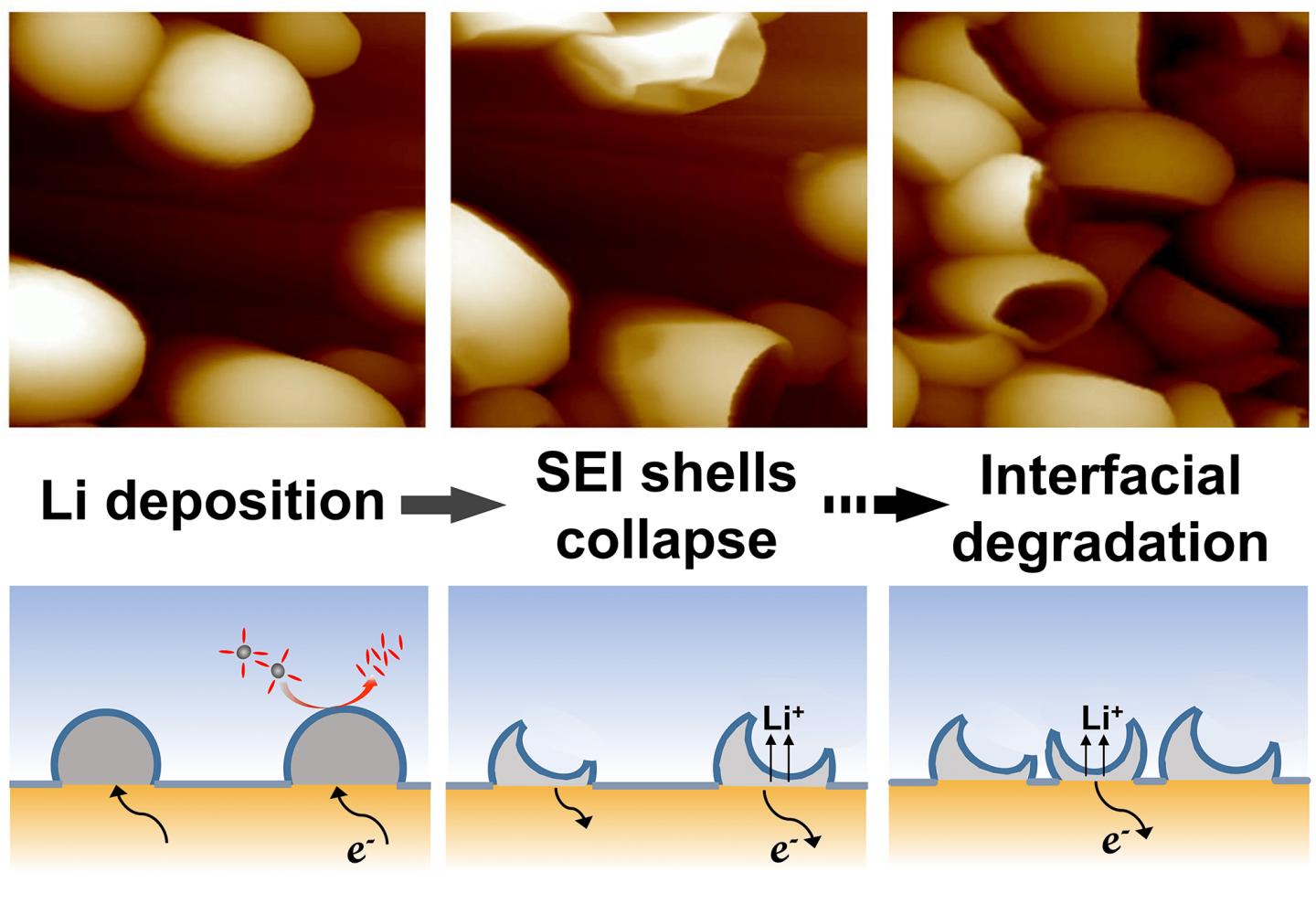
It’s noted that, in contrast to the SEI film formation at the surface of electrodes, a kind of SEI shells usually conformally forms at the outmost layer of the on-site deposited Li once the freshly deposited Li contacts with the electrolyte, which could directly influence Li nucleation, growth behaviors and electrochemical properties at the electrode/electrolyte interface.

Furthermore, the chemical/morphological instabilities of the on-site formed SEI shell pose challenges for the in-situ characterizations. Directly capturing the dynamic evolution of the SEI shells is crucial to interprete their impacts on the anode/elelctrolyte interface and battery performances.

The electrochemical atomic force microscopy (EC-AFM) enables the real-time characterization of the morphology change, mechanical modulus and potential/current distribution at the electrode/electrolyte interface under working conditions, providing an important in-situ analysis method with high spatial resolution for exploring the dynamic evolution of the on-site formed SEI shell on the deposited Li.

Recently, Prof. Li-Jun Wan and Prof. Rui Wen et al. provide the straightforward visualized evidence of SEI shells evolution during Li deposition/stripping to reveal anode degradation via in-situ EC-AFM.

During Li deposition, the quasi-spherical Li particles nucleate and grow on a Cu electrode. Subsequently, the collapse of the SEI shells is distinctly captured with the continuous Li stripping. As the cycling progresses, new Li deposits are prone to renucleating on the deposit-free sites with higher electrochemical activity. The fresh SEI shells form on freshly-deposited Li while the original SEI shells retain their collapsed morphology at the same position. Severe SEI regeneration/collapse along with electrolyte depletion and interfacial impedance increasing take one of the responsiblities for the degradation of anodes.

This work reveals the interfacial evolution at nanoscale, provides deep insights into the fundamental comprehension of SEI properties and further guides improvement strategies of the interface design in Li batteries.

###

See the article: Shi Y, Liu GX, Wan J, Wen R, Wan LJ. In-situ nanoscale insights into the evolution of solid electrolyte interphase shells: revealing interfacial degradation in lithium metal batteries. Sci China Chem, 2021, 64, doi:10.1007/s11426-020-9984-9.

https://www.sciengine.com/publisher/scp/journal/SCC/doi/10.1007/s11426-020-9984-9?slug=fulltext

Media Contact
Rui Wen
[email protected]

Related Journal Article

http://dx.doi.org/10.1007/s11426-020-9984-9

Tags: Chemistry/Physics/Materials Sciences
Share12Tweet8Share2ShareShareShare2

Related Posts

blank

Breakthrough in Environmental Cleanup: Scientists Develop Solar-Activated Biochar for Faster Remediation

February 7, 2026
blank

Cutting Costs: Making Hydrogen Fuel Cells More Affordable

February 6, 2026

Scientists Develop Hand-Held “Levitating” Time Crystals

February 6, 2026

Observing a Key Green-Energy Catalyst Dissolve Atom by Atom

February 6, 2026
Please login to join discussion

POPULAR NEWS

  • Robotic Ureteral Reconstruction: A Novel Approach

    Robotic Ureteral Reconstruction: A Novel Approach

    82 shares
    Share 33 Tweet 21
  • Digital Privacy: Health Data Control in Incarceration

    63 shares
    Share 25 Tweet 16
  • Study Reveals Lipid Accumulation in ME/CFS Cells

    57 shares
    Share 23 Tweet 14
  • Breakthrough in RNA Research Accelerates Medical Innovations Timeline

    53 shares
    Share 21 Tweet 13

About

We bring you the latest biotechnology news from best research centers and universities around the world. Check our website.

Follow us

Recent News

Decoding Prostate Cancer Origins via snFLARE-seq, mxFRIZNGRND

Digital Health Perspectives from Baltic Sea Experts

Florida Cane Toad: Complex Spread and Selective Evolution

Subscribe to Blog via Email

Enter your email address to subscribe to this blog and receive notifications of new posts by email.

Join 73 other subscribers
  • Contact Us

Bioengineer.org © Copyright 2023 All Rights Reserved.

Welcome Back!

Login to your account below

Forgotten Password?

Retrieve your password

Please enter your username or email address to reset your password.

Log In
No Result
View All Result
  • Homepages
    • Home Page 1
    • Home Page 2
  • News
  • National
  • Business
  • Health
  • Lifestyle
  • Science

Bioengineer.org © Copyright 2023 All Rights Reserved.