Among typical anesthetics, only isoflurane results in undisrupted memory formation in mice
Credit: Simon Wiegert, CC-BY
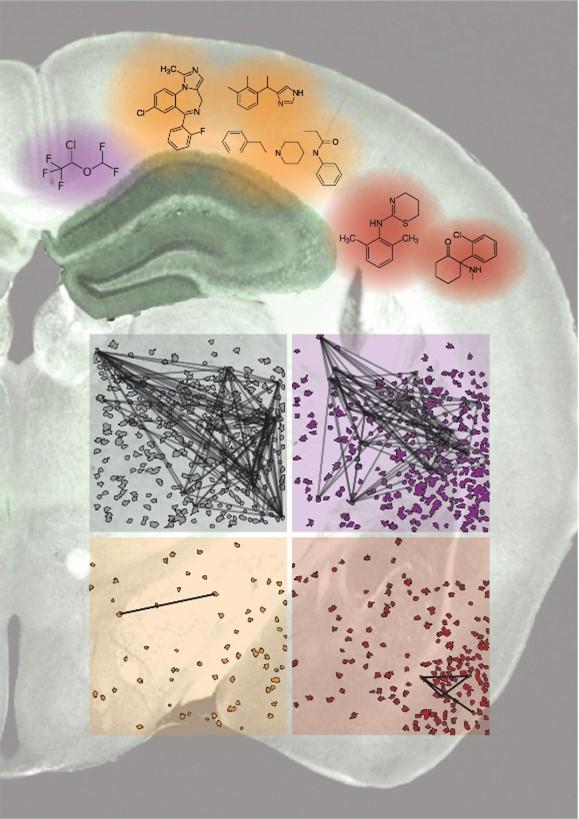
Memory loss is common after general anesthesia, particularly for events occurring immediately before surgery–a phenomenon called retrograde amnesia. But a new study publishing on April 1st 2021 in the open access journal PLOS Biology, led by Simon Wiegert at the University Medical Center Hamburg-Eppendorf in Germany, shows that changes in the hippocampus–the part of the brain used to make new memories–differ depending on which general anesthetic is used. Consequently, their effects on memory formation also differ.
Understanding how different anesthetics affect the brain, particularly the hippocampus, is therefore important for both clinicians with human patients and experimental scientists who work with animals. Wiegert and his team recorded brain activity from the hippocampus while mice were anesthetized using one of three common combinations of general anesthetics: isoflurane, ketamine/xylazine (Keta/Xyl), and medetomidine/midazolam/fentanyl (MMF). Brain activity was recorded electrically and by optically imaging calcium flow–a dynamic signal indirectly reflecting neuronal activity and a trigger that allows brain cells to pass signals to each other.
Both recording methods showed that each drug changed brain activity in the hippocampus compared to wakefulness or natural sleep. The researchers found a number of differences in how the specific anesthetics affected the brain. For example, Keta/Xyl strongly reduced overall calcium activity, while MMF affected its rate much more than the duration. Furthermore, all anesthetics affected the stability of synaptic connections between brain cells in the hippocampus. Keta/Xyl disturbed synaptic stability most drastically, reflecting its strong disturbances of neuronal calcium activity. Recovery time also differed; brain activity returned to normal in about 45 minutes after isoflurane anesthesia, but it took close to 6 hours for the other two drugs. Similarly, the mice showed signs of retrograde amnesia after both Keta/Xyl and MMF anesthesia. But after isoflurane anesthesia–the condition, which showed the mildest disturbances compared to natural sleep–they could still remember what they had learned before the surgery. Knowing these varying effects on the hippocampus and memory formation should be useful for doctors or experimenters when considering which method to use.
Dr. Wiegert notes, “200 million general anesthesia are administered worldwide per year, and amnesia is a central part of it. So, we wondered how it affects the (mouse) hippocampus – a brain region essential for the formation of everyday memories. Surprisingly, the literature is scarce and inconsistent. Therefore, we teamed up with the group of Ileana Hanganu-Opatz and other collaborators to fill this knowledge-gap. Using a large array of experimental methods and developing a number of new analysis routines, we investigated the effects of common anesthetics on the hippocampus at levels ranging from synapses to cellular ensembles and on memory formation. We were surprised to find very distinct short- and long-term effects between the anesthetics used in this study, despite all of them fulfilling the same hallmarks of general anesthesia. Alterations of brain networks in the hippocampus were also different from those described in the neocortex. In summary, our study suggests that isoflurane should be the anesthetic of choice, if brain processes relevant for memory formation should not be disturbed.”
###
Research article
Peer reviewed; Experimental study; Animals
In your coverage please use these URLs to provide access to the freely available articles in PLOS Biology:
http://journals.
Citation: Yang W, Chini M, Pöpplau JA, Formozov A, Dieter A, Piechocinski P, et al. (2021) Anesthetics fragment hippocampal network activity, alter spine dynamics, and affect memory consolidation. PLoS Biol 19(4): e3001146.
https:/
Funding: This work was funded by the Deutsche Forschungsgemeinschaft (DFG, SPP1926, FOR2419/P6, SFB963/B8 to J.S.W., SPP 1665/Ha 4466/10-1/Ha4466/12-1, SFB 936/B5 to I.L.H.-O., SFB 936/B7 to F.M.), the European Research Council (ERC2016-StG-714762 to J.S.W., ERC-2015-CoG 681577 to I.L.H.-O.), the German Academic Exchange Service (DAAD, STG/19/5744091 to A.F.), and the Chinese Scholarship Council (CSC 201606210129 to W.Y.). The funders had no role in study design, data collection and analysis, decision to publish, or preparation of the manuscript.
Competing Interests: The authors have declared that no competing interests exist.
Media Contact
Simon Wiegert
[email protected]
Related Journal Article
http://dx.