• HOME
  • NEWS
  • EXPLORE
    • CAREER
      • Companies
      • Jobs
    • EVENTS
    • iGEM
      • News
      • Team
    • PHOTOS
    • VIDEO
    • WIKI
  • BLOG
  • COMMUNITY
    • FACEBOOK
    • INSTAGRAM
    • TWITTER
Saturday, December 20, 2025
BIOENGINEER.ORG
No Result
View All Result
  • Login
  • HOME
  • NEWS
  • EXPLORE
    • CAREER
      • Companies
      • Jobs
        • Lecturer
        • PhD Studentship
        • Postdoc
        • Research Assistant
    • EVENTS
    • iGEM
      • News
      • Team
    • PHOTOS
    • VIDEO
    • WIKI
  • BLOG
  • COMMUNITY
    • FACEBOOK
    • INSTAGRAM
    • TWITTER
  • HOME
  • NEWS
  • EXPLORE
    • CAREER
      • Companies
      • Jobs
        • Lecturer
        • PhD Studentship
        • Postdoc
        • Research Assistant
    • EVENTS
    • iGEM
      • News
      • Team
    • PHOTOS
    • VIDEO
    • WIKI
  • BLOG
  • COMMUNITY
    • FACEBOOK
    • INSTAGRAM
    • TWITTER
No Result
View All Result
Bioengineer.org
No Result
View All Result
Home NEWS Science News

cientists observe role of cavitation in glass fracturing

Bioengineer by Bioengineer
April 1, 2021
in Science News
Reading Time: 2 mins read
0
IMAGE
Share on FacebookShare on TwitterShare on LinkedinShare on RedditShare on Telegram

IMAGE

Credit: Institute of Physics

Glassy materials play an integral role in the modern world, but inherent brittleness has long been the Achilles’ heel that severely limits their usefulness. Due to the disordered amorphous structure of glassy materials, many mysteries remain. These include the fracture mechanisms of traditional glasses, such as silicate glasses, as well as the origin of the intriguing patterned fracture morphologies of metallic glasses.

Cavitation has been widely assumed to be the underlying mechanism governing the fracture of metallic glasses, as well as other glassy systems. Up until now, however, scientists have been unable to directly observe the cavitation behavior of fractures, despite their intensive efforts.

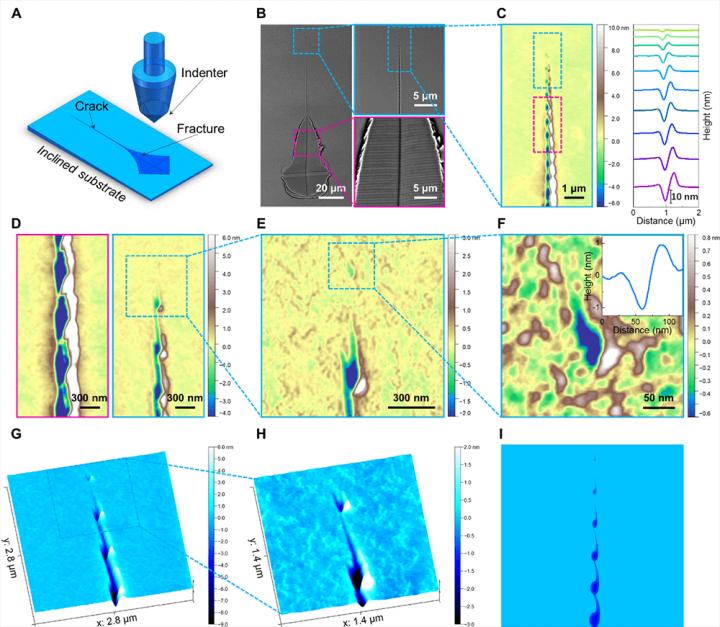
This situation changed with recent work by Dr. SHEN Laiquan, Prof. BAI Haiyang, Prof. SUN Baoan, and others from Prof. WANG Weihua’s group at the Institute of Physics of the Chinese Academy of Sciences (CAS), who have successfully observed the effect of cavitation on fracture behavior in glasses. They revealed that crack propagation is dominated by the self-organized nucleation, growth, and coalescence of nanocavities in metallic glasses.

They showed the evolutionary process of crack morphologies from separated nanocavities to wave-like nanocorrugations, and confirmed that cavitation is the origin of periodic fracture surface patterns.

In addition, they found that cavitation-induced nanopatterns are also prevalent in typical polymer glass (polycarbonate) and silicate glass (silica), indicating that the cavitation mechanism is common in the fracture of glasses. Plastic flow exhibited by the cavitation process thus proves that nanoscale ductility is involved in the breakage of nominally brittle glasses.

The discovery of cavitation behavior in the fracture of glasses challenges the traditional concept of how glasses break. The researchers’ findings have significant implications for the understanding of the fundamental process of failure in disordered systems, and provides incentives for engineering better glasses.

###

This study, entitled “Observation of cavitation governing fracture in glasses,” was published in Science Advances.

The work was supported by the Strategic Priority Research Program of CAS, the National Natural Science Foundation of China, the National Key Research and Development Program, and the National Natural Science Foundation of Guangdong Province.

Media Contact
BAI Haiyang
[email protected]

Original Source

http://english.cas.cn/newsroom/research_news/phys/202103/t20210330_266717.shtml

Related Journal Article

http://dx.doi.org/10.1126/sciadv.abf7293

Tags: Chemistry/Physics/Materials SciencesNanotechnology/Micromachines
Share13Tweet8Share2ShareShareShare2

Related Posts

Assessing the K-NHSPSC: Korean Patient Safety Culture Insights

December 20, 2025

Spot Urine CA 19-9: New Insights in Pediatric Hydronephrosis

December 20, 2025

Discharge Choices for Elderly Surgical Patients Explored

December 20, 2025

Health Needs Influence Care Utilization in Women Veterans

December 20, 2025
Please login to join discussion

POPULAR NEWS

  • Nurses’ Views on Online Learning: Effects on Performance

    Nurses’ Views on Online Learning: Effects on Performance

    70 shares
    Share 28 Tweet 18
  • NSF funds machine-learning research at UNO and UNL to study energy requirements of walking in older adults

    70 shares
    Share 28 Tweet 18
  • Unraveling Levofloxacin’s Impact on Brain Function

    53 shares
    Share 21 Tweet 13
  • Exploring Audiology Accessibility in Johannesburg, South Africa

    51 shares
    Share 20 Tweet 13

About

We bring you the latest biotechnology news from best research centers and universities around the world. Check our website.

Follow us

Recent News

Assessing the K-NHSPSC: Korean Patient Safety Culture Insights

Spot Urine CA 19-9: New Insights in Pediatric Hydronephrosis

Discharge Choices for Elderly Surgical Patients Explored

Subscribe to Blog via Email

Enter your email address to subscribe to this blog and receive notifications of new posts by email.

Join 70 other subscribers
  • Contact Us

Bioengineer.org © Copyright 2023 All Rights Reserved.

Welcome Back!

Login to your account below

Forgotten Password?

Retrieve your password

Please enter your username or email address to reset your password.

Log In
No Result
View All Result
  • Homepages
    • Home Page 1
    • Home Page 2
  • News
  • National
  • Business
  • Health
  • Lifestyle
  • Science

Bioengineer.org © Copyright 2023 All Rights Reserved.