Credit: MBI/HU
In a joint effort, researchers from the Humboldt-Universität (Berlin), the Max Born Institute (Berlin) and the University of Central Florida (USA), have revealed the necessary conditions for the robust transport of entangled states of two-photon light in photonic topological insulators, paving the way the towards noise-resistant transport of quantum information. The results have appeared in Nature Communications.
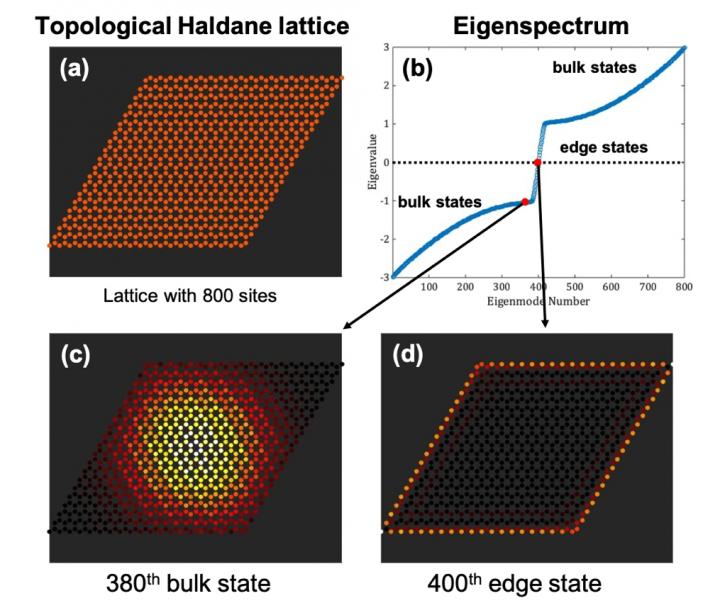
Originally discovered in condensed matter systems, topological insulators are two-dimensional materials that support scattering-free (uni-directional) transport along their edges, even in the presence of defects and disorder. In essence, topological insulators are finite lattice systems where, given a suitable termination of the underlying infinite lattice, edge states are formed that lie in a well-defined energy gap associated with the bulk states, i.e. these edge states are energetically separated from the bulk states, see Fig 1.
Importantly, single-particle edge states in such systems are topologically protected from scattering: they cannot scatter into the bulk due to their energy lying in the gap, and they cannot scatter backwards because backward propagating edge states are either absent or not coupled to the forward propagating edge states.
The feasibility of engineering complex Hamiltonians using integrated photonic lattices, combined with the availability of entangled photons, raises the intriguing possibility of employing topologically protected entangled states in optical quantum computing and information processing (Science 362, 568, (2018), Optica 6, 955 (2019)).
Achieving this goal, however, is highly nontrivial as topological protection does not straightforwardly extend to multi-particle (back-)scattering. At first, this fact appears to be counterintuitive because, individually, each particle is protected by topology whilst, jointly, entangled (correlated) particles become highly susceptible to perturbations of the ideal lattice. The underlying physical principle behind this apparent ‘discrepancy’ is that, quantum-mechanically, identical particles are described by states that satisfy an exchange symmetry principle.
In their work, the researchers make several fundamental advances towards understanding and controlling topological protection in the context of multi-particle states:
- – First, they identify physical mechanisms which induce a vulnerability of entangled states in topological photonic lattices and present clear guidelines for maximizing entanglement without sacrificing topological protection.
-Second, they stablish and demonstrate a threshold-like behavior of entanglement vulnerability and identify conditions for robust protection of highly entangled two-photon states.
To be precise, they explore the impact of disorder onto a range of two-photon states that extend from the fully correlated to the fully anti-correlated limits, thereby also covering a completely separable state. For their analysis, they consider two topological lattices, one periodic and one aperiodic. In the periodic case they consider the Haldane model, and for the aperiodic case a square lattice, whose single-particle dynamics corresponds to the quantum Hall effect, is studied.
The results offer a clear roadmap for generating robust wave packets tailored to the particular disorder at hand. Specifically, they establish limits on the stability of entangled states up to relatively high degrees of entanglement that offer practical guidelines for generating useful entangled states in topological photonic systems. Further, these findings demonstrate that in order to maximize entanglement without sacrificing topological protection, the joint spectral correlation map of two-photon states must fit inside a well-defined topological window of protection, Fig. (2).
###
Media Contact
Prof. Dr. Kurt Busch
[email protected]
Related Journal Article
http://dx.