Interdisciplinary team develops highly efficient surface reactions / Results published in ‘Nature Chemistry’
Credit: Klaasen/Witteler
Materials such as gallium arsenide are extremely important for the production of electronic devices. As supplies of it are limited, or they can present health and environmental hazards, specialists are looking for alternative materials. So-called conjugated polymers are candidates. These organic macromolecules have semi-conductor properties, i.e. they can conduct electricity under certain conditions. One possible way of producing them in the desired two-dimensional – i.e. extremely flat – form is presented by surface chemistry, a field of research established in 2007.
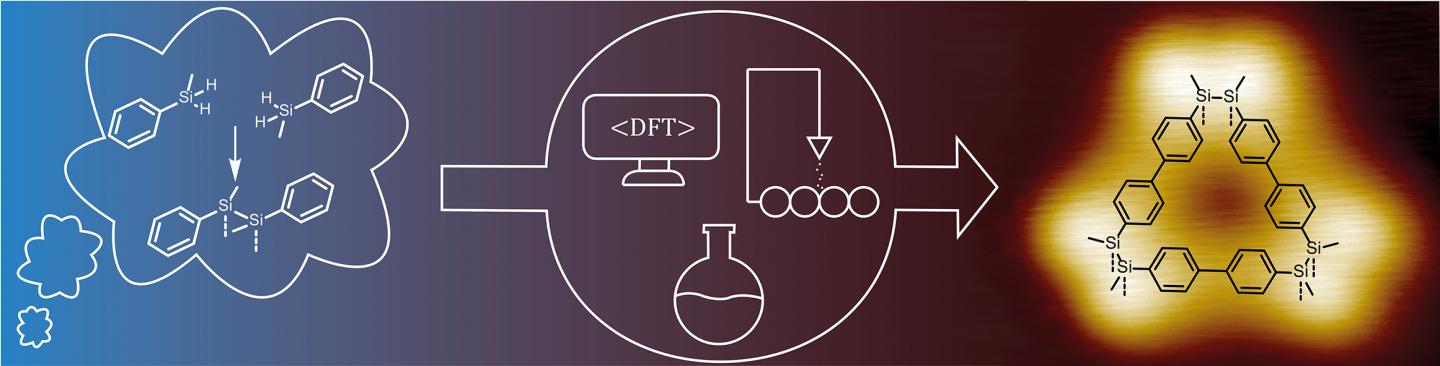
Since then, many reactions have been developed and interesting materials produced for possible applications. Most of the reactions are based on the formation of carbon-carbon bonds. A team consisting of various working groups from the departments of Chemistry and Physics at the University of Münster (Germany) has now used silicon-silicon bond formation to construct a polymer – a premiere in surface chemistry.
Previously, one obstacle had been the linking of silicon atoms. Constructing polymers in this way using traditional synthetic chemistry, i.e. in a solution, is complicated. The fact that they are now the first to have succeeded in producing a silicon polymer is something the Münster researchers owe to the possibilities offered by surface chemistry. The trick was as follows: the linking of the atoms takes place on an extremely smooth metal surface, onto which the molecules are vapour-deposited. This produces very thin material layers. If the usual carbon is replaced by silicon, long polymers can be obtained, even with mild reaction conditions. From silicon polymers, the researchers hope for innovative material properties and new, promising candidates for potential applications. The results of the study have been published in the journal “Nature Chemistry“.
Methodology
A team of chemists headed by Prof. Armido Studer produced molecules consisting of silyl groups connected by means of a so-called organic linker. Physicists from the team led by Prof. Harald Fuchs investigated their reactivity on metal surfaces (gold or copper). They demonstrated that the reaction of the silicon-hydrogen bonds within the silyl groups already occurred at room temperature, whereas a similar coupling of carbon-carbon bonds normally requires temperatures above 300 degrees Celsius. In the next step, the researchers clarified the exact structure of the links formed: two hydrogen atoms are removed from each silicon atom in order to create the high-order structures. More detailed analyses showed in addition a bonding of the silicon atoms to the metal surface.
As the structure of the final polymer could not be completely clarified using customary scanning tunnelling microscopy (STM), a team headed by chemist Prof. Johannes Neugebauer used computational chemical methods for this purpose and simulated the STM images of various potential products. To provide further support in characterizing the product, a team led by physicist Dr. Harry Mönig employed a method specifically intended for these issues based on atomic force microscopy. This method made it possible not only to depict the entire product, but also to localize the hydrogen atoms with drastically increased resolution. Johannes Neugebauer’s team also succeeded in developing a mechanistic model and simulating the necessary reaction steps to form the product found.
Contributions from different angles
“The properties of the polymers could be examined in future studies with regard to their electrical conductivity,” says chemist Dr. Henning Klaasen. “Also, the molecular design could be varied in order to adapt the properties for an application of the materials as organic semi-conductors.” And Lacheng Liu, a PhD student in Physics, adds, “In addition, this method could be used to develop a completely new strategy for molecular changes to functionalization of surfaces and nanoparticles.”
In future, the team plans to investigate in greater detail the surface chemistry of new silicon-containing functional groups and is also aiming to introduce further functional groups. “We have shown that not only carbon can be used to create fascinating structures. The various contributions made from different angles – by chemists and physicists, by people with a theoretical approach, by others with a practical approach – all required a high degree of creativity. This enabled us to explore a new path in bond formation reactions in surface chemistry,” is how Melanie Wittler, a PhD student in Chemistry, sums up the work done.
###
Media Contact
Dr. Henning Klaasen
[email protected]
Related Journal Article
http://dx.