• HOME
  • NEWS
  • EXPLORE
    • CAREER
      • Companies
      • Jobs
    • EVENTS
    • iGEM
      • News
      • Team
    • PHOTOS
    • VIDEO
    • WIKI
  • BLOG
  • COMMUNITY
    • FACEBOOK
    • INSTAGRAM
    • TWITTER
Saturday, February 7, 2026
BIOENGINEER.ORG
No Result
View All Result
  • Login
  • HOME
  • NEWS
  • EXPLORE
    • CAREER
      • Companies
      • Jobs
        • Lecturer
        • PhD Studentship
        • Postdoc
        • Research Assistant
    • EVENTS
    • iGEM
      • News
      • Team
    • PHOTOS
    • VIDEO
    • WIKI
  • BLOG
  • COMMUNITY
    • FACEBOOK
    • INSTAGRAM
    • TWITTER
  • HOME
  • NEWS
  • EXPLORE
    • CAREER
      • Companies
      • Jobs
        • Lecturer
        • PhD Studentship
        • Postdoc
        • Research Assistant
    • EVENTS
    • iGEM
      • News
      • Team
    • PHOTOS
    • VIDEO
    • WIKI
  • BLOG
  • COMMUNITY
    • FACEBOOK
    • INSTAGRAM
    • TWITTER
No Result
View All Result
Bioengineer.org
No Result
View All Result
Home NEWS Science News Chemistry

String theory solves mystery about how particles behave outside a black hole photon sphere

Bioengineer by Bioengineer
March 29, 2021
in Chemistry
Reading Time: 2 mins read
0
IMAGE
Share on FacebookShare on TwitterShare on LinkedinShare on RedditShare on Telegram

IMAGE

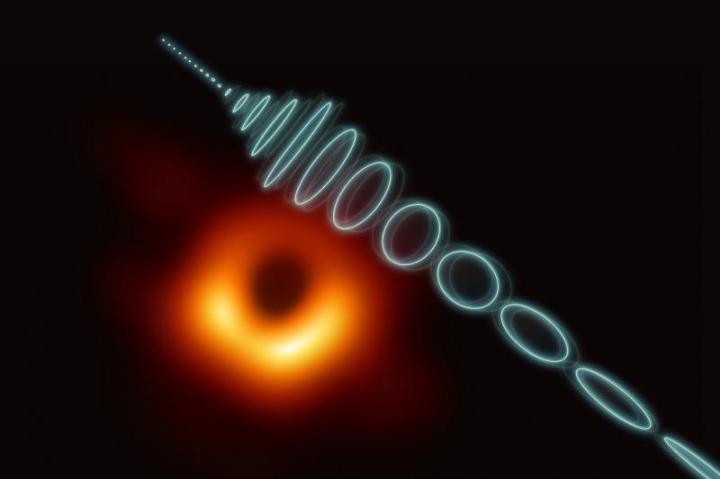
Credit: EHT Collaboration; Kavli IPMU (Kavli IPMU modified EHT’s original image))

A paper by the Kavli Institute for the Physics and Mathematics of the Universe (Kavli IPMU) Director Ooguri Hirosi and Project Researcher Matthew Dodelson on the string theoretical effects outside the black hole photon sphere has been selected for the “Editors’ Suggestion” of the journal Physical Review D. Their paper was published on March 24, 2021.

In a quantum theory of point particles, a fundamental quantity is the correlation function, which measures the probability for a particle to propagate from one point to another. The correlation function develops singularities when the two points are connected by light-like trajectories. In a flat spacetime, there is such a unique trajectory, but when spacetime is curved, there can be many light-like trajectories connecting two points. This is a result of gravitational lensing, which describes the effect of curved geometry on the propagation of light.

In the case of a black hole spacetime, there are light-like trajectories winding around the black hole several times, resulting in a black hole photon sphere, as seen in the recent images by the Event Horizon Telescope (EHT) of the supermassive black hole at the center of the galaxy M87.

Released on April 10, 2019, the EHT Collaboration’s images captured the shadow of a black hole and its photon sphere, the ring of light surrounding it. A photon sphere can occur in a region of a black hole where light entering in a horizontal direction can be forced by gravity to travel in various orbits. These orbits lead to singularities in the aforementioned correlation function.

However, there are cases when the singularities generated by trajectories winding around a black hole multiple times contradict with physical expectations. Dodelson and Ooguri have shown that such singularities are resolved in string theory.

In string theory, every particle is considered as a particular excited state of a string. When the particle travels along a nearly light-like trajectory around a black hole, the spacetime curvature leads to tidal effects, which stretch the string.

Dodelson and Ooguri showed that, if one takes these effects into account, the singularities disappear consistently with physical expectations. Their result provides evidence that a consistent quantum gravity must contain extended objects such as strings as its degrees of freedom.

Ooguri says, “Our results show how string theoretical effects are enhanced near a black hole. Though the effects we found are not strong enough to have an observable consequence on ETH’s black hole image, further research may show us a way to test string theory using black holes.”

###

Media Contact
john amari
[email protected]

Original Source

https://www.ipmu.jp/en/20210326-Singularities

Related Journal Article

http://dx.doi.org/10.1103/PhysRevD.103.066018

Tags: AstrophysicsAtomic/Molecular/Particle PhysicsChemistry/Physics/Materials SciencesParticle Physics
Share13Tweet8Share2ShareShareShare2

Related Posts

blank

Breakthrough in Environmental Cleanup: Scientists Develop Solar-Activated Biochar for Faster Remediation

February 7, 2026
blank

Cutting Costs: Making Hydrogen Fuel Cells More Affordable

February 6, 2026

Scientists Develop Hand-Held “Levitating” Time Crystals

February 6, 2026

Observing a Key Green-Energy Catalyst Dissolve Atom by Atom

February 6, 2026
Please login to join discussion

POPULAR NEWS

  • Robotic Ureteral Reconstruction: A Novel Approach

    Robotic Ureteral Reconstruction: A Novel Approach

    82 shares
    Share 33 Tweet 21
  • Digital Privacy: Health Data Control in Incarceration

    63 shares
    Share 25 Tweet 16
  • Study Reveals Lipid Accumulation in ME/CFS Cells

    57 shares
    Share 23 Tweet 14
  • Breakthrough in RNA Research Accelerates Medical Innovations Timeline

    53 shares
    Share 21 Tweet 13

About

We bring you the latest biotechnology news from best research centers and universities around the world. Check our website.

Follow us

Recent News

Succinate Receptor 1 Limits Blood Cell Formation, Leukemia

Palmitoylation of Tfr1 Drives Platelet Ferroptosis and Exacerbates Liver Damage in Heat Stroke

Oxygen-Enhanced Dual-Section Microneedle Patch Improves Drug Delivery and Boosts Photodynamic and Anti-Inflammatory Treatment for Psoriasis

Subscribe to Blog via Email

Enter your email address to subscribe to this blog and receive notifications of new posts by email.

Join 73 other subscribers
  • Contact Us

Bioengineer.org © Copyright 2023 All Rights Reserved.

Welcome Back!

Login to your account below

Forgotten Password?

Retrieve your password

Please enter your username or email address to reset your password.

Log In
No Result
View All Result
  • Homepages
    • Home Page 1
    • Home Page 2
  • News
  • National
  • Business
  • Health
  • Lifestyle
  • Science

Bioengineer.org © Copyright 2023 All Rights Reserved.