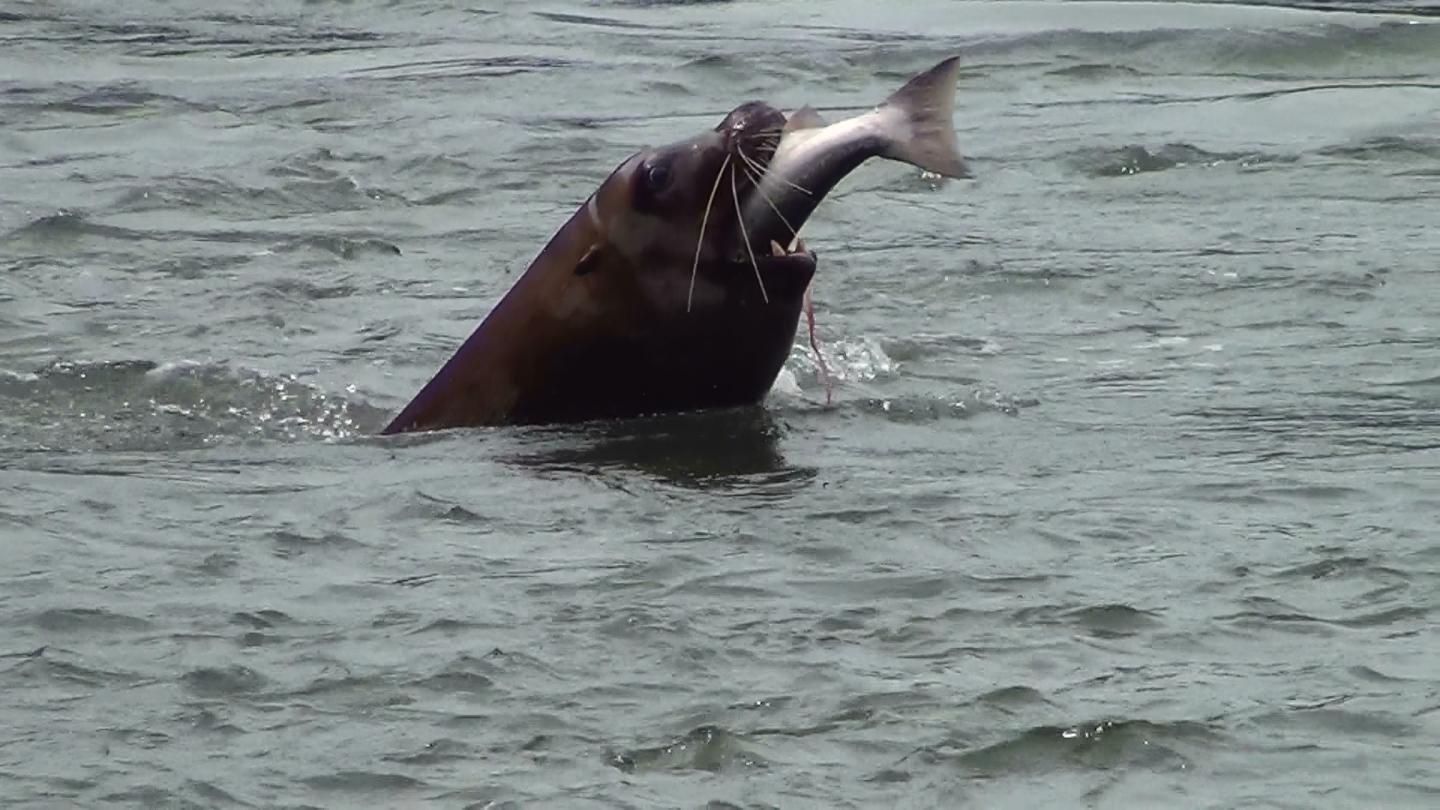
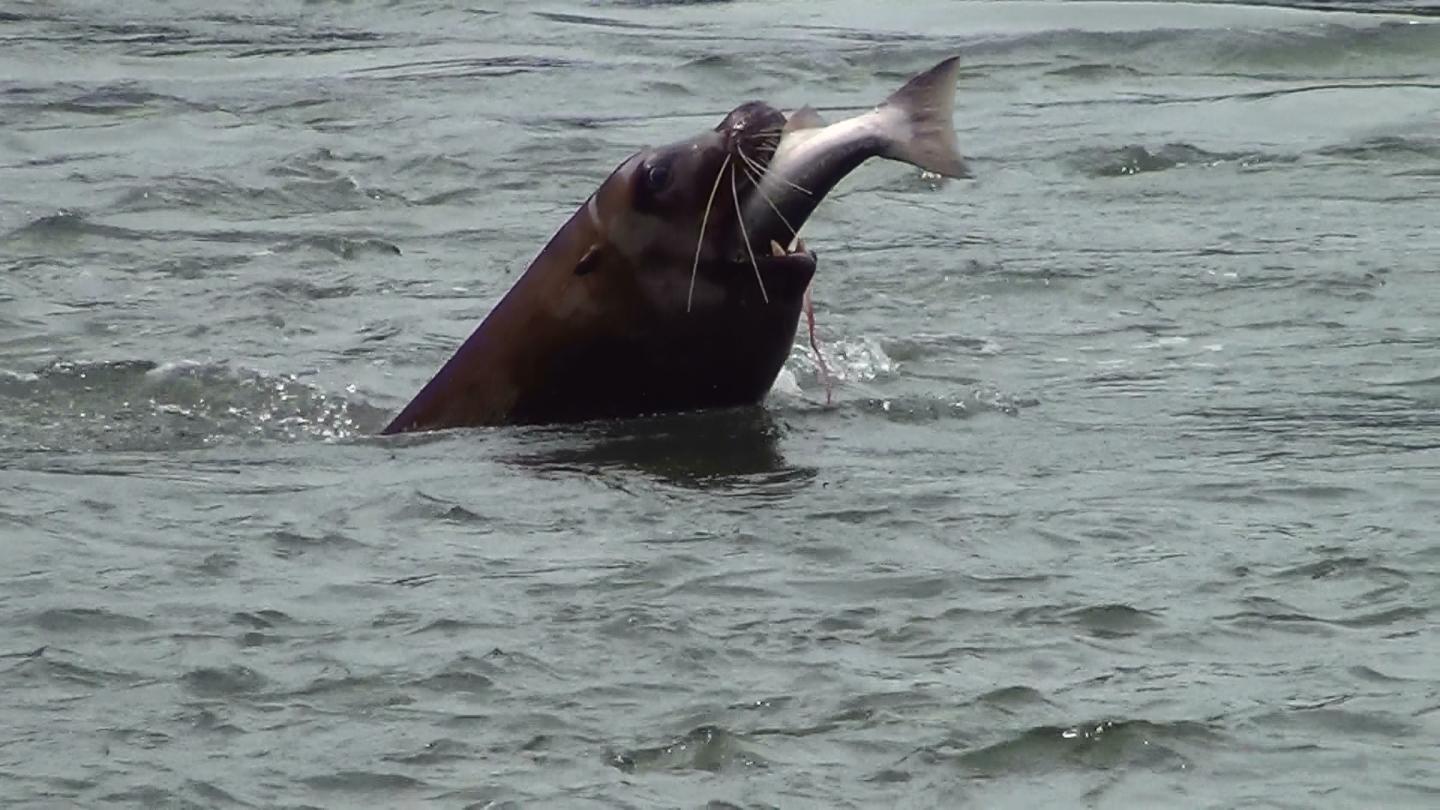
Credit: US Army Corps of Engineers
A new study used the same kind of models that scientists use to track disease to instead examine how some California sea lions have learned to prey on salmon gathering to ascend fish ladders at Bonneville Dam.
Although sea lions commonly feast on fish, their predation on salmon at Bonneville Dam on the Columbia River poses wildlife management challenges. The sea lions that gather on the Columbia each spring are protected by the Marine Mammal Protection Act while the salmon they are eating are protected by the Endangered Species Act.
In 2008 NOAA Fisheries authorized Oregon, Washington and Idaho wildlife authorities to begin trapping and removing sea lions shown to repeatedly prey on salmon at the dam. The removal program was designed to reduce impacts on protected salmon.
NOAA Fisheries recently authorized the states to continue the removals over the next five years.
The new study examined the effectiveness of the removal program, employing epidemiological models to assess how the behavior of eating salmon at the dam passes among sea lions. The research concluded that the removal program has successfully slowed the transmission of the behavior among sea lions, but would have been more effective if it had started sooner.
The findings highlight the need to act early "from both a conservation and management perspective to prevent the spread of a detrimental behavior and to minimize the total number of animals removed," the scientists wrote in the paper published in the journal Proceedings of the Royal Society B.
"The earlier you start, the more effective you are at slowing the spread, and the fewer animals you have to remove to make a difference," said Zachary Schakner, who coauthored the study as a graduate student at UCLA and is now Recreational Fisheries Coordinator in NOAA Fisheries' West Coast Region.
The states have removed 166 California sea lions since the effort began in 2008, a small fraction of the number of animals that migrate to the Columbia each winter and spring. The states may euthanize sea lions if no permanent holding facility, such as a zoo or aquarium, can be found.
In 2017 NOAA Fisheries will review the last five years of the program, and will take the study findings into account, said Robert Anderson of NOAA Fisheries' West Coast Region in Portland.
"What was really new was the combination of behavioral ecology with disease ecology to come up with management recommendations that could make the program more effective," said Michael Buhnerkempe, coauthor of the research and an assistant project scientist at UCLA.
The study examined the association between sea lions known to prey on salmon at Bonneville Dam with other animals that later developed the same behavior, assessing how the behavior passed among animals. The researchers then modeled various strategies for removing sea lions to determine which were most effective and which required the removal of the fewest sea lions.
Just as diseases are easiest to stop when they have affected only a few individuals, so are undesirable wildlife behaviors such as the predation on salmon at Bonneville Dam. The study found that the removal of sea lions would have been more effective, requiring the removal of fewer animals overall, if it had started soon after biologists first realized that sea lions were targeting protected salmon.
"If you can do that, you're beating it before it has a chance to explode into more of an epidemic," Buhnerkempe said. "Otherwise it quickly gets out of control."
###
Media Contact
Michael Milstein
[email protected]
503-231-6268
@NOAAFish_WCRO
http://www.westcoast.fisheries.noaa.gov/index.html
############
Story Source: Materials provided by Scienmag