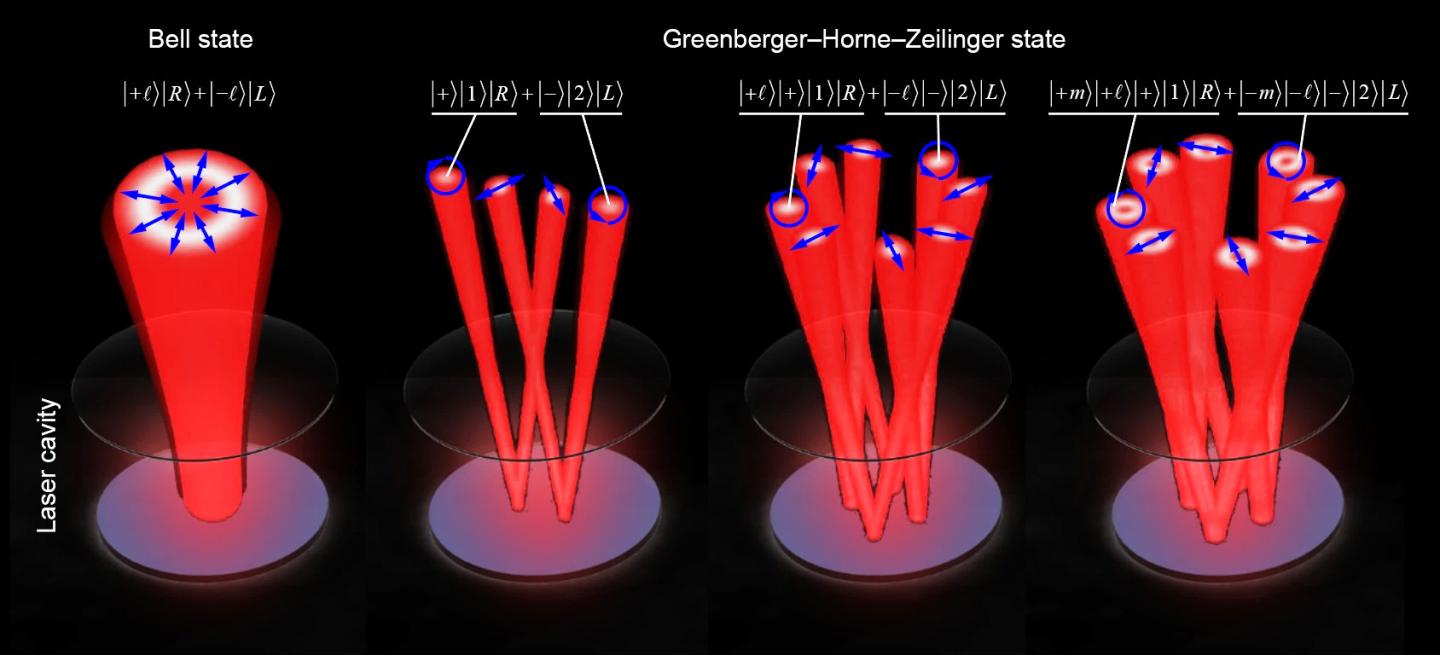
Credit: by Yijie Shen, Isaac Nape, Xilin Yang, Xing Fu, Mali Gong, Darryl Naidoo and Andrew Forbes
Tailoring light is much like tailoring cloth, cutting and snipping to turn a bland fabric into one with some desired pattern. In the case of light, the tailoring is usually done in the spatial degrees of freedom, such as its amplitude and phase (the “pattern” of light), and its polarization, while the cutting and snipping might be control with spatial light modulators and the like. This burgeoning field is known as structured light, and is pushing the limits in what we can do with light, enabling us to see smaller, focus tighter, image with wider fields of view, probe with fewer photons, and to pack information into light for new high-bandwidth communications. Structured light has also been used to test the classical-quantum boundary, pushing the limits with what classical light can do for quantum processes, and vice versa. This has opened the intriguing possibility to create classical light that has quantum-like properties, as if it is “classically entangled”. But how to create and control such states of light, and how far can one “push the limits”?
The prevailing tools for structuring light from lasers is hindered by the complexity of the specialized lasers needed, often requiring customized geometries and/or elements, while the prevailing two-dimensional paradigm of using only “pattern” and “polarization”, means accessing two-dimensional classically entangled light, mimicking quantum qubits, 1s and 0s. An example of this would be the well-known quantum Bell states, shown in Figure 1 (left), which as classical light appear as vectorial structured light, combining the two degrees of freedom of “pattern” and “polarization”. These two degrees of freedom mimic the two dimensions of the qubit quantum state. To create higher dimensions requires finding more degrees of freedom in a system seeming constrained to just two.
In their paper “Creation and control of high-dimensional multi-partite classically entangled light”, Chinese and South African scientists report on how to create arbitrary dimensional quantum-like classical light directly from a laser. They use a very simple laser available in most university teaching laboratories to show eight dimensional classically entangled light, a new world record. They then go on to manipulate and control this quantum-like light, creating the first classically entangled Greenberger-Horne-Zeilinger (GHZ) states, a rather famous set of high-dimensional quantum states, shown in Figure 1.
“Theorists have long suggested all the applications that would be possible with such quantum-like light, but the lack of any creation and control steps has prohibited any progress. Now we have shown how to overcome this hurdle,” says Dr. Shen from Tsinghua University (present senior research fellow in University of Southampton), the lead author of the paper.
Traditionally, exotic structured light from lasers requires equally exotic laser systems, either with custom elements (metasurfaces for example) or custom geometries (topological photonic based for example). The laser built by the authors contained only a gain crystal and followed textbook design with just two off-the-shelf mirrors. Their elegant solution is itself build on a principle embedded in quantum mechanics: ray-wave duality. The authors could control both path and polarization inside the laser by a simple length adjustment, exploiting what is called ray-wave duality lasers. According to Prof. Forbes, the project supervisor, “what is remarkable is not only that we could create such exotic states of light, but that their source is as simple a laser as you could possibly imagine, with nothing more than a couple of standard mirrors.” The authors realized that the crucial “extra” degrees of freedom were right in front of theirs eyes, needing only a new mathematical framework to recognize them. The approach allows in-principle any quantum state to be created by simply marking the wave-like rays that are produced by the laser and then externally controlling them with a spatial light modulator, molding them to shape. In a sense, the laser produces the dimensions needed, while later modulation and control molds the outcome to some desired state. To demonstrate this, the authors produced all the GHZ states, which span an eight dimensional space.
Because no-one had ever created such high-dimensional classically entangled light, the authors had to invent a new measurement approach, translating tomography of high-dimensional quantum states into a language and technique suitable for its classical light analogue. The result is a new tomography for classically entangled light, revealing its quantum-like correlations beyond the standard two dimensions.
This work provides a powerful approach to creating and controlling high-dimensional classical light with quantum-like properties, paving the way for exciting applications in quantum metrology, quantum error correction and optical communication, as well as in stimulating fundamental studies of quantum mechanics with much more versatile bright classical light.
###
Media Contact
Yijie Shen
[email protected]
Related Journal Article
http://dx.